

Bison Bites: Dispatch #10
Data bites touching on: Indiana's returning production, Nick Westbrook-Ikhine's role in the NFL, and Indiana's third-down production in 2024.


If you’re new enough to Bite-Sized Bison, you might not be familiar with Bison Bites. Each dispatch of Bison Bites is intended to be a quick-hitting list of approximately 3-5 statistics of interest between typical Bite-Sized Bison posts.
Indiana ranks 44th in the FBS in initial returning production.
Bill Connelly at ESPN released returning production figures for each of the (now) 136 teams in FBS football. He noted that returning production is lower than ever now, as the FBS averages returning 53.7% of its 2024 production, where it averaged 76.7% as recently as 2021.
Indiana ranks 44th in the nation, with 61% of its 2024 production set to return for 2025, before the spring portal period. This ranks 8th in the Big Ten.
CFBNumbers compared these returning production figures with their Final Consensus Power Ratings (combining several overall metrics), which seeks to find a definitive metric for quality. Indiana comes in above the trendline.
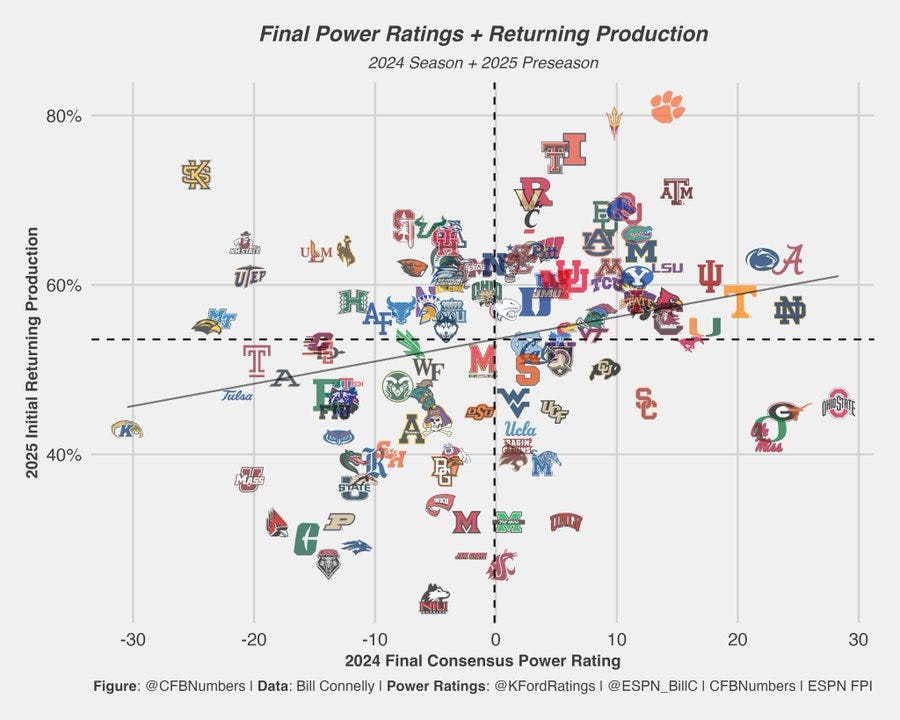
This metric isn’t perfect by any means. One of the most influential variables in the formula (for offense) is returning OL snaps, which, for Indiana, includes Carter Smith, Bray Lynch, and Drew Evans. If you read the Pre-Spring piece on LG, I’m not expecting both Lynch and Evans to be contributing simultaneously and also am hoping for development from Lynch, if he starts. Elijah Sarratt and Omar Cooper carry nearly the rest of the weight on the offensive side.
So it doesn’t account for very particular nuances of each team’s roster, but it also (obviously) doesn’t account for incoming transfer classes either. Indiana’s 2025 transfer class currently ranks 18th nationally. Returning to the chart above, the only neighbors ranked above Indiana in transfer class rankings are LSU, Texas A&M, Miami, Auburn, Texas Tech, South Carolina, and Oklahoma.
Additional notes:
When split between offense and defense, Indiana is fairly even, returning 61% of offensive production and 60% of defensive production.
Going into 2025, the Big Ten ranked 4th among FBS conferences (last among P4 conferences) in average returning production (56.2%), but the MAC, which is hemorrhaging coaches, is also hemorrhaging production, returning just an average of 43.6%.
Illinois is one of a few FBS teams poised to make substantial improvements. That Week 4 matchup is going to be fireworks.
Nick Westbrook-Ikhine has carved out a role in the NFL.
Indiana fans knew Nick Westbrook-Ikhine had NFL talent. He arrived to the IUFB conscious when he caught two passes (one for his first career TD) against Duke in the Pinstripe Bowl to end the 2015 season, and he and the offensive staff used that to springboard Westbrook-Ikhine into a 995-yard, 6-touchdown 2016 season. After beginning the 2017 season with a severe knee injury in kickoff coverage, he never was quite the same in Bloomington – and unfortunately didn’t quite reach the limits of expectation following that massive sophomore season. But by the end of his college career, he had played for three different offensive coordinators, with five different starting QBs, and appeared in three bowls (2015, 2016, 2019), leaving his mark on more than one era of Indiana Football.
It seemed to many – even those, like me, who were most confident in Westbrook-Ikhine – that it could’ve been the end of his playing career. Yet, here we are, in 2025, and Westbrook-Ikhine is coming off the best receiving season of his career (32 catches, 497 yards, 9 TDs) and just signed a 2-year deal with the Miami Dolphins, which is set to extend him through his seventh NFL season (2027). That is a long NFL career.
So what makes Westbrook-Ikhine so valuable in the NFL, besides his obvious intangibles?
It’s a few things:
Durability: There are 71 WRs in the NFL who’ve played each of the last 5 seasons. Westbrook-Ikhine is one of them. Among those 71 WRs, he ranks 20th, tied with Ray-Ray McCloud and Darius Slayton, in games played (80).
Blocking: In that group of 71 WRs, Westbrook-Ikhine ranks 4th in block rate. He’s blocked on 43.6% of the snaps he’s played, and he ranks 11th in PFF’s run-blocking grade within this group.
Clutch Receiving: He has been targeted just 207 times (55th in this group), but his contested catch-to-dropped passes ratio (25-to-11) ranks 26th. So he’s very strong in his opportunities. Then, he catches touchdowns. In this group, Westbrook-Ikhine ranks 3rd in percentage of targets resulting in TDs, topped only by Mike Evans and Gabe Davis. His career-high 9 TDs in 2024 ranked 9th in the NFL. Here’s a list of WRs in this group whom Westbrook-Ikhine has caught more TDs than: Michael Pittman (18), Tyler Boyd (17), DJ Chark (16), Juju Smith-Schuster (16), Darnell Mooney (16), Jerry Jeudy (15), Curtis Samuel (14), Robert Woods (14), Mecole Hardman (13), Zay Jones (11), Allen Robinson (10), and more.
At 6-foot-2, 211 pounds, Westbrook-Ikhine isn’t particularly large, but he profiles like a TE, given his physical presence among smaller defenders. He’s become very valuable as many offenses move toward schemes with short passes aimed toward YAC opportunities. This requires downfield blocking, and Westbrook-Ikhine can certainly block. Patrick Mahomes recorded the second-lowest average depth of target in the NFL last season, at 7.0 yards. The lowest? Miami QB Tua Tagovailoa. Miami head coach Mike McDaniels sees a role for Westbrook-Ikhine next to Tyreek Hill and Jaylen Waddle, and the former Hoosier may play his most meaningful football in that role.
Indiana ended 2024 ranked 38th in third-down EPA.
Third down was a silent assassin within Indiana’s offense in 2024. Mike Shanahan’s offense ranked 13th in the FBS in third-down conversion rate, at 47.2%, while the Hoosiers simultaneously ranked 3rd in fewest third downs faced (144). So let’s take a closer look.
Indiana’s success on third down is particularly impressive because the Hoosiers ranked 117th in third-down distance faced, with an average of 5.9 yards to go. Nobody in the Big Ten faced longer third downs than Indiana, yet the Hoosiers converted their third downs at the second-highest rate in the conference.
Much of this is credited to Indiana’s passing game. In fact, nearly all of it is, as the Hoosiers ranked 86th nationally in EPA per third-down rush and 95th in total rushes on third down. Kurtis Rourke was one of the best third-down QBs in the country, and Indiana ranked 18th in EPA per third-down pass.
And, of course, as the opponents became stronger near the end of the season, they became smarter against Indiana’s offense on third down, focusing on preventing passing success in those scenarios. Against Michigan State, Michigan, Ohio State, and Notre Dame, Indiana went 14-for-47 (29.8%) on third down and averaged a distance of 6.5 yards to go.
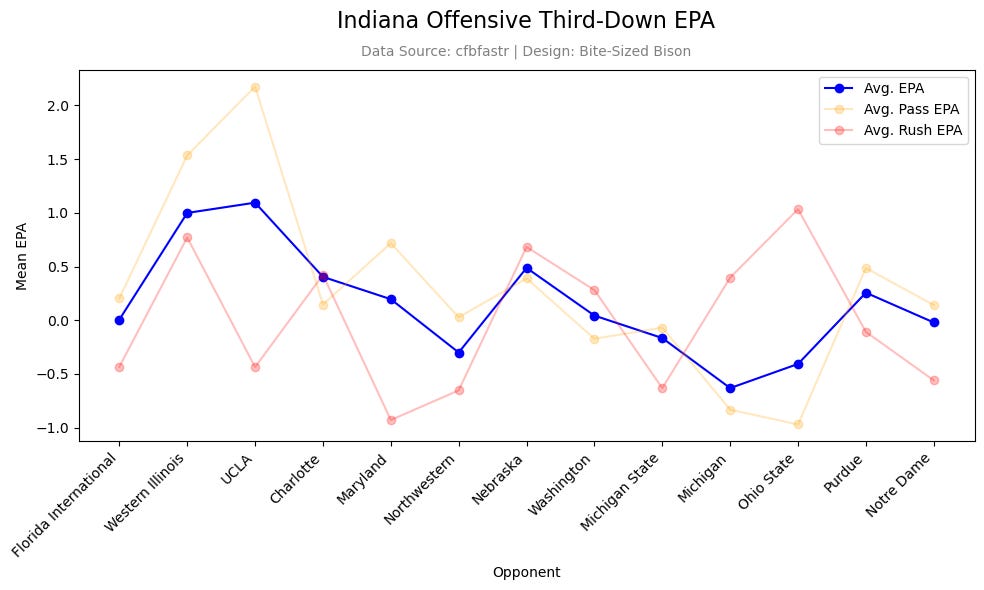
Indiana added a QB in Fernando Mendoza who has a great chance to carry on what Rourke left behind, but the biggest difference in this context might be the bulking Indiana has done in the RB and interior OL departments.