Bison Bites: Dispatch #9
Data bites touching on: Bryant Haines' updated salary, overall PFF FBS rankings, men's basketball lineup efficiency, and offensive/defensive cumulative EPA in 2024


If you’re new enough to Bite-Sized Bison, you might not be familiar with Bison Bites. Each dispatch of Bison Bites is intended to be a quick-hitting list of approximately 3-5 statistics of interest between typical Bite-Sized Bison posts.
Bryant Haines’ new salary would have ranked 8th among FBS assistant coaches in 2024.
Indiana shelled out an unprecedented amount of cash to bring Bryant Haines from JMU to Indiana after the 2023 season. Haines was the first IU assistant to own a million-dollar salary, and the move – to the untrained eye – could have seemed excessive. Haines made just $189k at JMU, and Indiana boosted its investment in the DC position by $590k to give Haines a near-million-dollar raise to $1.175M. The Hoosiers boosted the on-field assistant salary pool by roughly $1M, and half of it was going to a DC who hadn’t called a Power 4 game yet.
But Curt Cignetti knew. Haines proceeded to boost Indiana’s defensive EPA/play from 116th in 2023 to 19th in 2024 on his way to being a finalist for the Broyles Award.
A program can’t keep a DC like Haines without paying up, and making the leap from Matt Guerreri’s salary in 2023 ($585k) to Haines’ anticipated 2025 salary ($2M), as reported by Michael Niziolek of The Herald-Times, is a much greater ask institutionally than the jump Indiana needed to make to keep Penn State (and other programs) away from its golden DC.
Haines’ boost to $2M also comes at the same time that other programs are beginning to elevate coordinator salaries, as former Ohio State DC Jim Knowles was pulled away by Penn State, who offered $3.1M, and Auburn gave DC DJ Durkin a raise to $2.5M. There were only nine coaches making $2M+ in 2024, but that number will certainly rise in the next couple years. Indiana being one of the first to eclipse that mark suggests that the University means business with its football program. For reference, when Indiana signed Tom Allen as head coach in 2016, his salary was $1.79M, and it was big news after the 2019 season when IU extended Allen’s contract with a pay raise to $3.9M (raised to $4.9M after 2020).
As noted above, Haines’ $2M contract would have tied Ohio State OC Chip Kelly for 8th-highest in 2024. OC Mike Shanahan is slated to make $1.15M, which would’ve ranked 53rd among FBS assistants in 2024, and there is almost certainly a payday in his future as well.
Other notable assistant salaries in 2024 (via USA Today):
1. Blake Baker (LSU) - $2.5M
2. Wink Marindale (Michigan) - $2.3M
3. Jim Knowles (OSU) - $2.3M
19. Kane Wommack (Alabama) - $1.55M
35. Nick Sheridan (Alabama) - $1.35M
106. Charlton Warren (North Carolina) - $859,000
152. Willian Inge (Tennessee) - $720k
156. Mark Hagen (Louisville) - $700k
t-156. Bob Bostad (Indiana) - $700k
t-156. Kevin Peoples (LSU) - $700k
369. Matt Guerreri (OSU) - $425k
744. Walt Bell (Western Michigan) - $170k
Indiana led the FBS in players graded in PFF’s top-500.
I’ll explain how I filtered the grades at the bottom of this section, but the top 500 FBS players represented the top 17% of qualifying players. This is how the top-10 teams shook out:
Indiana - 11
Ohio State - 10
Iowa - 9
Kansas - 9
Ole Miss - 9
Oregon - 9
Texas - 9
5 teams (Alabama, Jacksonville St., Michigan, SMU, Tulane) - 8
Does this mean that Indiana had the most talented roster? Well, no. It means that Indiana’s individual players executed their roles very effectively within the systems run by Mike Shanahan and Bryant Haines. That’s certainly not taking anything away from Indiana either. In fact, it’s giving a ton of credit to the coaching staff for developing a system that worked for the roster on hand and is a testament to the veteran players the staff intentionally brought in to learn the systems. Indiana executed as well as anyone in college football in 2024, and few things highlight this more than how memorable the moments of lapsed execution stood out.
The 10 players that ranked in the top-500 for Indiana were:
Kurtis Rourke - 73
Mikail Kamara - 96
CJ West - 160
D’Angelo Ponds - 165
Trey Wedig - 169
Jailin Walker - 192
Carter Smith - 303
Elijah Sarratt - 315
Shawn Asbury - 379
Tyrique Tucker - 411
Amare Ferrell - 415
Pro Football Focus grades can be tricky. You have to be careful when considering each player’s grade, and when taken entirely out of context, it might not make the most sense. For example, incoming transfer RB Roman Hemby – who the college football world understands to be very talented – graded 22nd among Big Ten RBs with 100+ carries in 2024. That has a lot to do with the fact that his offensive line was one of the worst in the nation. That can be difficult to account for when grading players, so a knowledge of each player’s context is helpful in conjunction with grades. Players with smaller sample sizes are also at an advantage because they have fewer plays counting against their overall grades. For example, DJ Warnell graded 5th on Indiana’s defense in 2024, despite playing just 29 snaps before entering the portal. So we need to filter those players out, which is what I did to get started here.
I filtered by various measures according to position: 400 snaps for OL, 300 snaps for defense (to account for DTs, who play fewer snaps), 50% of max dropbacks (QBs) and rushing attempts (RBs), and then 30% of max targets (WRs and TEs) due to an outlier WR with 171 targets at San Jose State. This gave us the major contributors on each team in the FBS, which totaled to 3,050 players (just under 23 per team), so that checked out.
The trio of Oumar Ballo, Malik Reneau, and Mackenzie Mgbako ranks in the 13th percentile in Big Ten trio efficiency.
This has been at the center of debates around this men’s team all season – regarding the two-big lineups and the log jam it causes with Mgbako at the three – but this trio, even with Reneau’s injury, has been on the floor for 415 possessions (14th of 89 IU trios) and is the bulk of Indiana’s second- and third-most used five-man lineups, all according to EvanMiya.com.
Reneau is the one caught in-between in this scenario. He’s Indiana’s second-most efficient individual, by Bayesian Performance Rating (BPR); in fact, these three are Indiana’s top-three in BPR. But when paired with either Oumar Ballo or Mackenzie Mgbako, the team’s efficiency margin is worse than with any other pairing featuring Reneau. Yet, how can you keep the 7-footer (who is also the 22nd-most efficient player in the conference) off the floor (Ballo)? Or your team’s leading scorer in its last 10 games (Mgbako)?
But when adjusted for strength of players on the floor, the lineup most often used when IU takes Reneau off the floor (Ballo/Mgbako/Goode/Galloway/Rice) is essentially equal in efficiency margin – 33.6 with Reneau, 33.3 without.
Much of this is simply symptomatic of misfit scouting reports/gameplans. It doesn’t need to be this way, in terms of two bigs. Maryland is a common comparison, given Julian Reese’s skillset at the four and Derik Queen at the five; yet, there are three more efficient Maryland lineups (with Reese and Queen) before Indiana’s most efficient lineup, as the Terps aren’t trying to force an Mgbako-like player at the three. Nevada even has a more efficient lineup, according to EvanMiya.com, with a jammed frontcourt as well. However, there aren’t many teams built with two bigs the way Indiana is. Most have a stretch-four or stretch-five to allow better spacing, but as noted above, even with Reneau off the floor, Indiana hasn’t taken much of a step forward, in terms of efficiency.
As the team continues into its last handful of games, the lineup playing most often (16.6% of minutes in its last five games, according to KenPom) is Ballo-Mgbako-Goode-Leal-Galloway, a lineup that ranks 76th out of 87 Big Ten lineups with 60+ possessions played.
There are 11 combinations of Indiana lineups that have played 30+ possessions together, four of which exist on its top tier of efficiency:
Ballo-Goode-Tucker-Leal-Galloway: 57.5 adjusted efficiency margin
Ballo-Reneau-Mgbako-Galloway-Rice: 33.6
Ballo-Mgbako-Goode-Galloway-Rice: 33.3
Reneau-Goode-Tucker-Galloway-Rice: 27.7
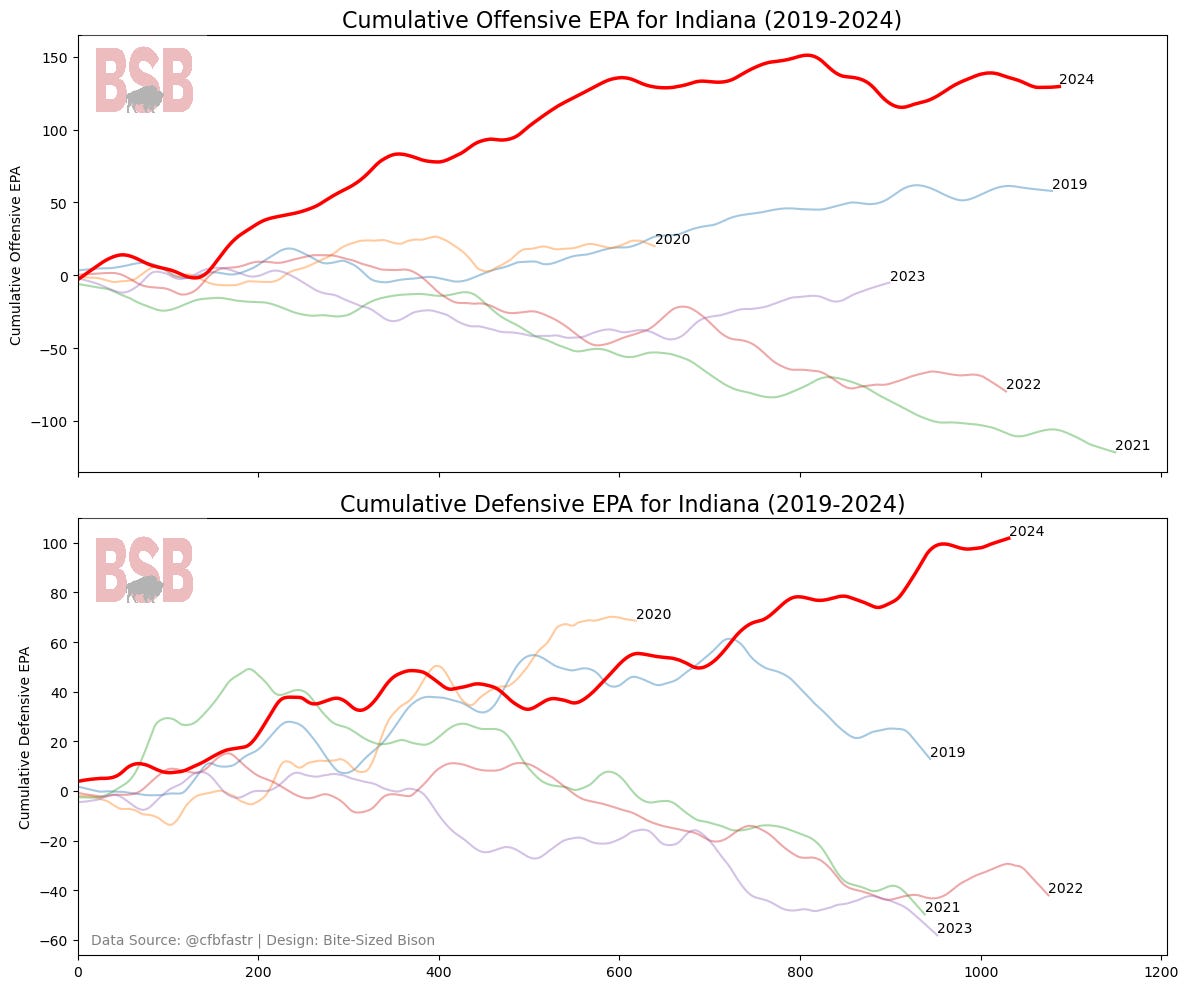
Indiana showed incredible improvement on both sides of the ball in 2024.
I realized I never shared the full-season view of the following chart, which had been updated weekly throughout the year. As you can see, Mike Shanahan and Bryant Haines absolutely earned the increased salaries noted in the first section.