

Farewell AMA: Part 2
Answering questions from readers as BSB winds down. Part 2 answers the football-specific questions, after Part 1 addressed data science and BSB questions.

If you weren’t already aware, Bite-Sized Bison is winding down as the College Football Playoff nears (read a letter from me here). If you had a paid subscription, it’s already been downgraded to a free sub, and prorated refunds are making their ways out now. Anything published by BSB from now on will be free to everyone, and all paywalls on previous content have been lifted.
I wanted to offer a chance to answer lingering questions folks might have – about BSB, roster construction, recruiting, leftover analysis, etc. – so I opened up an AMA (Ask Me Anything) recently and fielded some of those questions.
Part 1 of the AMA, which focuses on BSB and data science/analytics, is linked here.
Part 2, focusing on the football-centered questions, is below.
What stat(s) is the most surprising to you in this two-year run?
Something my brain continues to go back to is this graphic from November 2024, a week before the end of the season.
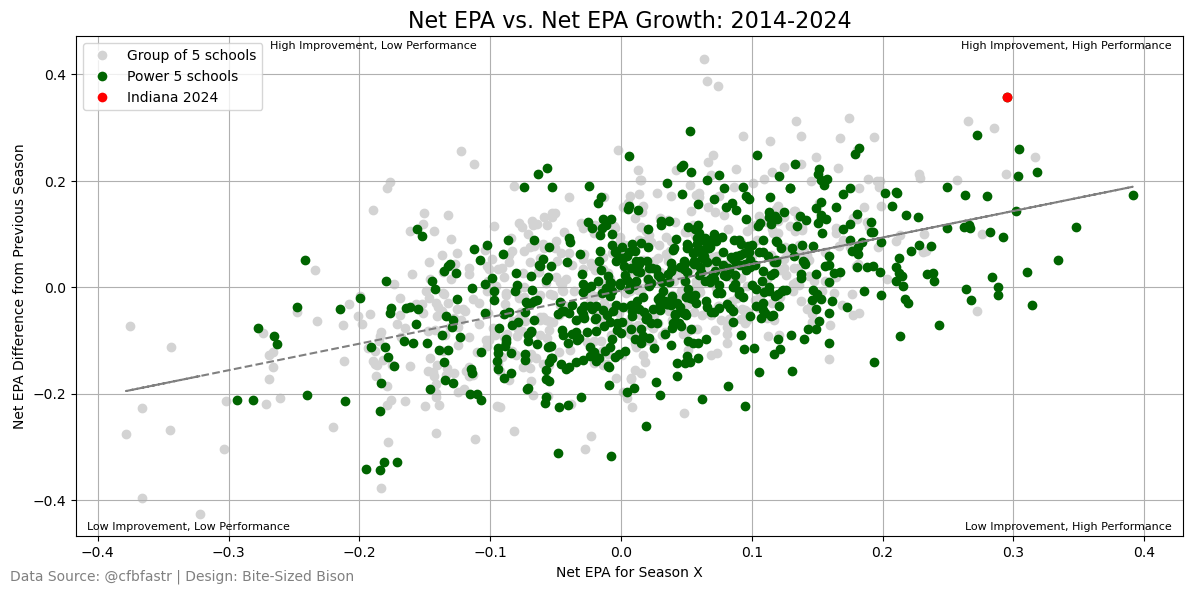
This chart shows single-season change by per-play value (EPA/play). The y-axis shows the difference between seasons, while the x-axis shows the actual Net EPA/play for the respective season. In short: y-axis is “How much did a team change from the previous season?”, and x-axis is “How efficient is that team that season?”
The red point shows that Indiana in 2024 made the greatest positive improvement of any Power 5 team from 2014-2024 (the CFP Era), and no team in that span made that type of improvement while performing at the same level as Indiana.
If I were to recreate that chart updated for 2025, Indiana would be much closer to the trendline because the change was less dramatic. There may never be a season like Indiana’s 2024 season again.
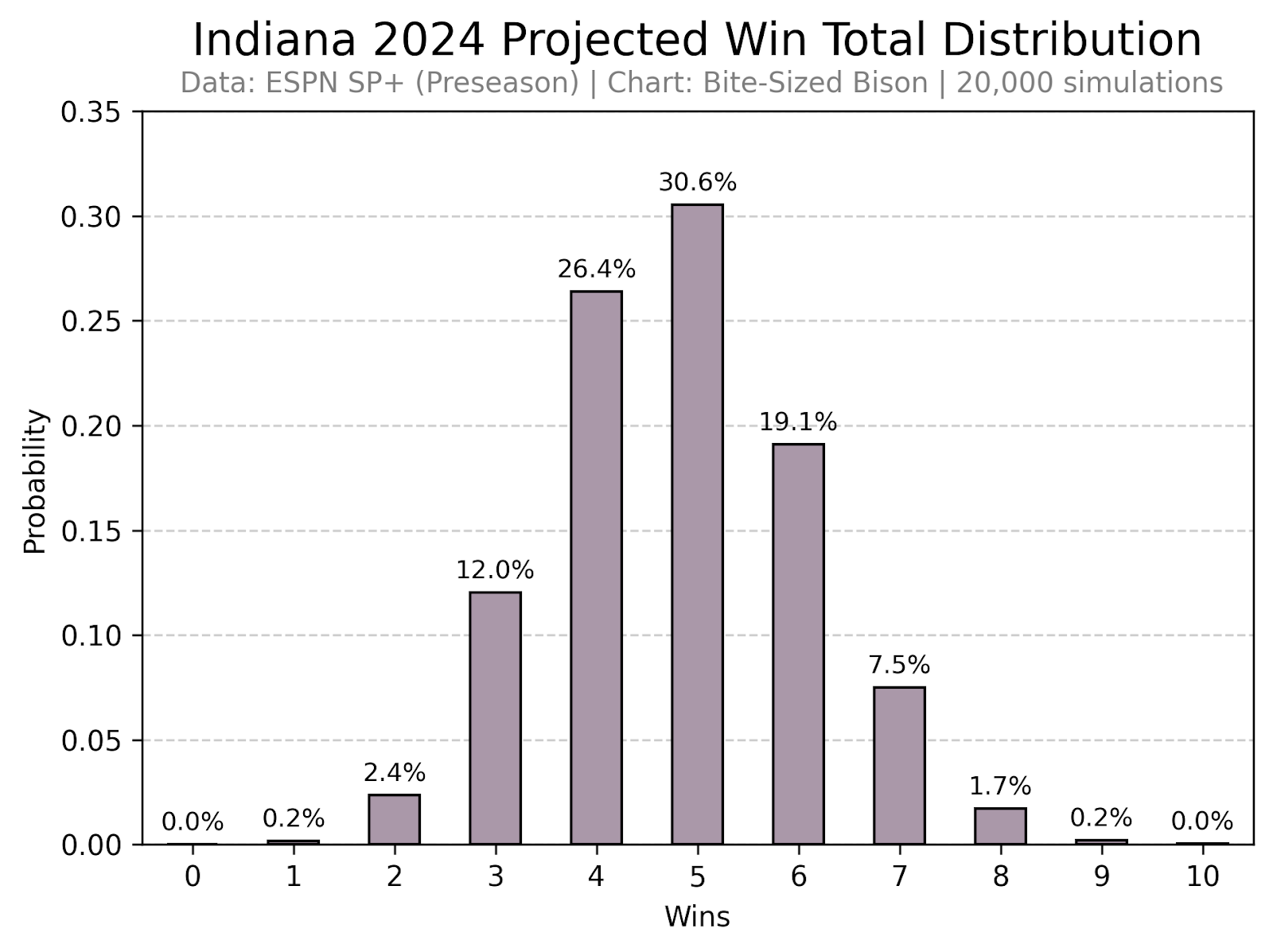
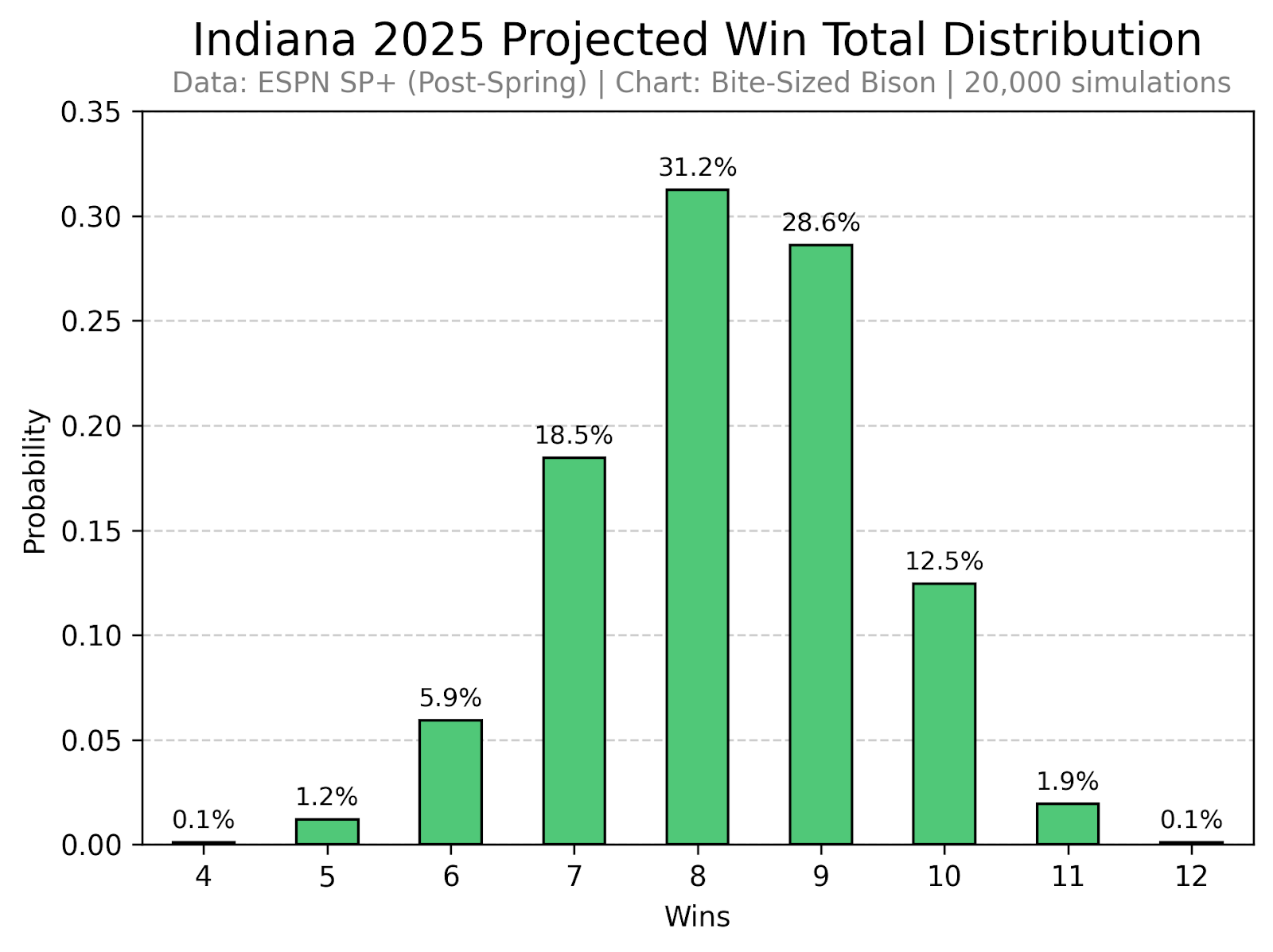
I’ll add that before Indiana’s 2024 and 2025 seasons, going 11-1 and 12-0 was nearly improbable. Using SP+ data in a BSB win probability model, 11 wins wasn’t even on the table for Indiana after 20,000 simulations of 2024 preseason data, and 12 wins was a 0.1% probability for 2025.
Just look at that 2024 win total projection!
As you did your analytical breakdown throughout this season, was there any certain thing beyond the obvious (I.e. we’ve got a great Defense, Mendoza’s a great QB) that surprised you, either as a team metric or as an individual player?
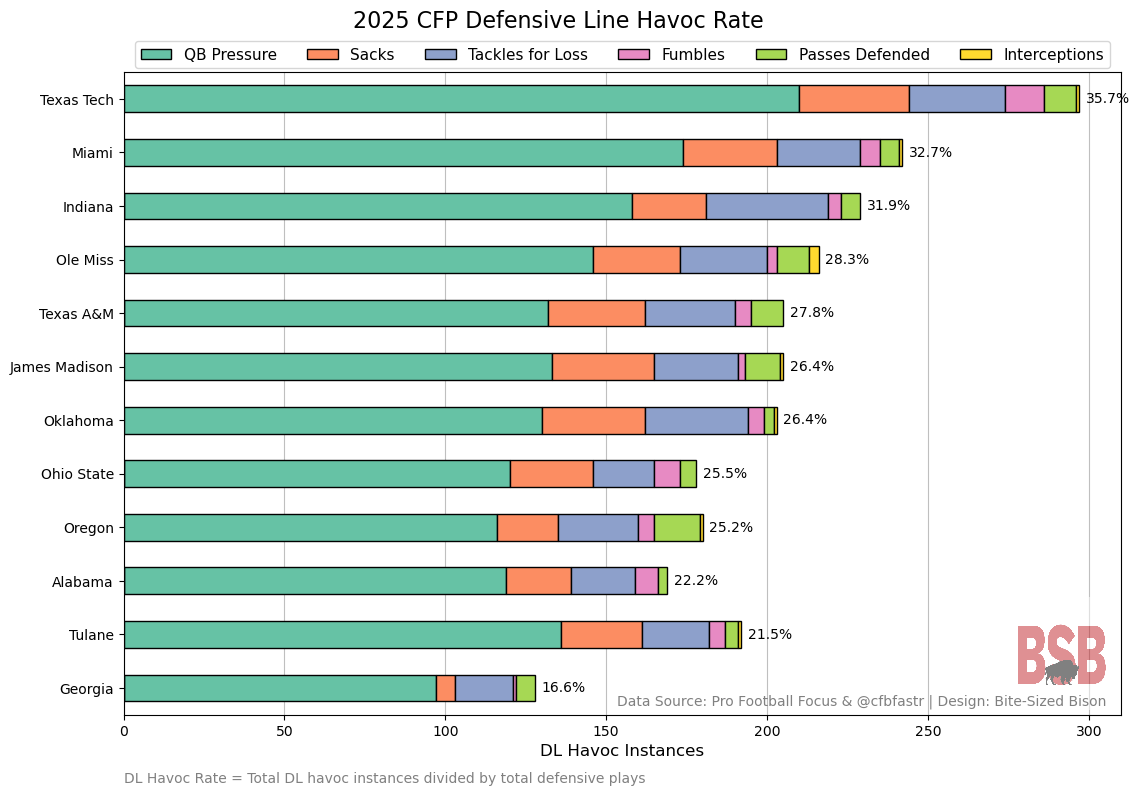
I’m just continuously floored by how much havoc the defensive front causes, especially from the DL alone. Indiana leads the country in front-seven havoc rate. That’s not easy, and it’s not common to influence games as often as Indiana’s defensive front does. Watching the interior DL during games is not as entertaining for other fanbases as it is for the Indiana fanbase. So I can’t answer this question without noting this chart:
To answer your actual question, though, it’s honestly this: Fernando Mendoza – yes, very good – won the Heisman Trophy, yet he has only been used (passing or rushing) on 49.2% of Indiana’s offensive snaps, excluding garbage time (all of those fourth-quarter minutes he missed). That ranks 16th among Big Ten QBs this season, and only Northwestern’s Preston Stone has a lower usage rate among season-long starters.
Kurtis Rourke was similar in 2024. He was used on 53.1% of non-garbage snaps, which ranked 13th among Big Ten QBs, and he finished 9th in the Heisman vote.
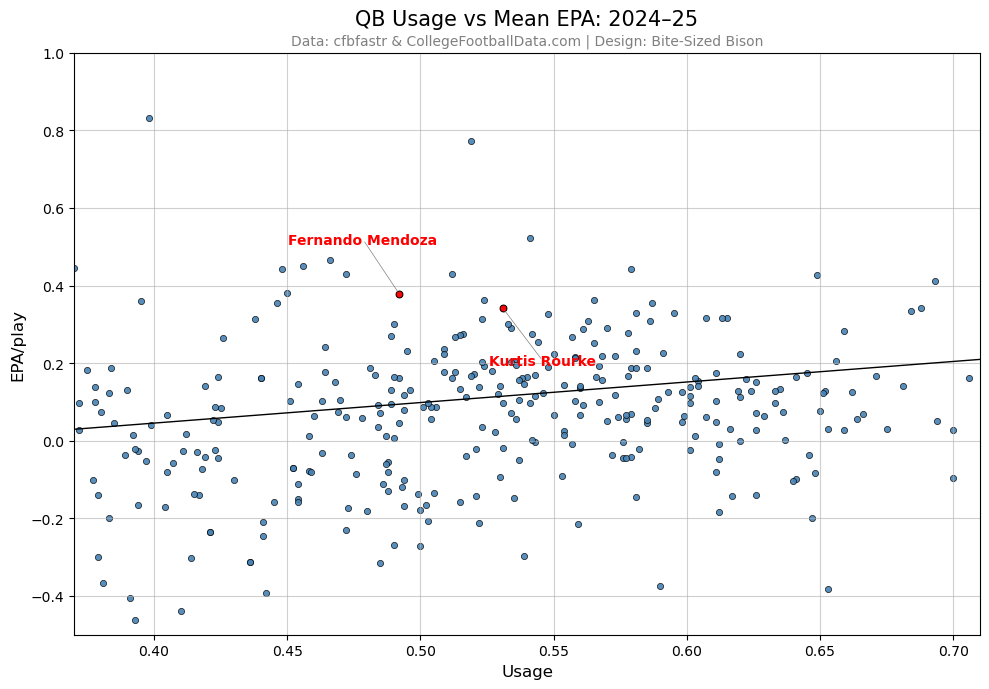
While both are and were extremely effective QBs, Indiana has also been one of the most efficient offenses in the country, while using its Heisman-caliber QBs only just over 50% of the time. That’s a testament to Mike Shanahan and how he’s been able to scheme two offenses – both of which operate in different ways, by the way – to achieve balance. It’s not just a professional way to approach offensive philosophy in 2025, but it’s also how the best offenses work in college football. Ohio State’s Julian Sayin and Oregon’s Dante Moore are also outside the top-10 in usage rate among Big Ten QBs.
This is sustainable in Bloomington. This isn’t a matter of two overachieving individuals at the QB position, much like Mike Penix was in 2020, putting that offense on his shoulders.
Lots of questions about Stephen Daley and Indiana’s DL in the CFP!
Stephen Daley is a hell of a player, and I really feel for him, especially given the outsized role he needed to play after Kellan Wyatt’s injury. One of the broadcasts mentioned a quote from Bryant Haines this season where Haines said Daley is “one of the most athletic guys” the defense has had along the line at Indiana. Indiana loses a lot with the loss of Stephen Daley. But it doesn’t hurt the defense as much as folks might fear it does.
This will sound like I’m discrediting Daley’s performance in 2025, but that’s not the intention. I’m just seeking to offer perspective on his role and contribution to the DL, because seeing that he recorded the 2nd-most TFLs nationally (19.0) after becoming the sole starter in Week 9 rightfully seems insane. However, Daley had played three full games of snaps before Wyatt went down to injury; they were not playing the same role in the defense. So when Wyatt went down, it’s not that Daley stepped into a starter’s role from a reserve position. He already had his role, and Bryant Haines needed to adjust it after the Wyatt injury – and adjust he did! Daley has now played the 97th-most snaps (528) among FBS DEs, which is a perfectly normal number of snaps for a starting DE (Mikail Kamara has 511). Daley had a TFL for every 27.7 snaps played, which is almost 2 per game!
But let’s get away from the TFL number for a second. PFF graded Daley 40th among FBS DEs with 500+ snaps and roughly average overall in pass rush (88th in that group). His Pass Rush Production metric ranked 164th among FBS DEs. So Daley is a durable, athletic guy whose strength is in run defense. And he executed his role well.
Haines can scheme for that. So much of an individual defender’s success in the last two seasons has been because Haines has placed them in position to make those plays according to their strengths – Daley is no different with his TFL opportunities. Haines will do the same without Daley on the edge.
The heart of the defensive front is the interior DL. Guys like Tyrique Tucker, Mario Landino, and Hosea Wheeler are where things start for Indiana defensively. That interior scheme and rush by Bryant Haines is a unique way of attacking offenses. This is also what made last season’s defensive front so formidable, as the interior naturally forces opposing offenses toward the edge. Indiana also has LBs who can play along the edge. Rolijah Hardy and Isaiah Jones have played the 25th- and 31st-most snaps on the edge of the DL, respectively, among FBS LBs. Devan Boykin – despite playing far fewer total snaps than most leading safeties because of his Rover position – has recorded the 27th-most snaps along the edge of the DL among FBS safeties. These are ways Haines has already been bolstering the edge of the defense.
So who steps into Daley’s role on the edge? It could be any number of players. Daniel Ndukwe could be a one-to-one fix, if he’s progressed enough physically. Mario Landino could play closer to the edge and get away with fewer snaps from a true DE. Mikail Kamara could jump back into the role, if Haines believes that’s a higher priority than the new role Kamara has served so far this season. There may also be some more 4-3 looks, with three down linemen rather than the four from the 4-2-5.
Haines’ defense is built to sustain these losses. While it is still a loss and Indiana would be better off with Daley (could say the same for Wyatt), Haines has proven an ability to leverage his defense’s multiplicity against opposing offenses regardless of missing personnel – even without D’Angelo Ponds at Iowa.
Just look at this Twitter thread that analyzes how Haines approached the Ohio State defense, or this Twitter thread that lays out why Haines is regarded as one of the best – if not the best — DCs in the country. It’s not by an individual’s performance that the defense has remained consistently successful for two full seasons.
Portal strategy during CFP…are we likely in negotiations with outside targets, internal retention? Odds any players opt out and enter portal before game?
Yes, all the way around.
These discussions have been going on for some time now for any program that is run efficiently during this era of college football. You may have seen where Clemson’s Dabo Swinney said he wouldn’t “cut deals” with transfers before the portal window arrived (as reported by my good friend and former Herald-Times reporter Jon Blau). But that’s a losing formula. This is why I’m slow to place blame on Brendan Sorsby, whose camp was making deals with other programs while playing as Indiana’s starter in 2023 (that’s another newsletter item, though).
At this point, it wouldn’t be shocking if Indiana 1.) had its sights on many potential transfers (whether those players’ intentions to enter have been reported or not) and had reached out to several, 2.) had discussions with its own players on their intentions vs. the program’s needs, and 3.) had already been made aware of (or broke the news to) current Hoosiers’ intentions to enter the portal. They might even have deals with various players already made, particularly at QB.
Curt Cignetti is very much aligned with the college football calendar, so even though there have been some big games, a staff must be on top of this for future success and adherence to a long-term plan.
I will note, though, that any “opt-outs” will not be any players who’ve made serious contributions to the 2025 Hoosiers. These will be younger players or transfers who couldn’t break through. But even then, the number will be low.
How do you foresee this team addressing the QB position next season?
At QB, I feel 99% sure they’ll bring in a talented somewhat-proven transfer for another season. Alberto Mendoza seems to be progressing well, but this position is so, so significant to Cignetti’s teams, even before Indiana.
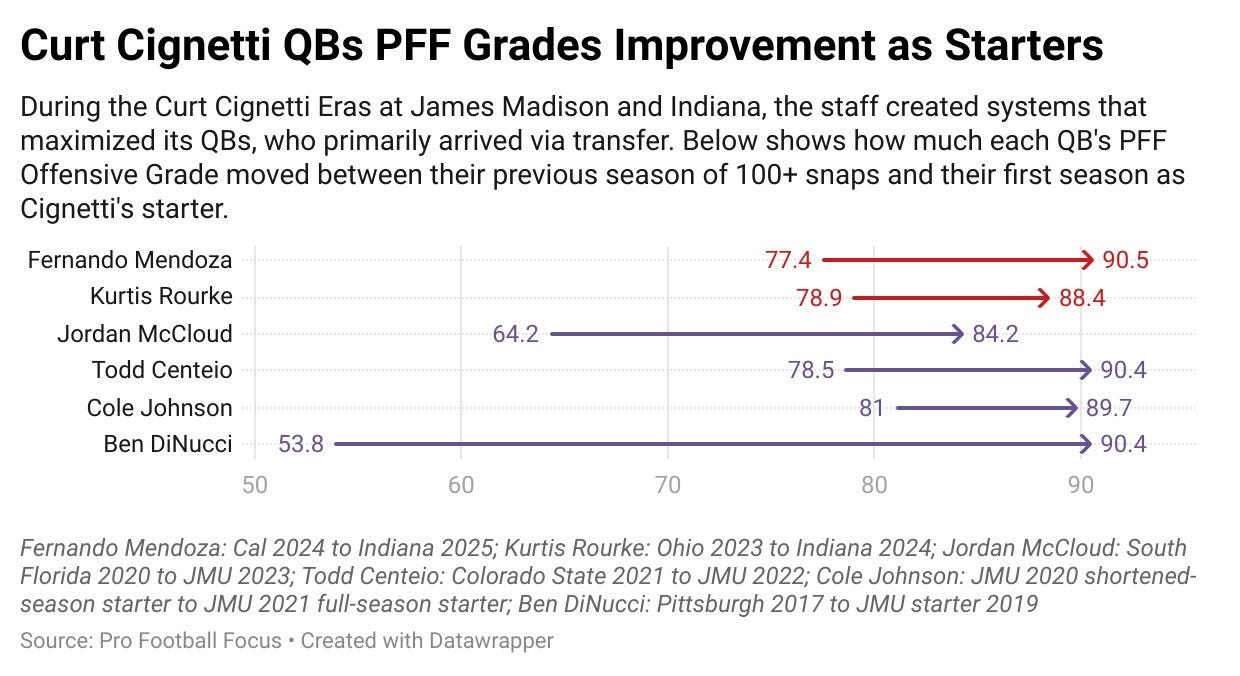
Alberto will be just a redshirt sophomore in 2026 with little competition, if the staff was to not bring in a transfer. You have to make the starting job extremely difficult to win to maintain the level of success Cignetti has come to produce, especially now when Indiana’s QB position is one of the best nationally for two straight seasons. Guys will want to be at Indiana; the Hoosiers should use that leverage.
There will be a deal in place before the transfer window opens in January. There will be a slew of announcements that day, and Indiana will be one of them.
Very interested in next year’s roster. And where can we get good analysis now that BSB is shutting down. Most talking heads are superficial.
To answer the back-half of your question, I’ll direct you to this particular section of Part 1 of these AMAs. I list several sources that might offer some good analysis in place of BSB and also some sources that helped teach me various concepts of the game, outside of my own experiences.
As for the 2026 roster, there is a tab on the BSB Scholarship Chart that maps out roughly what the scholarship situation will be like next year, before outgoing transfers are reported. I have questions for every position, so I’ll lay them out here before I go:
At QB: Obviously, who will Indiana bring in to lead this group and bridge into the grassroots era in 2027? What does Tyler Cherry look like coming off of his injury? Does Alberto Mendoza stay if he doesn’t win the starting job?
At RB: Assuming Lee Beebe is healthy for 2026, does the staff roll with the freshmen behind Beebe and Khobie Martin, or do they bring in another back to round out the anticipated trio?
At WR: Does Omar Cooper forgo his senior season? Does Tyler Morris return after his injury, or does he choose to move on? If both leave, this would create the possibility of adding up to three WRs – a slot to pair with LeBron Bond, a perimeter wideout, and a more dynamic Cooper-like receiver to bridge into Davion Chandler’s era. Regardless, I think we will be seeing much more slot work (closer to 2024) than we’ve seen this season.
At TE: There are four freshmen at this position in 2026, and that’s it. First, do any of them hit the portal? Second, does Indiana add another from the portal? Indiana runs a ton of 11 personnel, so there’s a reality where the staff adds one TE to serve the Horton/Nowakowski role and plays one or two freshmen behind him. I think 2027 is when we will see those young TEs break into roles transfers have served (looking at Blake Thiry in particular).
At OL: Where does Indiana add in the portal? Carter Smith is almost certainly gone, so there is an immediate need at both tackle positions. That will require some resources, so I’m curious how the staff approaches the interior. Where does Bray Lynch play? I’ve been waiting to see if Lynch makes the move to center, where he was developed during the Tom Allen Era, but so far he hasn’t. However, Adedamola Ajani is knocking on the door for Lynch’s RG job opposite Drew Evans, so if the staff needs to spend big at tackle, moving Lynch to center to compete with Austin Leibfried isn’t the worst idea. I’m also curious who will be that utility depth piece Cignetti’s OLs typically have (Tyler Stephens in 2024, Zen Michalski in 2025). Besides spotting along the line, both Stephens and Michalski had packages developed for them as additional linemen in both offenses.
At DT: Does Tyrique Tucker leave for the NFL? He could, but he does have another year left. This is a big question for Indiana’s 2026 defense because if Tucker leaves, Mario Landino would be the only returning DL from this team. They’d need to add a nose tackle to bridge into the Jhrevious Hall era, as well as a replacement for Hosea Wheeler (if Hall isn’t ready to step into that role). Look for Indiana to add at least three DTs in the portal, with a lot of talent coming for 2027.
At DE: How many DEs does the staff add through the portal? There is a ton of young talent here, including six (!) freshmen in 2026. This may be the position we learn the most about during the CFP after Stephen Daley’s injury. What we’ve learned about the DE position in Bryant Haines’ system is that it doesn’t require the biggest bodies or 5-star talent to be effective, which is good for the CFP. Afterwards, Mikail Kamara will most likely be gone (though there is question about an additional year of eligibility, with COVID and his previous injuries), and Kellan Wyatt and Daley will most likely be gone. There are big shoes to fill, and some of these guys, like Daniel Ndukwe and Ansrew DePaepe (MSU transfer, not his brother William), are getting to the age where decisions need to be made about how they can contribute moving forward. How good is Andrew DePaepe? This was a fairly sought-after transfer back in the spring of 2024, yet we haven’t seen much of him as he’s recovered from injury. Is he an answer for 2026?
At LB: Who is the third LB in the 2026 defense? It’s become clear that Bryant Haines likes to run three-LB sets when he can, but is Kaiden Turner ready to be that third LB? Quentin Clark had a lot of potential coming out of high school, but he’s played 2 snaps from scrimmage during the Cignetti Era. The staff also really likes current true freshman PJ Nelson. This is a position that may have the most budding talent on the back end, but is it ready for 2026, and if not, who will bridge that room to 2027?
At CB: There are a ton of questions for this position. Does D’Angelo Ponds return for his senior season? Is Jamari Sharpe who the staff wants at CB2 in 2026? How is Amariyun Knighten coming along after his injury? Do either Ryland Gandy or Knighten (two transfers before the 2025 season who have hardly played) stick around for 2026? Is anyone behind them ready to play significant snaps? I’ll be watching this room for potential rotating through the portal.
At SAF: Does Indiana add just one safety through the portal? Amare Ferrell and Byron Baldwin seem like the starters at SS and ROVER in 2026, but who replaces Lou Moore at FS? That may be asking a lot of Jah Jah Boyd next season.
At P and LS: Indiana won’t have a scholarship punter or long snapper after 2026, so they’ll need to add at both spots.
Overall, the current count of 2026 scholarships is 75, just 10 beneath the cap. If you read through that speed round of questions, it’s clear that Indiana will need to add more than 10 transfers to have the attrition needed to compete at a high level in 2026. That means several younger guys will need to be nudged out. Expect some portal-entry announcements in the next month or so – both during the portal window and during the five days after the CFP concludes – as Indiana makes room and boosts its talent floor.
What Freshman/Sophs might break out next yr like Charlie Becker did this year?
To be equal to a Charlie Becker, these guys would need to be relatively unknown or unseen, so I will work with that criteria – disregarding Byron Baldwin, LeBron Bond, Khobie Martin, and Adedamola Ajani.
These are some guys I’m anticipating from the younger classes, and if the dominos fall correctly, could be difference-makers in 2026: RB Sean Cuono, WR Davion Chandler, TE Blake Thiry, C Austin Leibfried, DE Tyrone Burrus, DE Triston Abram, DT Jhrevious Hall, LB PJ Nelson, and LB Quentin Clark.
Do athletics seem different in the NIL era, in regards to how the players interact with the media? Is the vibe the same or does it seem less collegiate, more like work?
There are much more qualified people with better answers to this question, but I’ll offer a couple thoughts.
It’s been awhile since I was actually in the media interacting with players like a reporter, but I do still follow along closely and have friends in the media still, and I have a unique perspective on this after interacting with and watching players grow up as a recruiting reporter. I will say that this has always varied by program and player. For example, when I jumped onto the Ohio State beat, the tone of those media availabilities was a bit more professional because the players were a tad more media-trained and/or the media was just larger so there was more to guard against. That’s not to say they were robots or anything; they still showed their personalities. But they simply were seen by more eyeballs and needed to be careful.
I think there are some throughlines that keep things similar. One is that these are still people aged roughly 18-23 and interacting with media for the first time in their lives, especially if they weren’t recruited at a high level. Another is that the players themselves aren’t necessarily more business-savvy. The reports we see about business dealings involving players – NIL deals, transfers, contracts, etc. – aren’t facilitated by the players; it’s their representation. Their names and photos are just attached to the reports, which can sometimes be unfortunate for them (thinking back to the Lee Beebe transfer, for example).
I do think something we are seeing, though, is that as we progress deeper into the video-focused media landscape, players are entering college with way more experience on camera than ever before. I’ve personally noticed how that has translated into some interviews or NIL appearances. It’s not necessarily that they’re more professional in their tone but more that they’re just more comfortable than they once were.
Ultimately, college football is college football because these guys are just so young. By nature, college athletics are guarded against some of the media strategy you might see in the pros. But of course, not everyone.
Share a moment or two pre-Cig that you enjoyed from IU football. The more obscure the better.
Well, now you’ve got me tearing up, folks.
There are so many. There are a lot from being on the beat with the other reporters too, but I’ll stick with what the fans would recognize. There are the obvious ones – The Reach by Mike Penix, the explosive Penix-to-Fryfogle game in Columbus, the Gator Bowl in Jacksonville, Tom Allen’s postgame press conference after beating Nebraska in 2019, and many more. I’m going to go for some obscure ones (as requested). In no particular order:
I worked really hard for the IDS to turn around a profile on new head coach Tom Allen when that transition happened in December 2016. Read that profile here.
Related to Tom Allen: When he was DC in 2016, he was leading one of the biggest defensive turnarounds in the country. During a media availability in Henke Hall, I was lucky enough to get him one-on-one and told him I was curious how exactly he was doing this – give me the nuts and bolts. He sat with me for 15+ minutes (a very long time in that environment) explaining how the 4-2-5 worked (and its weaknesses) and how he was changing the defensive culture inside the locker room. It was pretty clear he was a special guy. I’ll always remember that conversation as a 21-year-old student-journalist, and in a lot of ways, it was the first of many discussions I’d have with top coaches about scheme and culture.
Just Zander Diamont. I’m not even talking about his charisma. The guy was a baller on the field. He had his game against Purdue to cap a pretty inconsistent 2014 season, the 79-yard score against Ohio State with College GameDay in town, the Legs ‘n’ Bacon package with RB Tyler Natee in 2016, and he nudged Kevin Wilson and Richard Lagow to run a particular play to Ricky Jones to tie Michigan State, 14-14, in the fourth quarter in 2016 (a story told by Ricky Jones). That’s just scratching the surface. He was a player of moments. I’ll never forget covering the Purdue game in Bloomington and being there in the media when he dropped the news that he was retiring from football a year earlier than expected.
One interview I will never forget was with Michael Penix not long after he committed to Indiana. He told me he was “the next Mike Vick,” and I chuckled because that was a big statement to make. Then, he went on to become Michael Penix, playing in the National Championship for Washington. Mike talked to me in that interview the exact way he talks to the media today.
My second year on the Indiana Football beat was 2015, when IU beat Purdue in West Lafayette to advance to its first bowl game since 2007. It was cold, and the visiting locker room was cold too, but that didn’t keep the team from celebrating. Now, when I hear the song “Big Rings” by Drake, I can only think of that team. There was something special about them. It might have been my age (20 years old) and still being introduced to the program and its fans, but no matter what Indiana did during the Allen Era or does during the Cignetti Era, that team will have a special spot in my memory.
This isn’t really Indiana Football, but I was lucky enough to cover Saquon Barkley in his home stadium when IU traveled to Happy Valley in 2017. He is the only player I can remember where the entire stadium would hold its breath when the ball was going to him. You could feel it. I’ll never forget that, nor his one-handed catch in the flats that day.
Ralph Green had a Pro Day in 2017 that was very entertaining for the media. These pro days, much more under the microscope now versus back then, were pretty slow, long days around 2017. Most of the guys working out, including Green, would never see an NFL snap, some would never see an NFL camp. I may have been one of a few people really locked into these workouts. So when Green was who Green is – the boisterous guy who carried the Old Brass Spittoon around in 2016 – it was a nice break. See part of that interaction here.
I was doing a class project in 2016 related to Indiana Football, so while recording myself talking in Memorial Stadium, Stephen Houston crashed the video by taking my mic and interviewing me. I don’t remember what was said (I’ll have to find that video some day), but it was a funny moment.
Don Fischer sat down with me for a 2-hour interview on a podcast I hosted for a semester my senior year of college. The episode has been deleted from Soundcloud (see for yourself), but that was a huge moment for me and also for my family, which is filled with massive IU Basketball fans. Thank you to Don.
Jon Gruden visiting Bloomington for Indiana’s Spring Game and speaking to the media was a fever dream. I wasn’t aware of his connection to Indiana until that day.
I also had several long conversations with Kevin Wilson while I reported on Ohio State, when he was OC and TEs coach there.
My first interview as a college football reporter was with Deland McCullough when I was a freshman in college. I was awful, but he was very kind.
There are a lot of other great memories not tied to Indiana too that will stick with me:
Watching Tiger Woods win the Master’s with Drake Maye and his family after a recruiting event
Jaxon Smith-Njigba and I had talked a lot throughout his recruitment. He was snubbed from The Opening — the biggest annual national recruiting event in Texas. He was later added to the lineup but only because someone needed to drop out. At the event, he was tearing it up and, at one point, made a circus catch along the sidelines near where I was and stood up looking at me. He said, “That’s why they should’ve invited me.” He’s leading the NFL in receiving yards 6 years later.
Lining up as a WR across from Jeff Hafley (now the Green Bay Packers DC) as he showed me a press technique he was teaching the OSU CBs at the time
Talking with Ohio State DL coach Larry Johnson about what he was watching for when Jack Sawyer was doing a workout at his high school in Pickerington, OH. I also learned to take pro-level photos at a high school basketball game that Sawyer was playing in.
Being at the Elite 11 Finals in Frisco, TX, when CJ Stroud balled out and earned his Ohio State offer later that day. The rest of that story is history.
Meeting Marvin Harrison, Sr. when he visited Columbus with his son, Marvin Jr., as Ohio State was pursuing him
Covering the Pro Day for Dwayne Haskins and Terry McLaurin
Talking ball with NFL scouts each spring
Attending coaching clinics and summer camps in Columbus, where I met tons of collegiate coaches at all levels and listened to OSU coaches discuss scheme
There are so many more I just can’t recall right now, but these were a several that came to mind first as I sit here thinking back. Thank you for humoring me.
This is a lovely set of recollections. It was sad today when my phone notified me of a refund from substack. IU football fandom will miss BSB (it's funny that two of my favorite media outlets are BSB).
Farewell to you Taylor, and best of luck!
Unbelievably, you were able to make the greatest season of my life even more enjoyable. Take care.