

Introducing Darian DeVries
Indiana Men's Basketball has its next head coach -- Darian DeVries, from West Virginia (and Drake).


Perhaps the most impressive fact you will read in this BSB is that since Drake Men’s Basketball’s first season of 20+ games in 1917, the program had won 20+ games on just four occasions (1969-1971, 2008); then, when Darian DeVries was hired as head coach in 2018, he immediately led the Bulldogs to six consecutive seasons of 20+ wins. He also led them to three NCAA Tournament appearances, something the program had done only four times – those aforementioned 20-win seasons – before him.
That is Indiana’s next men’s basketball head coach, the University announced on March 18.
Here at Bite-Sized Bison, we will focus on metrics and data, but there has been some great reporting/analysis on the topic in the last week, thanks to many local contributors. I’ll list some below that I found particularly informative:
Darian DeVries Introduction Press Conference (Inside The Hall)
Behind the scenes of Indiana basketball hiring Darian DeVries as new coach (Mike Niziolek and Zach Osterman)
Darian DeVries Full Film Breakdown (Tony Adragna)
New Head Coach Darian DeVries: Coach's Perspective (Hoosiers Connect)
Indiana has a new coach (CrimsonCast)
Darian DeVries’ WVU staff had several IU basketball ties (The Daily Hoosier)
Darian DeVries is an unorthodox hire. He’s just who Indiana men’s basketball needs (Indiana Daily Student)
DeVries comes to Indiana from West Virginia, where he served as the Mountaineers’ head coach for one season – leading the largest turnaround in program history (more on this later). After pulling eight players, including his son Tucker DeVries, from the portal before the 2025 season, DeVries set out to patchwork a team that was already coming off a Big 12 last-place (9-23) season. Leading into this season, the Big 12 coaches projected West Virginia to finish 13th in the conference, but the Mountaineers finished 8th (19-13) and somewhat controversially missed the NCAA Tournament.
This is all to say that piecing together the 2025 West Virginia team – plus losing Tucker DeVries and Jayden Stone, who were two of the top returning scorers in the sport – is not going to lead to the most accurate look into what a Darian DeVries team may look like, particularly when comparing the WVU profile with Indiana’s. But have a look for yourself…

Observations:
This is where losing Tucker DeVries and Jayden Stone hurt the most. The 6-foot-7 anticipated offensive bellcow (DeVries) went down after just 8 games, but not before posting 26 points (on 8-of-12 3-point shooting) in WVU’s win over Arizona and 16 more points in WVU’s win over Gonzaga. He was also present for a bad loss to Pitt and an overtime loss to Louisville. The Mountaineers averaged 77.8 points per game during the 6-2 stretch with DeVries and 68.2 points per game during the entire season. Stone, who averaged 20.8 points per game at Detroit Mercy in 2024, is a do-it-all point guard, whose scoring strength is as a driver but also possesses passing skills that ranked him top-500 nationally in assist rate last year. That pairs really well with DeVries’ system and would’ve elevated the WVU offense significantly.
The offensive pressure then fell on Indiana-native point guard Javon Small, who played 89% of WVU’s minutes this season. That ranks 38th among all D-I players. He averaged 19 points per game, 6 assists per game, and 4 rebounds per game. Amani Hansberry, a 6-foot-8 sophomore forward, brought a majority of the rebounding presence and added 10 points per game.
The offense lived or died by whether 3-point shooters could execute, which, if you watched Tony Adragna’s film breakdown linked above, begins to make sense. Many of DeVries’ screen actions create opportunities from three, particularly because of how he weaponizes space. WVU ranked 282nd in percentage of points from two, so it relied on threes going down, and when they did, WVU didn’t lose often. Only four of its 13 losses – Houston, Louisville, BYU, and Colorado – featured better than 30% 3-point shooting. But season-long numbers show that WVU attempted the 56th-most threes per game at just the 251st-best percentage.
Ultimately, what capped WVU’s offensive potential was simply a lack of talent. Adding two of the game’s top returning scorers would’ve made this offense more dynamic and explosive.
Observations:
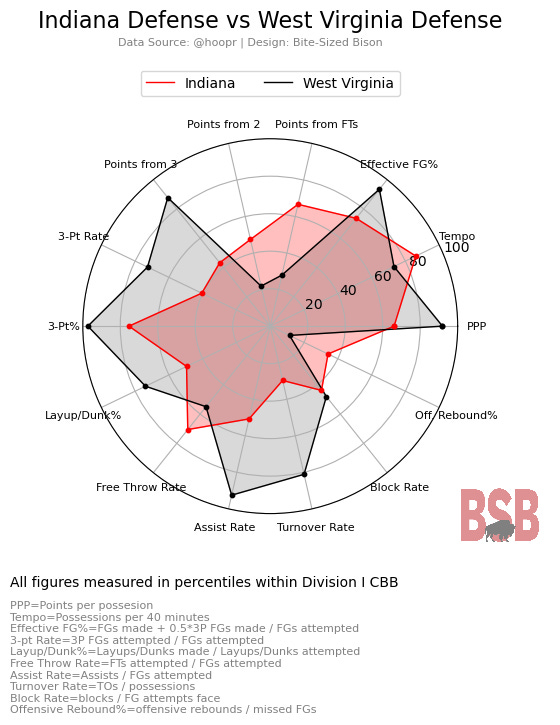
Defense was the key turnaround at WVU from 2024 to 2025. KenPom ranked WVU’s defensive efficiency at 14th nationally (was 178th in 2024), and its Points Per Possession (PPP) reflects something similar.
WVU’s perimeter defense was stellar, holding opponents to just 29.7% from three (12th nationally), even though teams attempted the 61st-most threes against them.
WVU performed much better than Indiana in forcing turnovers (defensive turnover rate) and limiting ball movement (defensive assist rate). It also owned a higher defensive block rate than Indiana while having the 170th-ranked roster in average height (IU’s was 11th).
This team really struggled to rebound. Its tallest starter – Amani Hansberry – was 6-foot-8, and its backup center – 6-foot-11 Eduardo Andre – would tap in for 17 minutes per game. The Mountaineers would eventually rank 290th in total rebounding and would lose the average rebounding battle, 33-36. This season at WVU is an anomaly under DeVries, as his teams have finished in the top-100 every other season in offensive rebound rate allowed.
A Proven Builder
Something noted in Osterman and Niziolek’s reporting was that Indiana was seeking a coach who had built a program “from scratch.” They wrote in The Herald-Times:
“(John) Decker’s number crunching picked up on the fact that (Archie) Miller had more or less sustained success at Dayton, rather than built it — Brian Gregory won 97 games in his final four seasons coaching the Flyers, before handing off to Miller, who won 90 in his first four years there. DeVries compared favorably in that analysis. Drake had won just 40 games in the four years before he arrived, compared to 95 in his first four years.”
This sentiment takes aim at concerns that the DeVries hire is another instance of an effort that led to Archie Miller’s era in Bloomington beginning in 2017 – hiring mid-major champions for a Big Ten job with a brand as large as Indiana’s.
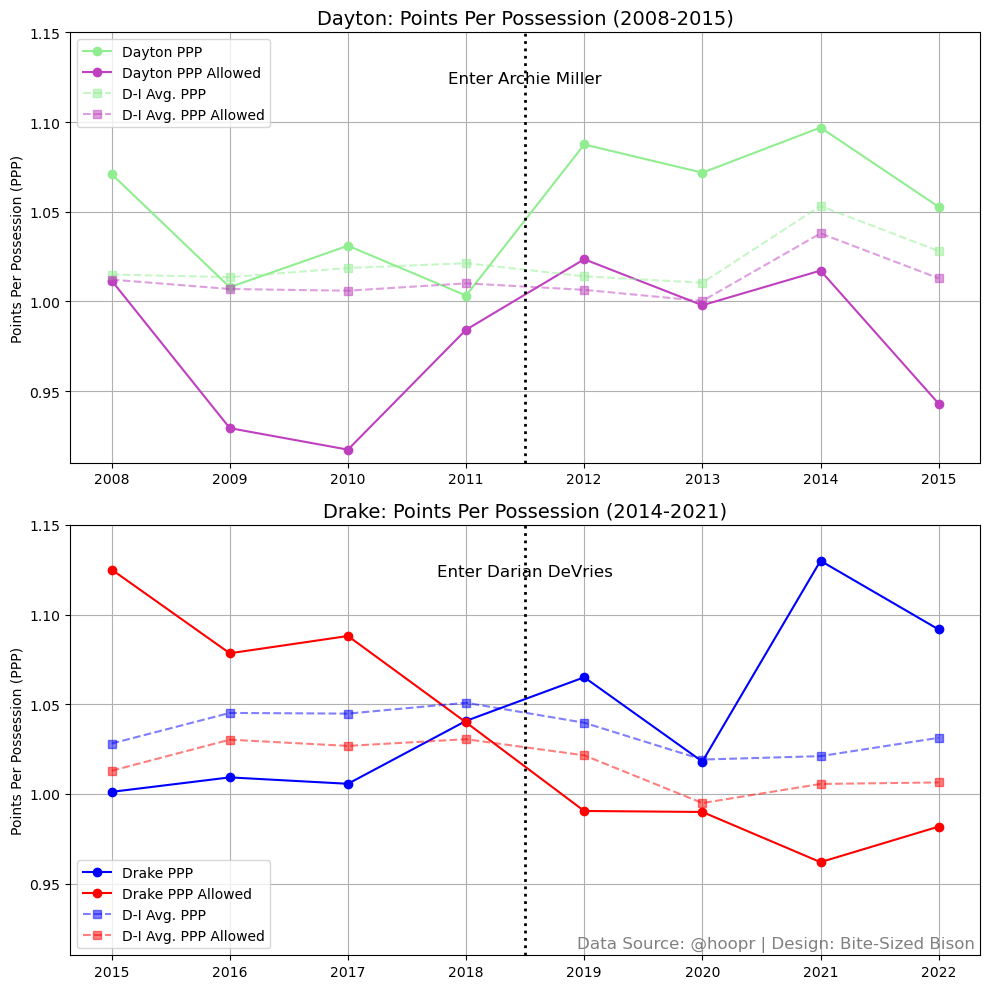
The wins speak for themselves, but the advanced metrics also support the idea that DeVries could be different. Below is a chart comparing Archie Miller’s first four years at Dayton (2012-2015) with Darian DeVries’ first four years at Drake (2019-2022), by points per possession. Not only did DeVries bring wins to Drake, he also brought efficiency. Claiming that Miller didn’t improve Dayton in his first four years would be a risky take, as he certainly brought increased efficiency along with an Elite Eight appearance in 2014. But DeVries turned Drake’s program entirely around.
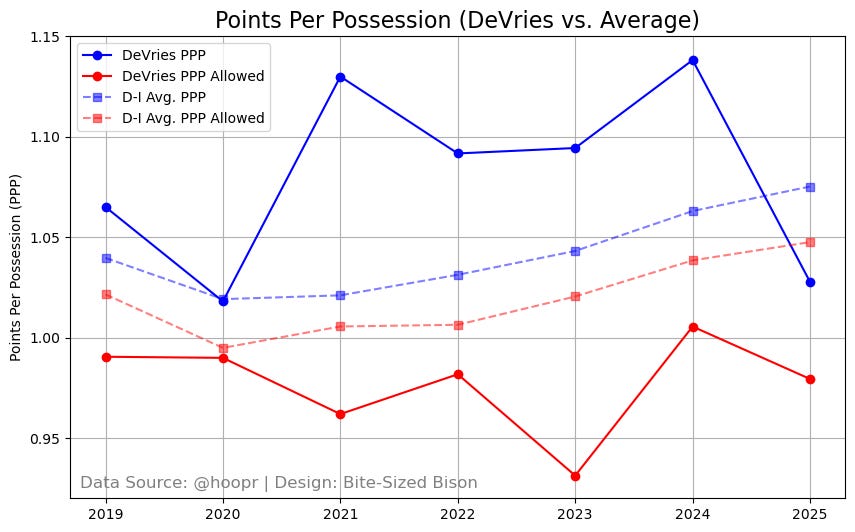
DeVries didn’t stop there either. Below is his entire head coaching era, from 2019 to 2025.
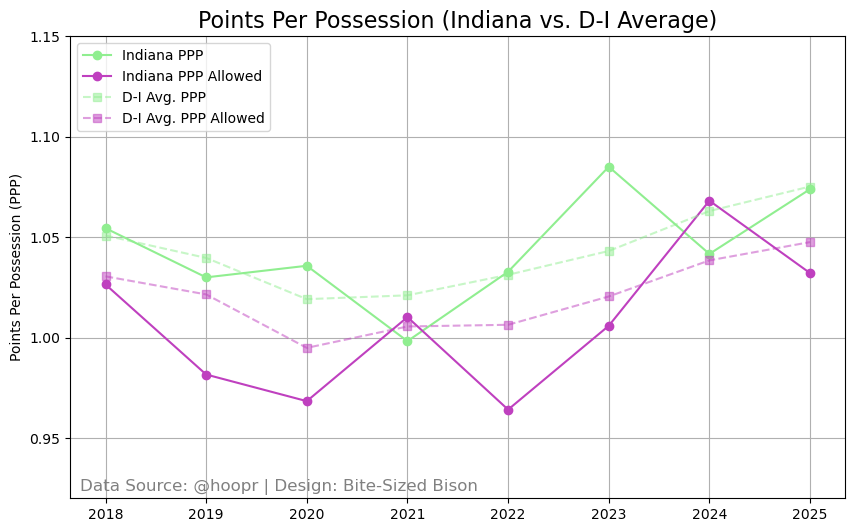
For reference, this is Indiana during a similar stretch (covering Archie Miller and Mike Woodson’s tenures).
Historically Quick Turnaround at WVU
Building off the previous point, when Darian DeVries took over the head coaching role at Drake going into the 2019 season, he inherited just 19% of the previous year’s rostered minutes (1,337 total). Only one starter for the 2019 team – forward Nick McGlynn – was carried over from the previous administration. The work DeVries and his staff did to construct that roster was phenomenal, before the transfer portal was what it’s understood to be today. He talks a bit about constructing rosters about 15 minutes into the Hoosiers Connect video linked above.
At West Virginia, it was even more bleak. DeVries inherited 7 total minutes of the 2024 roster’s minutes played – all from Aden Tagaloa-Nelson, who plays safety for the football team too.
The cupboard was bare, and he and his staff filled it by reeling in eight transfers from the portal and swaying two previously committed high school prospects to flip to WVU. Only Tucker DeVries (34.5 mpg, 14.9 ppg, 4.9 rpg in 8 games) and Joseph Yesufu (19.1 mpg, 6.4 ppg) had played for DeVries before, and only freshman guard KJ Teller (13.2 mpg, 2.4 ppg, 1.1 apg) was committed to Drake before flipping to WVU.
Yet, with that patchwork of a roster, DeVries and his staff coached West Virginia to the greatest increase in defensive efficiency from 2024 to 2025, by points per possession.
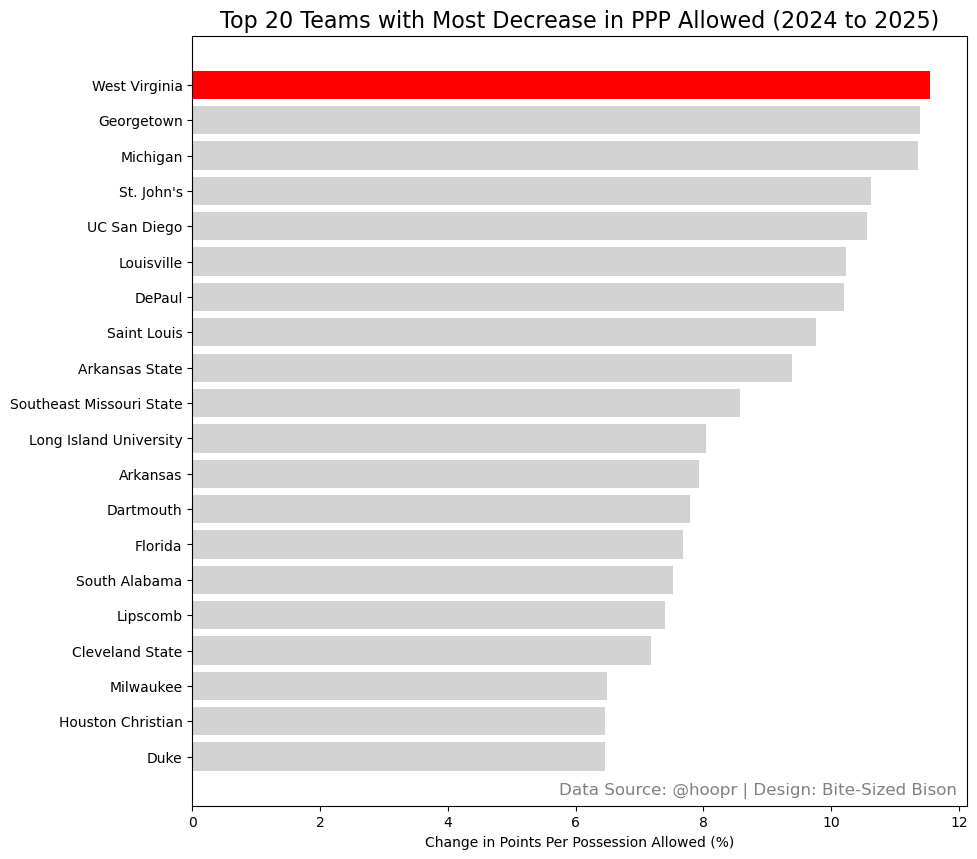
With the defensive improvement in mind, this 2025 season could have reached quite a height for West Virginia, if it hadn’t lost its top two scorers. Tucker DeVries ranked 10th in the nation at Drake last season, with his 21.6 points per game, and Jayden Stone – formerly of Detroit Mercy – ranked 22nd last season with 20.8 points per game. Both were top-10 scorers returning to the game this season. Stone was injured just weeks before the 2025 season began, and, as noted previously, DeVries was only available for eight games before also being sidelined by injury.
Some Hallmarks of a DeVries program
We’ve already touched on efficiency and defense, which cannot be excluded when considering what a DeVries team looks like, but for more on those two ideas and the granular concepts that make them happen, I’d direct you to Tony Adragna’s film breakdown linked above.
Here are some others.
Shooters are a must
Indiana fans have starved for efficient shooting since the Tom Crean Era. Since 2017, there has been just one season (2023) when Indiana ranked inside the top-200 in three-point percentage.
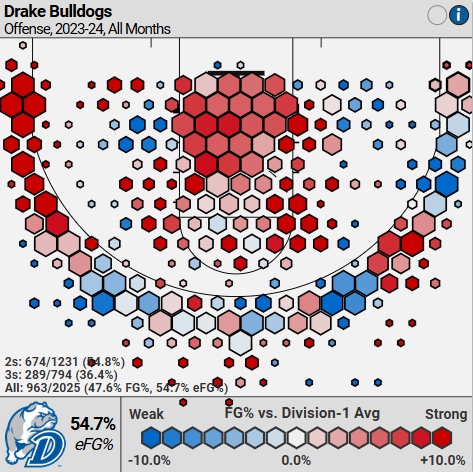
Those days seem to be passed. DeVries programs are typically in the top-100 in three-point percentage, and as noted previously, many of his sets create opportunities from outside the arc. West Virginia did not shoot efficiently from three even though it shot from deep many times, but DeVries’ last team at Drake did. This seems to be a clearer look at what the typical Darian DeVries shot chart might look like. Red indicates a higher percentage of shots converted, while a larger hexagon indicates the volume of shots from that area of the floor.
Source: CBB Analytics
Now, compare that shot chart with Indiana’s from the 2025 season.

Source: CBB Analytics
Of course, Tucker DeVries helps a lot in this territory, but even before Darian DeVries added his son to the offense, his 2021 Drake team ranked 57th nationally in three-point percentage (36.4%). That team featured three guys in the rotation who shot 100+ threes and ranked inside the top-500 nationally in three-point percentage. During Indiana’s best three-point shooting season since 2017 (2023), it had one player meet that criteria – Miller Kopp (142 attempts, 44.4%). Tamar Bates was very close.
Even at WVU, when the shooters weren’t as effective, the offense still leaned on three-point shooting pretty heavily, as noted above. Three players shot well above 100 threes. Point guard Javon Small attempted 235 threes!
Additionally, DeVries’ spacing on offense disincentivizes mid-range jumpers, meaning more efficient shots – compare the sizes of hexagons in the two shot charts for further evidence.
Taking shots early in the shot clock
It seems DeVries is going to have his team prepared to go into every possession peeking for opportunities at transition scores. If nothing is there, then they will fall back into their offensive sets. He noted this during his introductory press conference as a hallmark in Indiana Basketball’s style during his tenure.
This is a lot easier said than done. Below is how his teams have ranked (by percentile) in shots taken fewer than 12 seconds into the shot clock.
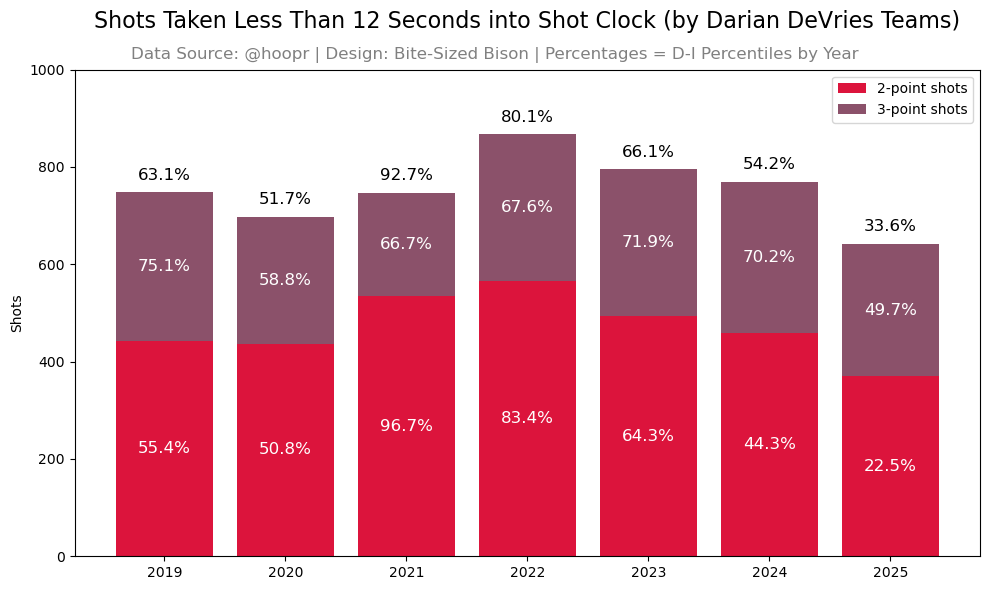
Each percentage seen in the chart above represents a percentile – whether it’s percentile of two-point shots attempted in less than 12 seconds, percentile of three-point shots attempted in less than 12 seconds, or percentile of total shots attempted in less than 12 seconds. DeVries is typically in the top-half of Division I teams in this department. Seasons 2021 and 2022 were likely his most ideal seasons for pushing the pace, and when relating this chart to the points per possession charts above, those seasons correlate with some of the best offensive basketball he’s coached to this point – important to note Tucker DeVries was not on the 2021 team.
An additional note is that his teams typically are one of the most willing teams to take threes early in shot clocks, regardless of season.

Here, we see how efficient DeVries teams are when shooting the ball early. It peaks at 2021 and 2022, but 2023 is a significant dip, which coincides with a dip out of the top-100 in offensive efficiency for Drake.
Most DeVries teams that are efficient on offense will be taking shots early in the shot clock, to reinforce what he said he anticipated during his introductory press conference.
Close victories
A data point that Scott Dolson emphasized when addressing Darian DeVries attributes that made him an attractive candidate for the job was that he’s won 65% of career games when the game is within 5 points. Using data from hoopr, BSB determined his record to be 39-23 in those scenarios. In that same span of seasons (2019-2025), Indiana was 36-28 (56%).
Between the 2020 and 2021 seasons, DeVries even won 12 consecutive games like this. In 2025, with West Virginia, DeVries defeated Kansas, Utah, and Cincinnati in these scenarios – WVU beat Arizona and Gonzaga by a combined 15 points, both in overtime, so those are omitted.
These types of games are significant. For example, in 2023 and 2024, Drake played nine and eight 5-point games, respectively. The Bulldogs went 5-4 in 2023 and 5-3 in 2024 on their way to 27-8 and 28-7 seasons. Just this season, Indiana played five such games and won two. Beating any of Michigan, Purdue, or Maryland – the three losses – might have earned a Tournament bid.
Limiting non-steal Turnovers
To Hoosiers Connect, DeVries noted that one of his most consistent practice drills is a one-minute ball handling drill to avoid non-steal turnovers. He said he believes even with just one minute dedicated to this drill, it plants a seed in players’ minds. This seems to check out throughout his head coaching tenure.
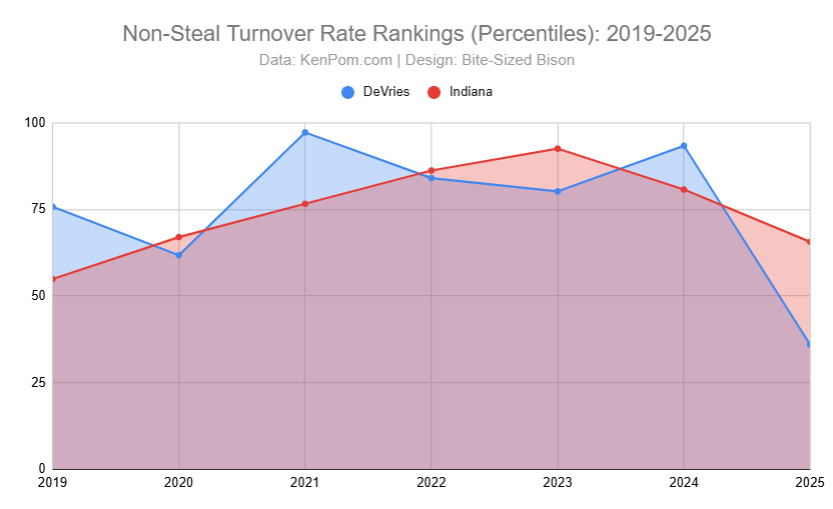
Indiana hasn’t exactly struggled with non-steal turnovers since 2019, and it peaked with Jalen Hood-Schifino and Xavier Johnson at point guard in 2023. However, a baseline Darian DeVries team seems to take care of the ball a bit better.
We again see a dip due to West Virginia’s offense this season. This is undoubtedly due the team losing its two primary ball handlers so close to the beginning of the season. Even in 2019, when DeVries reshaped Drake’s roster, the non-steal turnover rate was in the top quarter of Division I programs.
We fans gotta be patient. Things are moving fast. As John Wooden taught, “Be quick but don’t hurry.”