

Peach Bowl Preview: Oregon
Prepare for Indiana's Peach Bowl (!) matchup against the Oregon Ducks with a look at what BSB is watching for!


There is a real chance that whoever wins the Peach Bowl, between Indiana and Oregon, will go on to win the National Championship. SP+ projects that there is a 67.5% chance that either of these teams win the title, with Indiana being the favorite (40.8%).
And to make matters more difficult, these two teams played each other once before – back in Week 7 in Eugene. The Hoosiers won 30-20, thanks to a 12-play, 75-yard fourth-quarter drive by Indiana that was capped by a red zone TD pass from Fernando Mendoza to Elijah Sarratt.
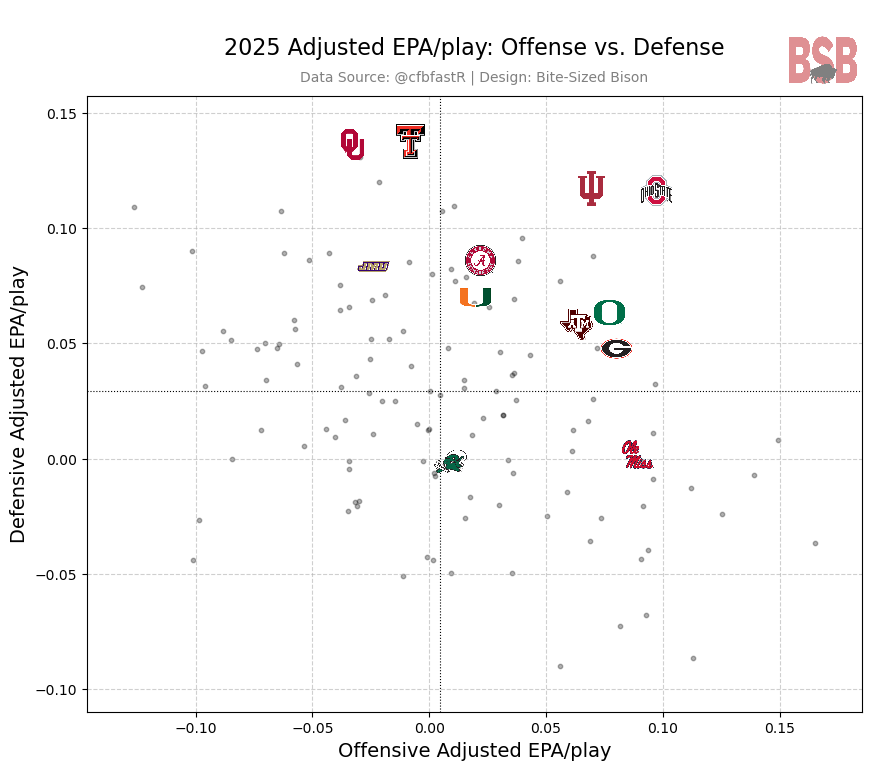
Oregon enters this game coming off of one of its better defensive performances, shutting out Texas Tech in the CFP Quarterfinal. While that is certainly an impressive feat, BSB readers know that Texas Tech’s offense was not as strong as its 7th-ranked points/game figure (39.4) might suggest. Not only does Texas Tech rank 41st in offensive FEI, it’s also below the median in opponent-adjusted offensive EPA/play.
The real feat for Oregon was limiting the Texas Tech defensive front to just 10 QB pressures and 2 sacks while completing 27-of-34 passes at 7.2 yards/attempt.
The Ducks rightfully didn’t take Texas Tech’s offense very seriously, as Dan Lanning elected to attempt 8 fourth-down conversions – converting just 4 of them – after going 4-of-19 on third downs. The numbers were overall somewhat ugly for Oregon, despite a 23-0 win, as it finished with a net success rate just above 5%.
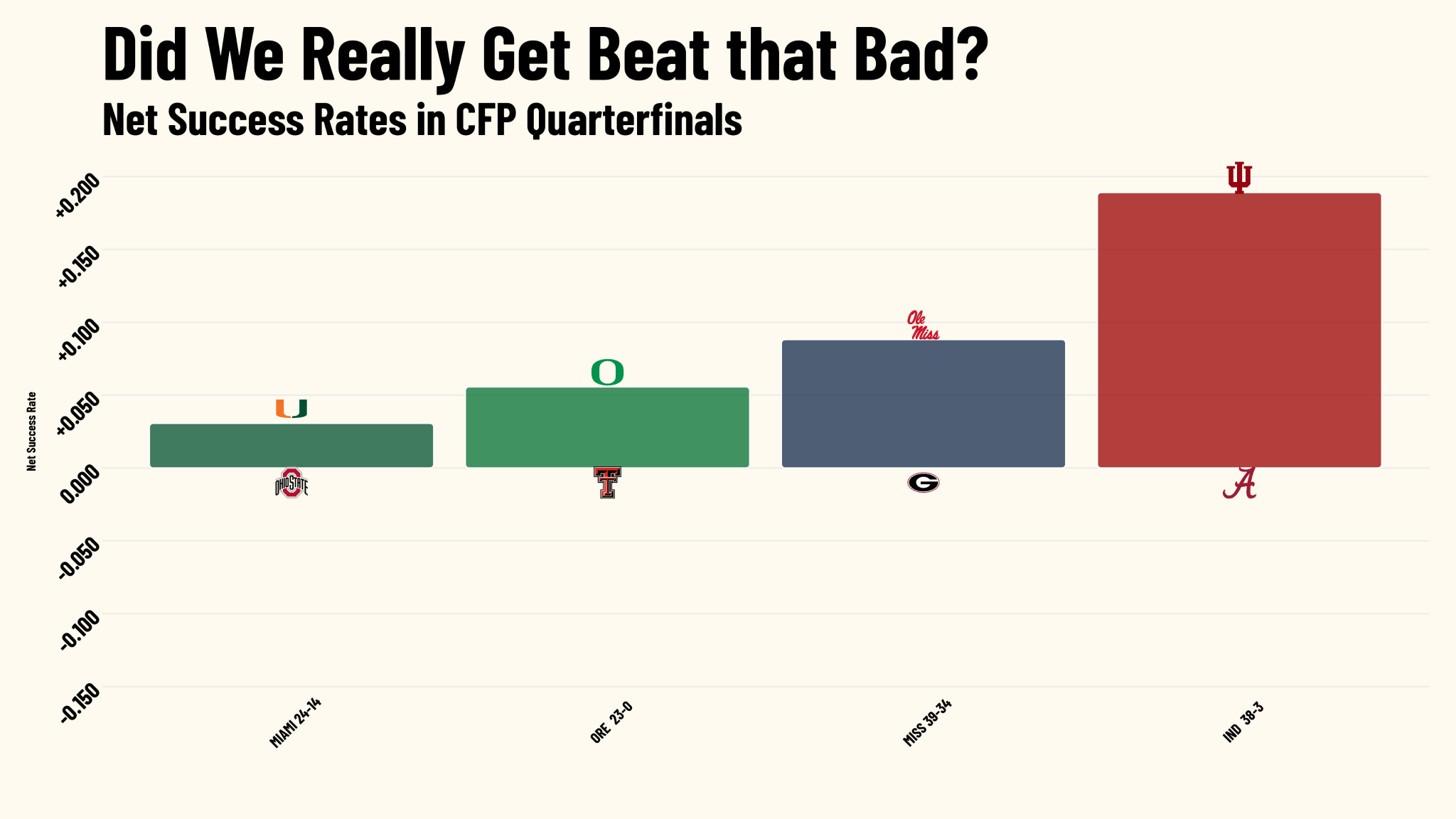
Source: Parker Fleming of CFB-graphs.com
The last time these two teams met, it was a slugfest.
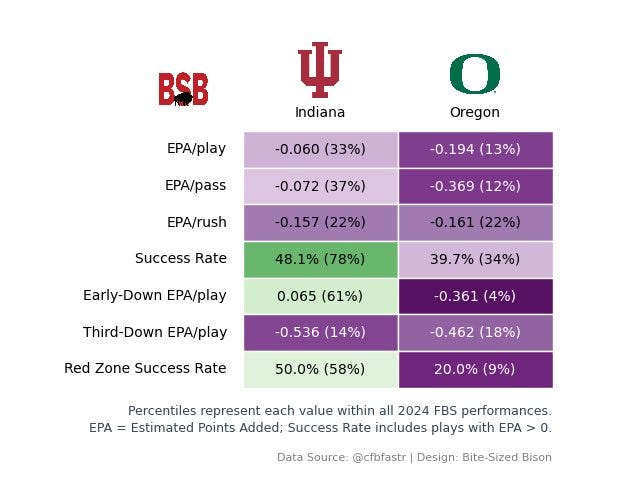
Indiana’s defense really stole the show in Eugene. Oregon scored just 13 offensive points and hadn’t seen many offensive showings that poor during the Dan Lanning Era (2022-present), really only topped by the shocking CFP matchup against Ohio State last season.
It was the third-worst per-carry performance (now the fifth-worst) since 2022:
Ohio State, 2024: -0.8 yards/rush
Texas Tech, 2025: 1.4
Utah, 2022: 2.4
Washington, 2025: 2.5
Indiana, 2025: 2.7
It was also the third-most sacks taken by an Oregon QB since 2014:
Marcus Mariota - 7 (Washington St. in 2014)
Dillon Gabriel - 7 (Ohio State in 2024)
Dante Moore - 6 (Indiana in 2025)
At the same time, Indiana’s running game struggled to get going (3.0 yards/carry) in ways that it’s overcome recently against other comparable rushing defenses, like Ohio State (3.5) and Alabama (4.3).
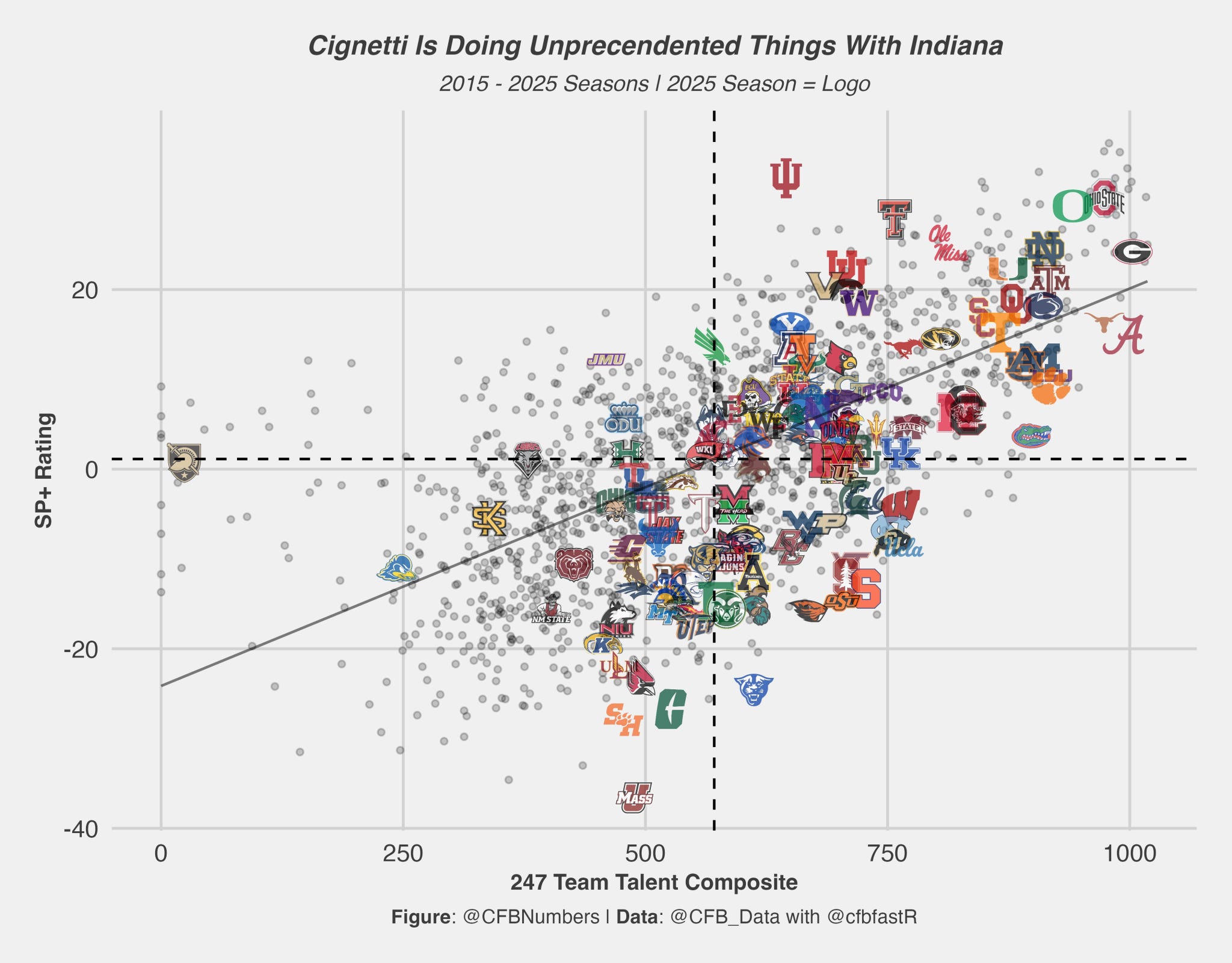
For awhile now, the expectation was that Indiana was going to meet up with a team it had already played this season – Ohio State or Oregon – and the result would be a clash of the two best teams in college football. That’s what we’re seeing Friday night. The chart below (thanks to friend of BSB, CFBNumbers) compares SP+ rating to 247Sports Team Talent Composite since 2015. As the title of the chart says, this is unprecedented territory.
Let’s get into the numbers…
Advanced Stats Preview (The Chart)
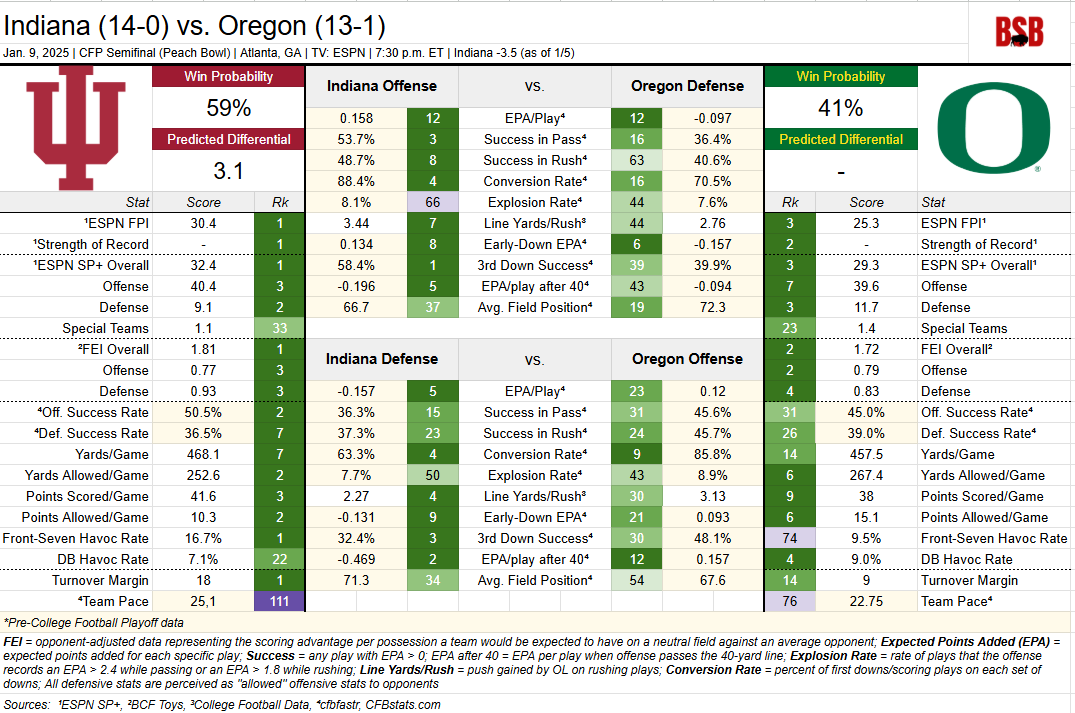
Notes:
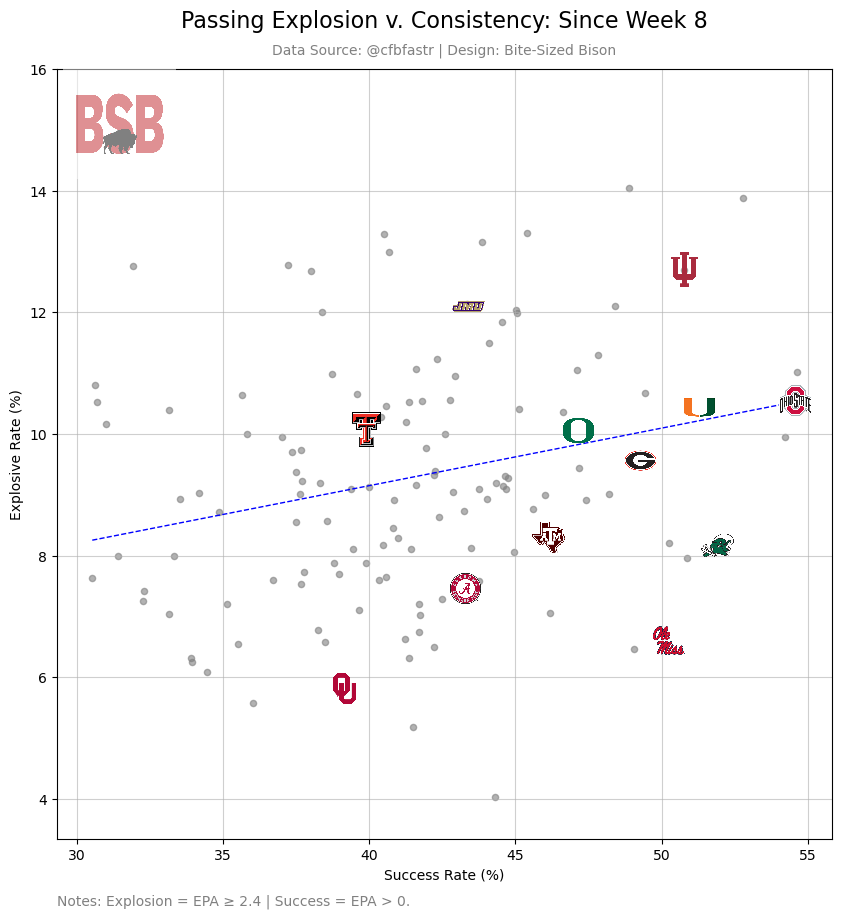
Oregon Explosion Rate Allowed: Oregon will surrender some explosion, particularly in the passing game – especially for a defense with so much athleticism and havoc in the backfield. Against passes of 20+ air yards, Oregon ranks 86th in EPA/play allowed, 95th in completion percentage (39.3%), 48th in passer rating allowed (82.4), 54th in yards/game allowed (55.6), and 12th in defensive pass interference committed (8). They’ve also never intercepted a pass of 20+ air yards. Both QBs grade top-5 nationally on throws of 20+ yards downfield, but Indiana has been as explosive as anyone in the back-half of the season.
Oregon EPA/play After the 40: In Week 7, Indiana held Oregon to two field goal attempts when it approached the red zone. It’s a big reason why Oregon had just 13 offensive points in the game. The numbers show that Oregon finds a lot of success as the field shortens, but there are holes. A massive weapon for Oregon in the red zone has been its RB Jordon Davison – at 6-feet, 236 pounds – who is tied for 13th in rushing TDs nationally but has been ruled out for the Peach Bowl. Dante Moore has actually struggled in the red zone, ranking 43rd in SIS’ points earned/play metric and owning negative EPA when passing inside the 20. As a result, Oregon ranks 47th in TD rate in the red zone. Indiana ranks No. 1 in TD rate allowed.
Oregon Rushing Success Rate Allowed: Oregon’s rushing success rate allowed may lead some to believe they aren’t good at defending the run; they are – allow just 3.3 yards/carry. They held IU to 3.0 yards/carry in Week 7. But if there was a phase that Indiana could attack, it’s Oregon’s rush defense. The Ducks rank 40th in first downs surrendered to rushing plays (94), while Indiana is 7th in first downs achieved by rushing plays (164). This could be one of those metrics that adjusts on a rematch, especially after Indiana just ran the ball on 71% of offensive snaps against Alabama – who was 26th in rushing success rate allowed – and finished in the 57th percentile in EPA/rush.
How do the star QBs perform?
While the rushing attacks will likely determine who wins this game, it was the play of Fernando Mendoza that created the separation in Week 7. Both QBs will surely be top-5 or top-10 picks in the upcoming NFL Draft, should Dante Moore choose to leave college.
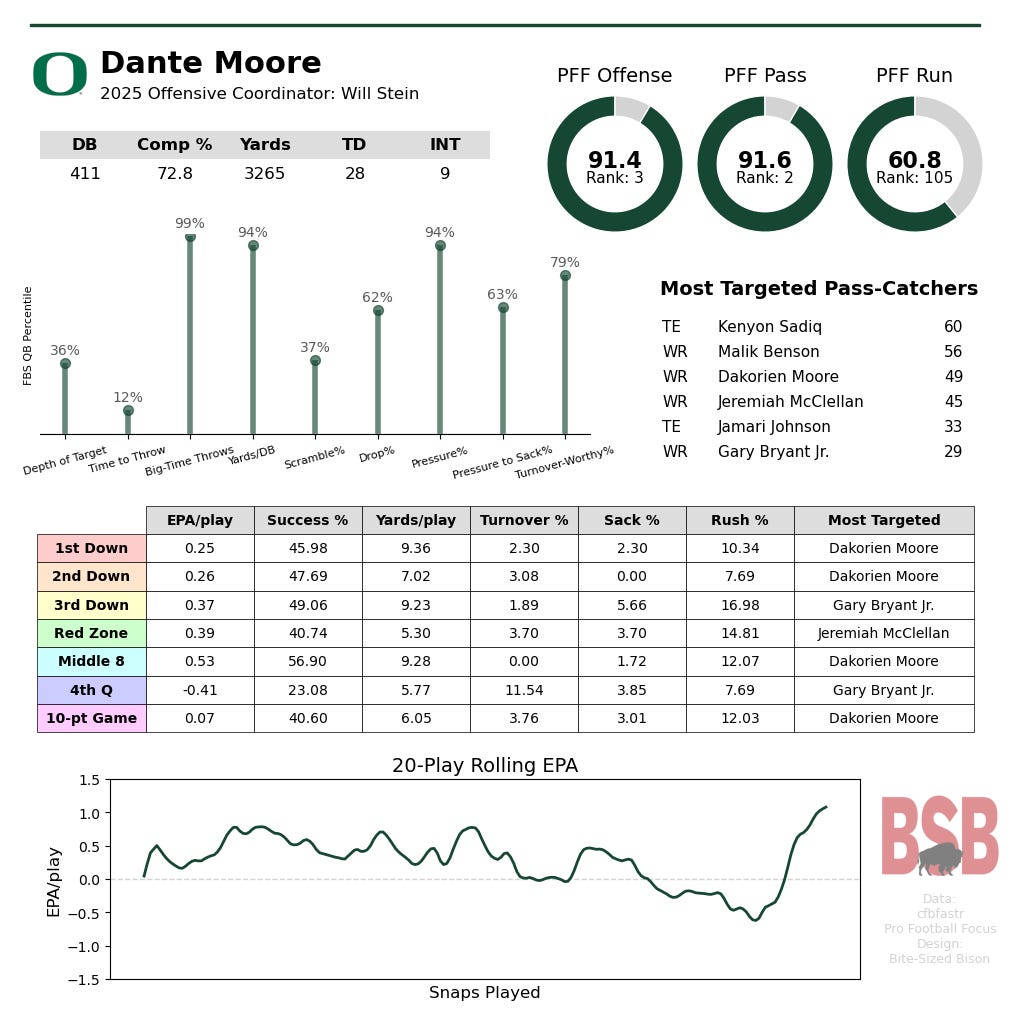
Notes:
Perhaps the stat most reiterated as these two teams rematch is that Indiana sacked Dante Moore 6 times in Week 7. You can see that he ranks in the 94th percentile among FBS QBs in pressure felt, so he stays clean, but against Indiana, he was pressured a massive 20 times. That is equal to the two next-highest pressure totals he felt all season (Penn State - 10; Texas Tech - 10). The odds that Indiana gets that type of pressure again are low, and the interior pressure surprising a young QB isn’t necessarily there anymore. However, keeping Moore as clean as possible must be priority No. 1 for the Ducks. This is a new-look defensive front for Indiana since Week 7.
One development since these teams last played is that Moore is getting the ball out much faster in the second half of the season. He was around 2.60-2.80 seconds to throw when Indiana first saw him (2.76 vs. Indiana) but is now way down to around 2.20-2.30 in the back-half. In the CFP, he’s gotten rid of the ball in 2.25 seconds on average. This has gone a long way for Oregon’s passing game.
Moore has thrown 3 INTs in the CFP, including a 0-to-1 TD-to-INT ratio against Texas Tech. He’s committed at least one turnover-worthy play in five of his last six games. Against Indiana, that can’t happen. The Hoosiers are No. 1 in the nation in turnover margin.
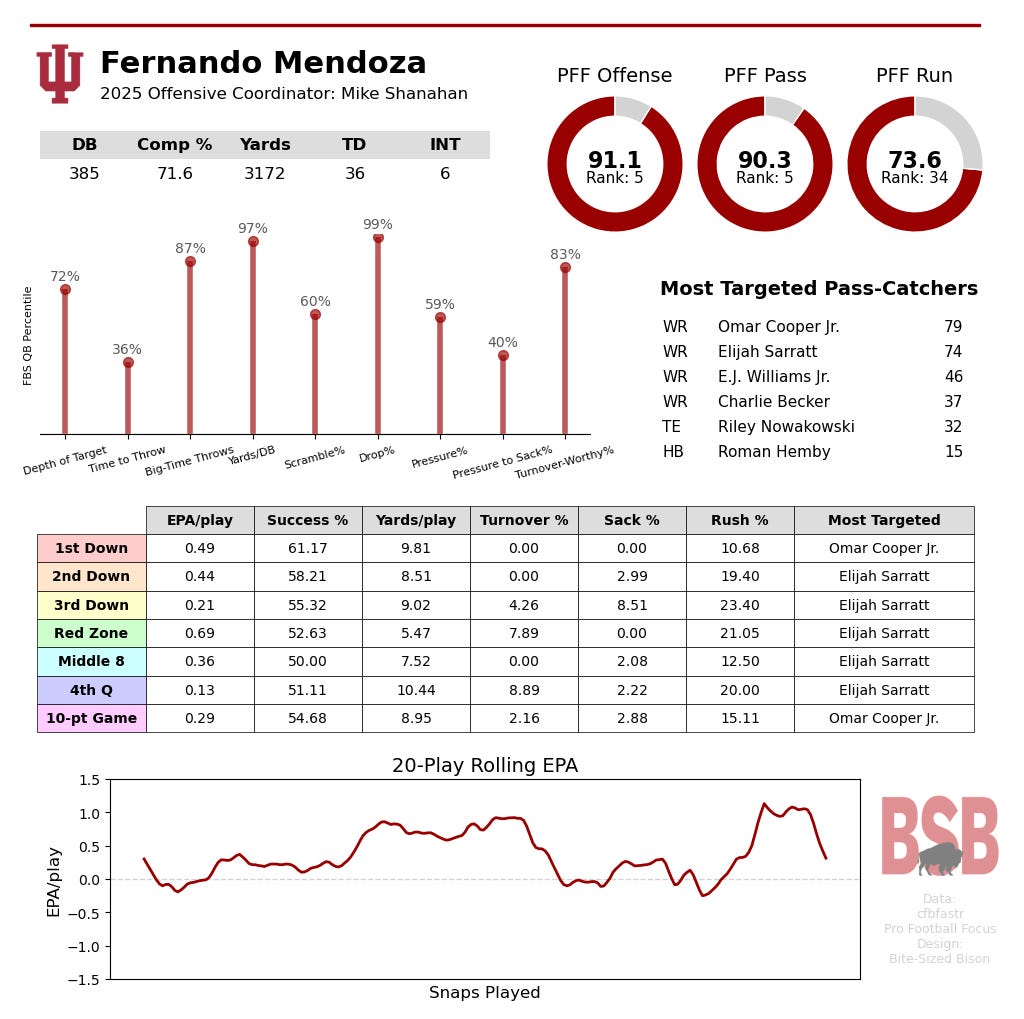
Notes:
There is little to say about Fernando Mendoza that hasn’t already been said, but something I haven’t noted about his chart yet this season is how steady he’s been on first down. He has not been sacked nor turned the ball over on first down through 14 games. For an offense that needs to stay on schedule, that is paramount from the QB.
Mendoza’s depth of target has increased over the last several weeks, during Charlie Becker’s rise. Learn more about that later in this newsletter.
Can Indiana disturb Oregon’s rushing attack again?
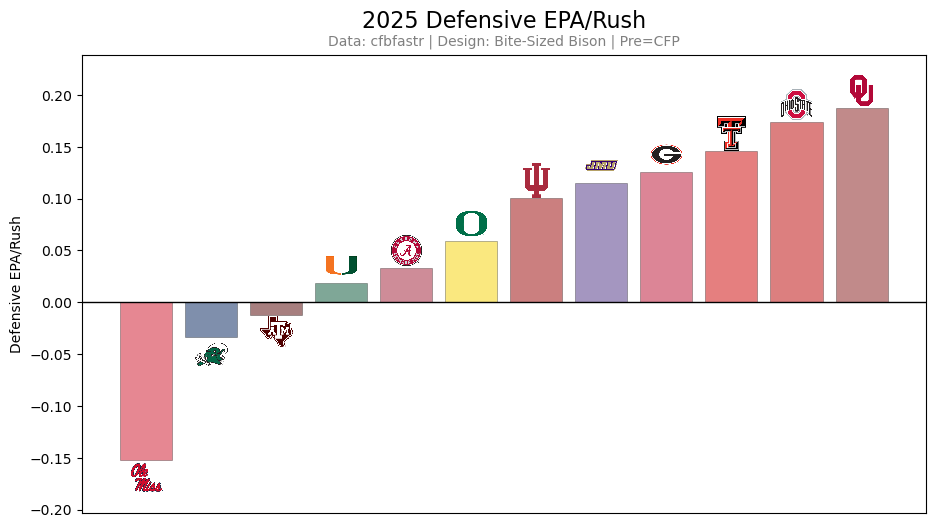
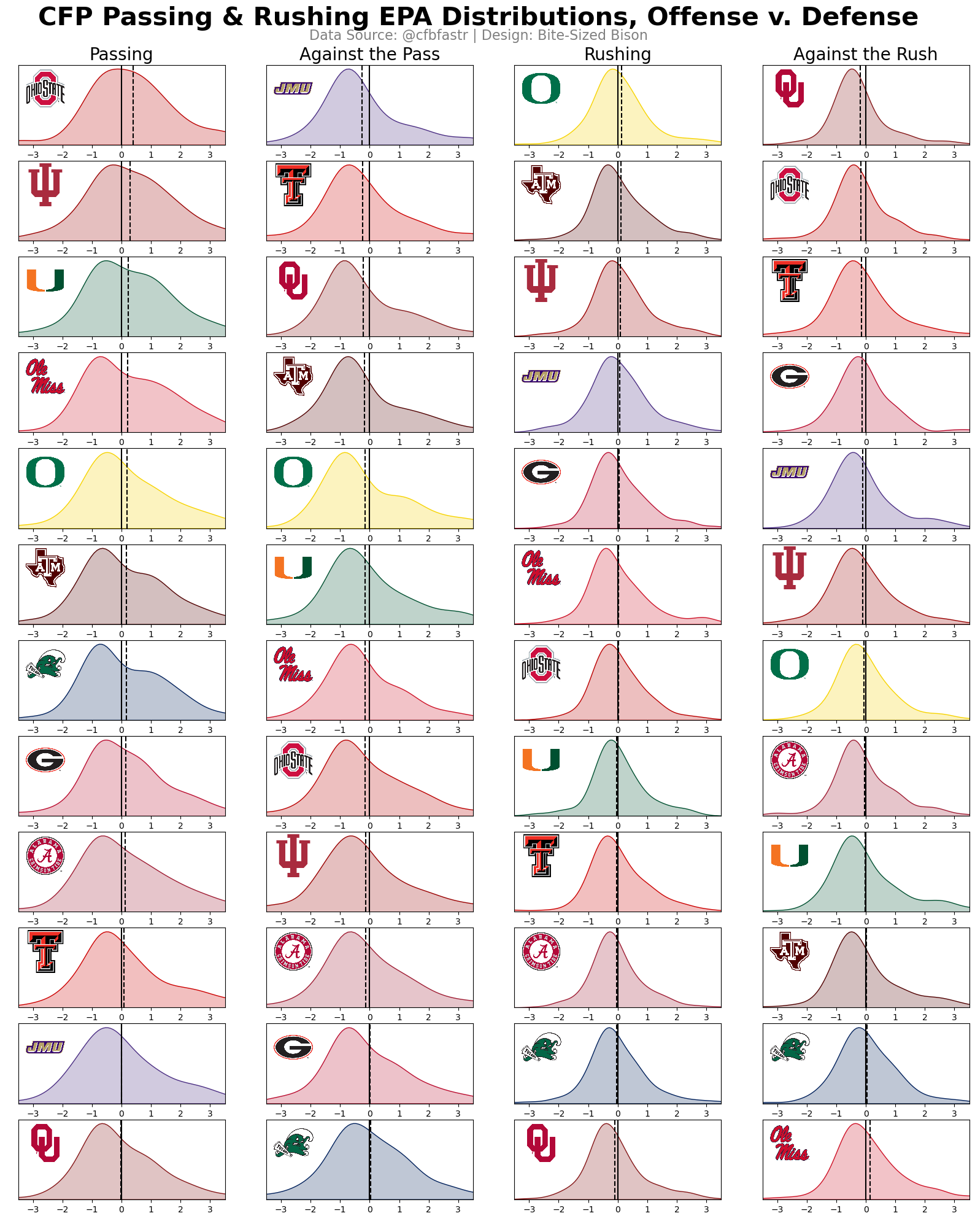
This phase of the game is massive for both teams. These are the best two offenses remaining, in terms of moving the ball and staying on schedule (see the graphic below), and the running game is central to that effort. Both teams are top-3 in the CFP field in EPA/rush.
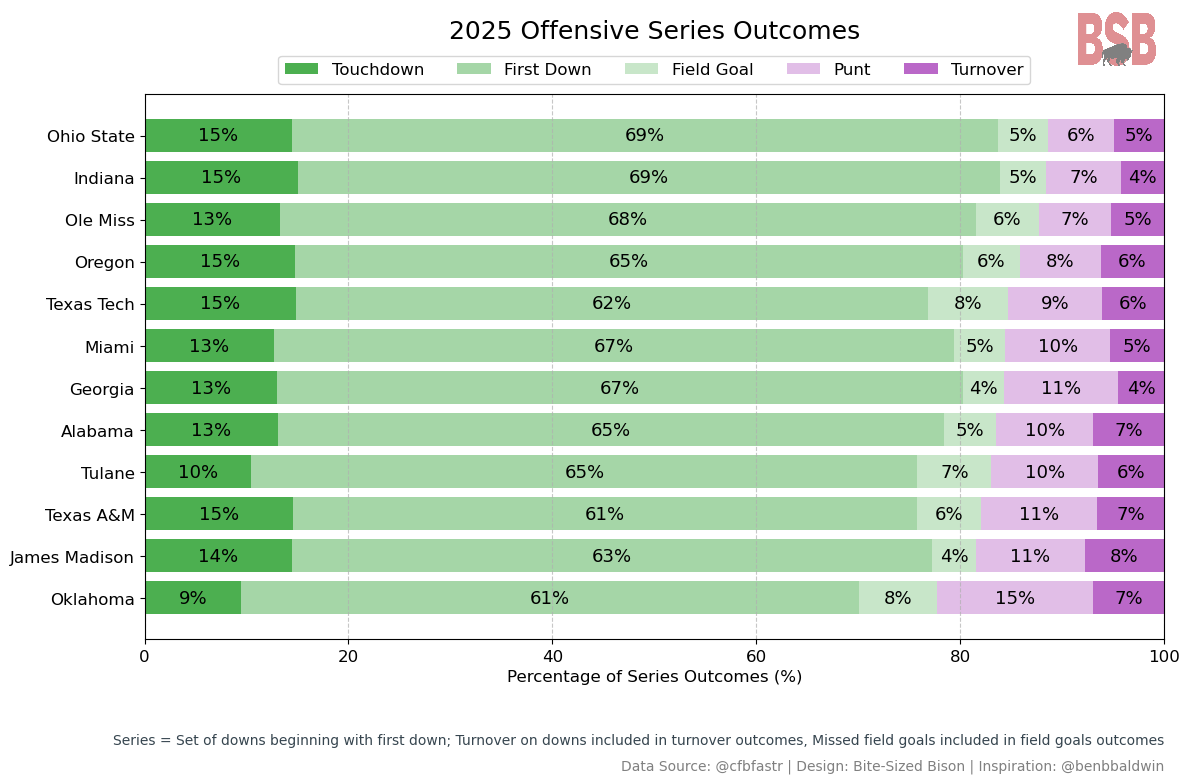
Indiana did a very effective job shutting down this aspect of Oregon’s offense in Week 7, but Oregon remains one of the better rushing teams in the country, averaging 5.5 yards/rush (11th nationally) and ranking 24th in rushing success rate.
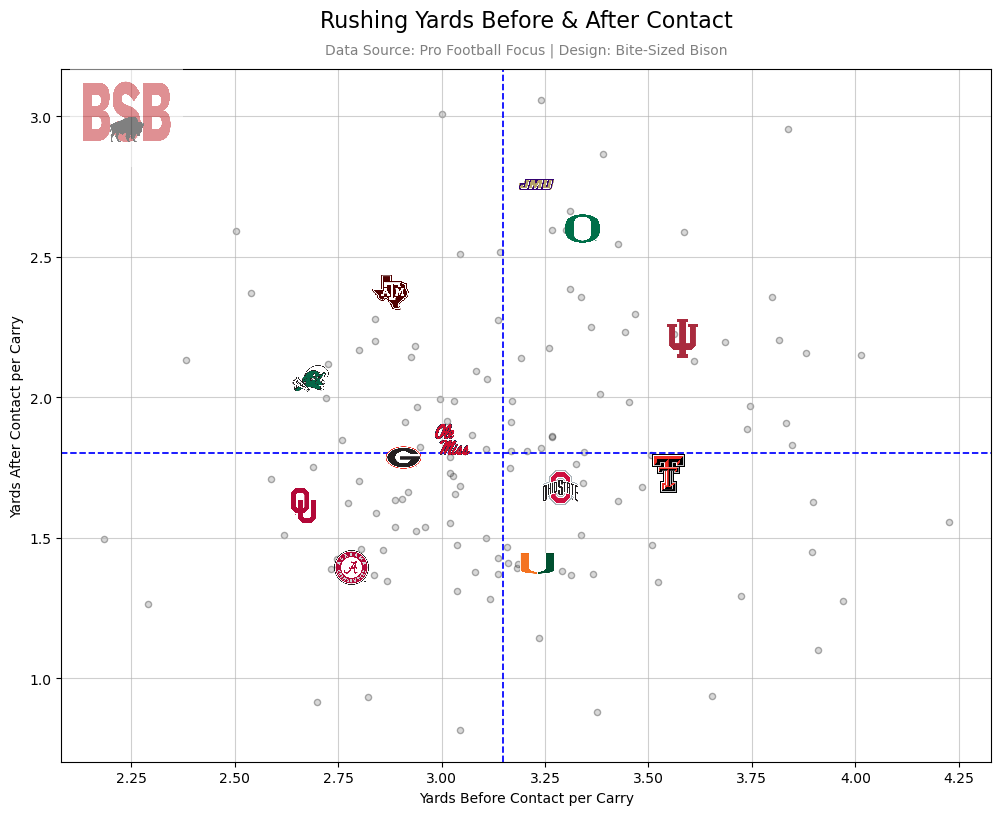
When it comes to disrupting the Oregon rushing game, there are a three questions to consider for Indiana’s defense:
How much do the losses of Jordon Davison and Jayden Limar hurt Oregon?
Can the Hoosiers keep outside zone contained?
Can Indiana limit Oregon’s rushing attack with three down linemen?
1. How much do the losses of Jordon Davison and Jayden Limar hurt Oregon?
Oregon’s backfield has finally grown into itself near the end of the season, with four solid RBs led by Jordon Davison and Noah Whittington. Davison averaged 7.4 yards/carry against Indiana in Week 7, especially after the longest rush of the day for either team (26 yards on an outside zone carry). At 6-feet, 235 pounds, Davison has unusual size and is tied for 13th nationally with 15 rushing TDs. But he’s been reported to have suffered a broken clavicle and was ruled out on the most recent availability report. On top of this, redshirt sophomore RB Jayden Limar declared for the portal (after playing in the Texas Tech game last week) and will also miss this game. Limar served as the No. 4 RB but would’ve been leaned on after Davison’s injury.
What makes this concerning for Oregon’s offense is that the Ducks run the 3rd-most 2-RB packages in the country.
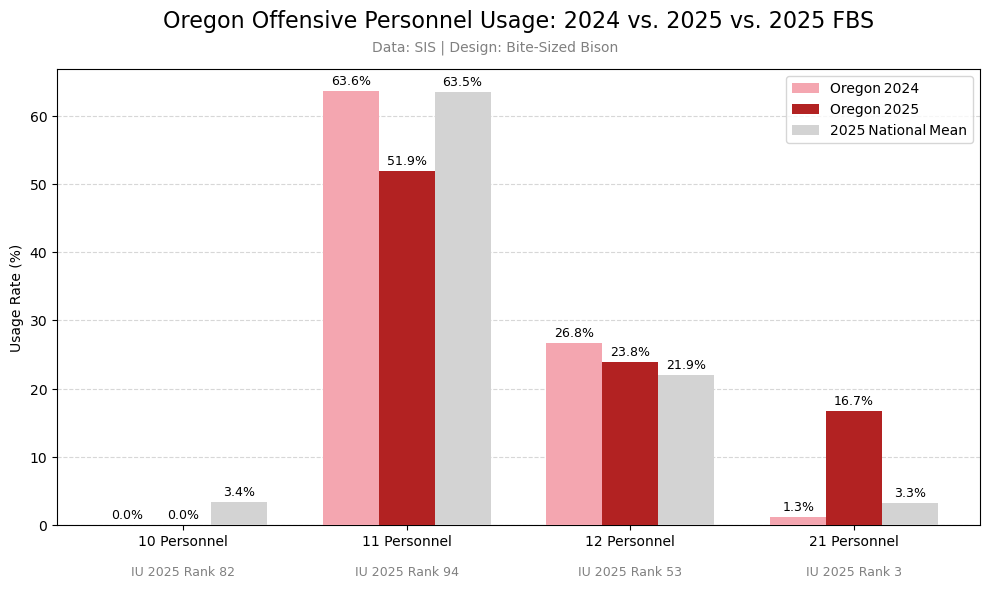
OC Will Stein – the incoming Kentucky head coach – leverages offbeat personnel packages, passing out of these 2-RB and 2-TE looks very often. It’s a trend inspired by the Sean McVays of the world, but with potentially only two RBs available – especially with Davison’s skillset missing – it limits what Stein can do with that 16.7% of the playbook. That takes some pressure off of Indiana’s LBs, who would be the target of these personnel conflicts.
Also, Davison is an elite pass-blocker out of the backfield for Oregon. He ranks No. 2 among Big Ten RBs by PFF on pass-blocking snaps, and while Whittington is top-15, Hill has played just 1 pass-blocking snap all season.
This will be a challenge for Stein’s offense, which needs an effective rushing performance to beat Indiana.
2. Can the Hoosiers keep outside zone contained?
Oregon likes to hit the edge and perimeter in the running game. It’s not its primary method of running the ball, but it does it at a very high rate and is very dangerous when it gets going on the edges. 48% of the Ducks’ designed carries go outside the outside shoulder of the tackle, and they average 6.6 yards/rush. The chart below shows that Oregon ranks in the top-40 for each of the stretch, pitch, and sweep rushing concepts, and – since stretch and outside zone are so closely related – if you combined those two concepts, Oregon uses an off-tackle zone concept on 20.6% of its rushes.
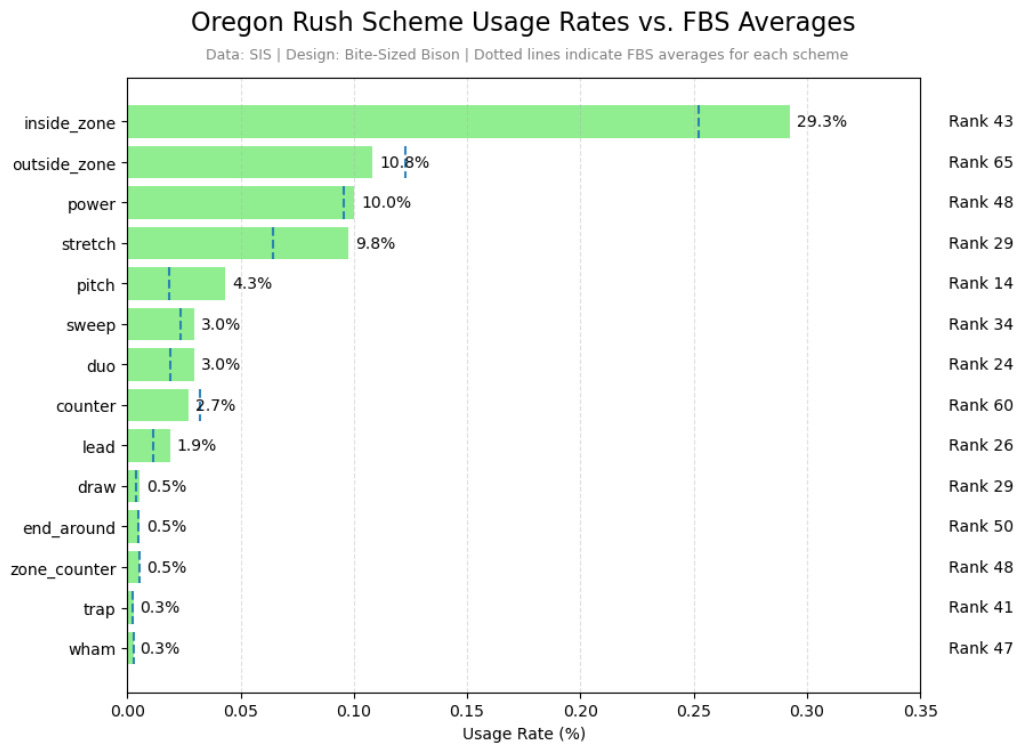
What this means is that Oregon likes to hand the ball to its RB with a horizontal focus, stretching the defense laterally, while its RB searches for opportunities to cut vertically upfield. The hope is that linebackers will over-pursue past their gap responsibilities, opening seams for RBs to cut in behind them.
This will be a strength-on-strength battle, though, because nobody in the country has been as effective against edge-focused zone-rushing concepts (roughly 28.4% of Oregon’s rushes) than Indiana. The Hoosiers allow just 2.6 yards/carry (3rd nationally) against outside zone concepts, with the highest stuff rate and the most TFLs. But Oregon is a top-20 rushing offense within these concepts, and, while the Ducks only recorded 81 total rushing yards against Indiana earlier this season, they averaged 5.9 yards/rush in outside zone against the Hoosiers, accounting for 41 of their yards on the ground.
The reason Indiana has success against outside zone rushing concepts is because its defense is designed to attack inside-out, from the interior DL toward the edges. Outside zone and stretch concepts seek to allow over-pursuit from over-aggressive fronts, but Indiana isn’t necessarily attacking from the edges, so it can muddy the angles while squeezing the ball carrier toward the boundary.
3. Can Indiana limit Oregon’s rushing attack with three down linemen?
With both Kellan Wyatt and Stephen Daley out for the CFP – both played against Oregon in the first matchup – Bryant Haines went with a primarily 3-DL look against Alabama, particularly on early downs. It typically featured Mikail Kamara at DE on the outside of the tackle (position 5 in the graphic below), Tyrique Tucker at nose tackle above the center (0), and Mario Landino just inside the tackle (4i) on the opposite end. Daniel Ndukwe played just 23 of Indiana’s 50 defensive snaps as the edge presence making up for the losses of Wyatt and Daley.
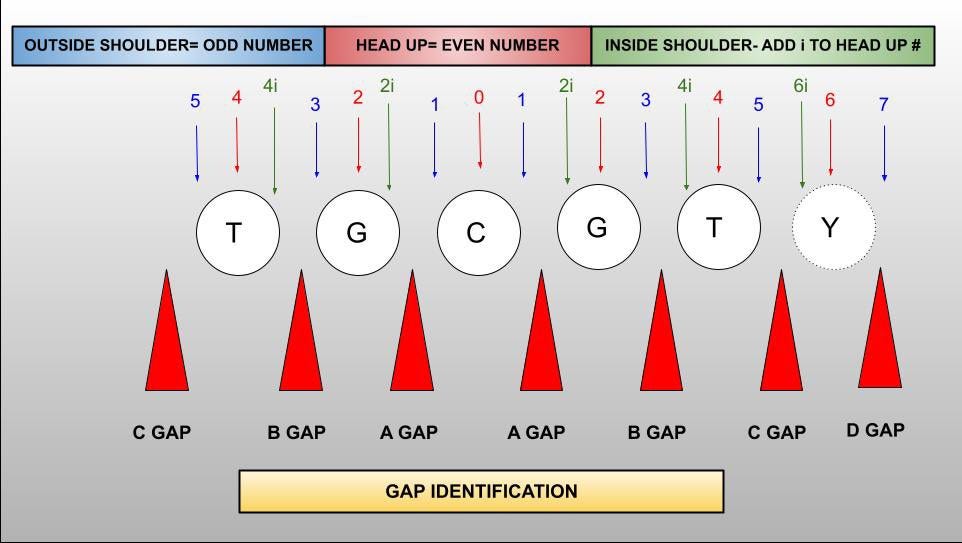
Oregon is generally good when running against fronts with three defensive linemen – averaging 5.8 yards/carry (7th nationally) and ranking 20th in EPA/carry – but it varies by opponent. While James Madison, USC, and Minnesota went to 3-DL looks frequently in recent Oregon matchups and didn’t fare well, Texas Tech – a much more comparable DL to Indiana’s (see the graphic below) – used 3-DL sets 17 times and held the Ducks to just 2.4 yards/carry and a negative EPA/play. The Red Raiders limited Oregon to 1.4 yards/rush in total last week. It was Oregon’s worst rushing performance since playing Indiana (2.7 yards/rush).
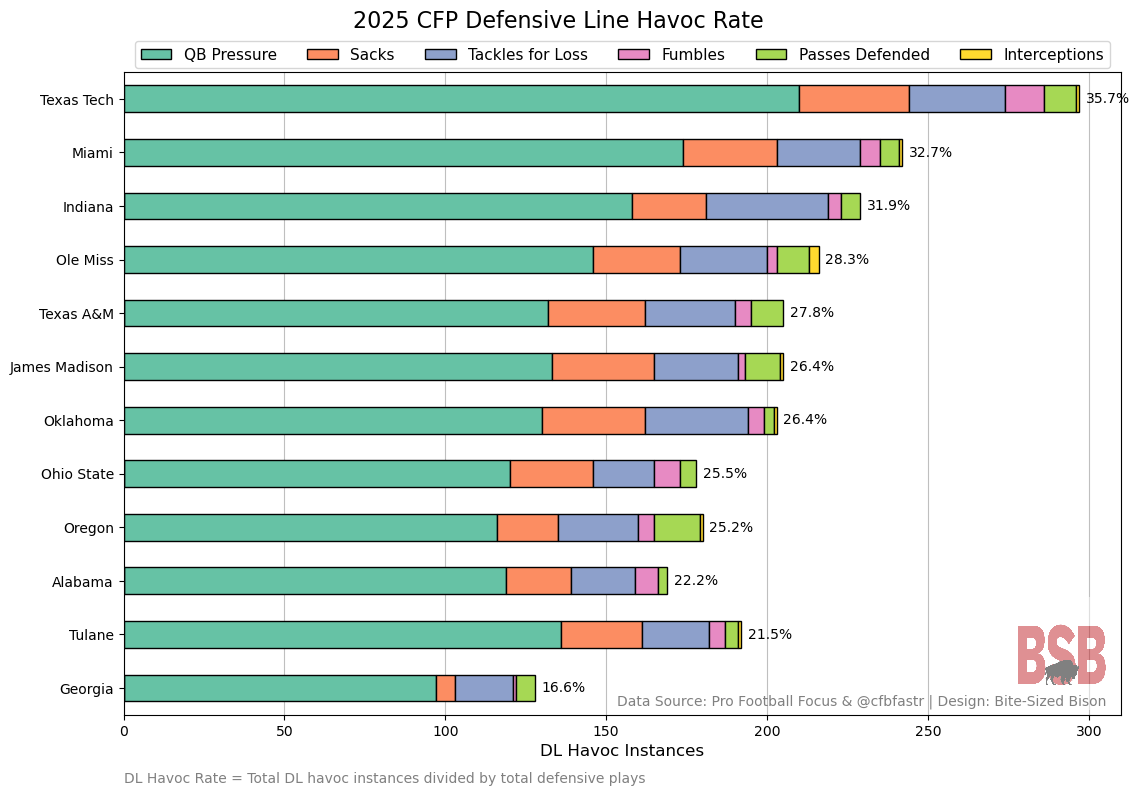
When Oregon and Indiana last played, Indiana went to 3-DL looks just 6 times, holding the Ducks to -2.0 yards/rush. Indiana’s use of three linemen will look different in this matchup, not only in frequency but also in personnel (noted near the bottom of this newsletter), so that’s one phase where these teams’ growth points will be seen.
Indiana’s linebacker play – Aiden Fisher, Rolijah Hardy, and Isaiah Jones. Those three will be challenged this week in particular by Oregon’s rushing attack, not just by the outside zone but also by the duo concept – an inside zone-adjacent concept that seeks to open gaps by getting OLs into the second level of the defense – as Oregon ranks 24th in how often it uses duo.
The new look on the front is more LB-focused but also leans into Indiana’s multiplicity and creative action on the interior DL, particularly in run defense. It further leverages simulated pressure that Haines has become notorious for scheming into his defense in unpredictable ways. But there’s also an increased emphasis on the nickelback position, with Devan Boykin. Boykin individually blew up 6 Alabama offensive plays, recorded 3.0 TFLs in run defense, blitzed twice and sacked the QB both times, and allowed just 24 yards on 5 catches. He did so by lining up nearly everywhere on the defense, including 6 snaps on the edge of the DL. Boykin will be particularly significant against an Oregon offense with so many weapons and matchup dilemmas.
How does Indiana respond to Oregon’s man-to-man coverage for a second time?
Elijah Sarratt said it earlier this week: Oregon ran man-to-man coverage schemes on roughly 70% of its coverage snaps. It’s true, Fernando Mendoza threw into man coverage 19 times in Week 7 and performed well enough – 11 completions (57.9%), 116 yards (6.1 yards/attempt), 1 TD, and 1 pick-six. It was the best passing performance against Oregon’s man coverage all season until James Madison threw for 10.2 yards/attempt in the CFP.
Oregon’ s man-to-man coverage is amongst the best in the country. The Ducks run man the 12th-most often and rank 3rd in yards/attempt allowed (4.4). Indiana has played three other teams in the top-60 for rate of man-to-man coverage – Illinois, Maryland, and Penn State – and none of them run it as often or as well as Oregon. This is what Oregon does, because it has great athletes in its defensive backfield (4th nationally in DB havoc rate), particularly true freshman CB Brandon Finney (2 INTs and a fumble recovery against Texas Tech last week and a pick-six against Indiana in Week 7).
Since the first matchup between these teams, Indiana has actually dropped back against man coverage the 13th-most times in the nation – UCLA and Penn State using it the most against IU in the regular season, but Ohio State and Alabama also hit the Hoosiers with man on 59% of Mendoza’s dropbacks. Since Week 7, Mendoza has completed 63% of his passes for 707 yards, 9 TDs, and 1 INT against man coverage. His yards/attempt (9.4) is the 15th-highest, and Indiana’s allowed pressure rate (31.7%) is the 19th-lowest.
Much of this is because of the evolution of Indiana’s passing attack since it last played Oregon. Sarratt, of course, is Indiana’s top receiving target against man coverage – 37 targets (30th nationally), 22 catches, 341 yards, 5 TDs. But true sophomore Charlie Becker’s emergence has also opened up Indiana’s attack against man-to-man schemes. Becker ranks 3rd among all FBS pass-catchers in yards per route run (4.7) against man coverage and is 2nd nationally in EPA/target against man. Within this, he’s caught an insane 10-of-12 contested targets, ranking 12th among FBS WRs in contested catch rate (83%).
Before Week 11 at Penn State, Becker had 8 career targets, all thrown in 2025, including just 1 against Oregon. In 2024, he burned his redshirt as a special teams player. Since taking on a larger role the week before Penn State, though, Becker is graded as the No. 2 WR in the FBS by PFF. In five games, he’s caught 21 of 29 targets for 399 yards, and 2 TDs.
Part of this new dimension he’s brought to Indiana’s offense is stretching the opposing defense vertically (see chart below), which Indiana struggled to do in the first half of the season. While this certainly opens space for the passing attack, such as room for YAC specialists Omar Cooper and Riley Nowakowski to work after the catch, it also increases angles for the rushing attack too, which struggled to find much against Oregon in Week 7.
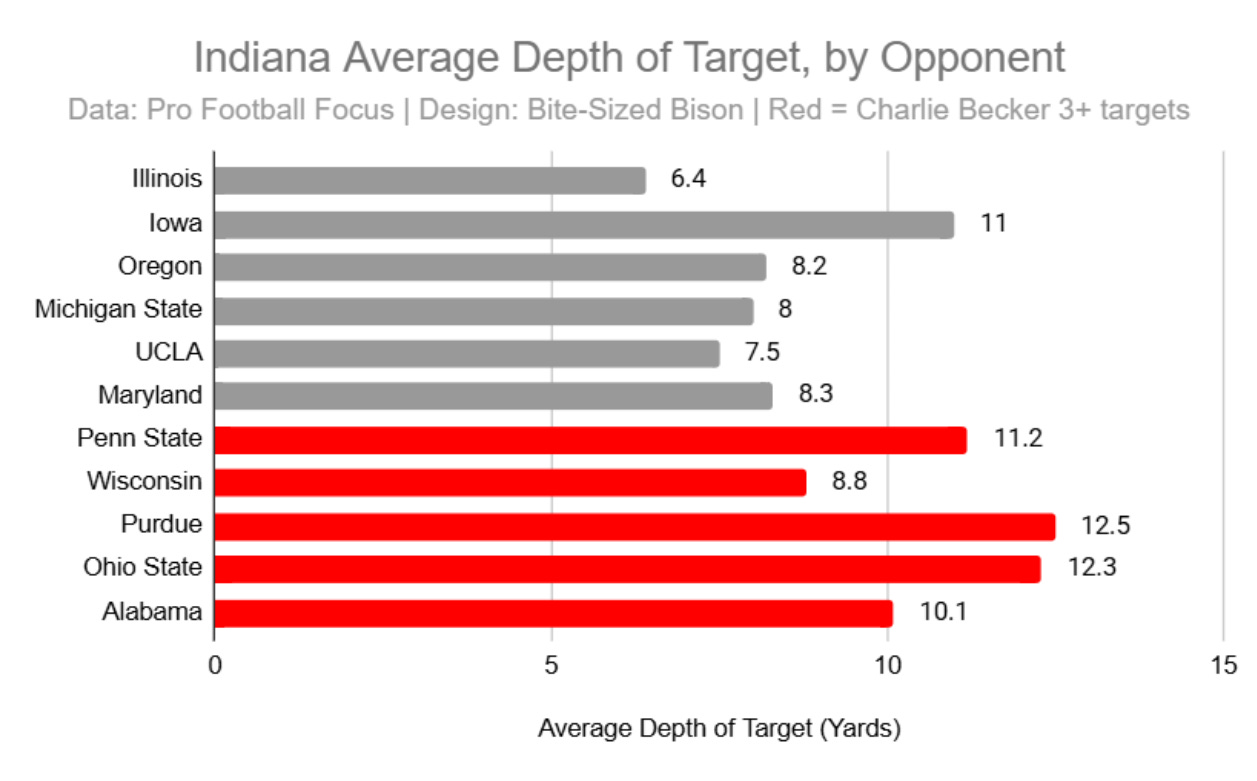
Since Becker’s breakout against Penn State, Indiana ranks 6th in yards/attempt (11.2) and 10th in success rate (52.6%) against man coverage. Yet, the Alabama game was the first game in which Sarratt, Becker, and Omar Cooper were healthy and playing together. We’re still learning what that trio looks like in tandem. Those three vs. Oregon’s DBs will be quite a showing.
How often does Oregon blitz?
Besides the blitzes Kane Wommack deployed against Indiana in the Rose Bowl, Oregon offered the most efficient blitz against Indiana in 2025, in terms of generated pressure.
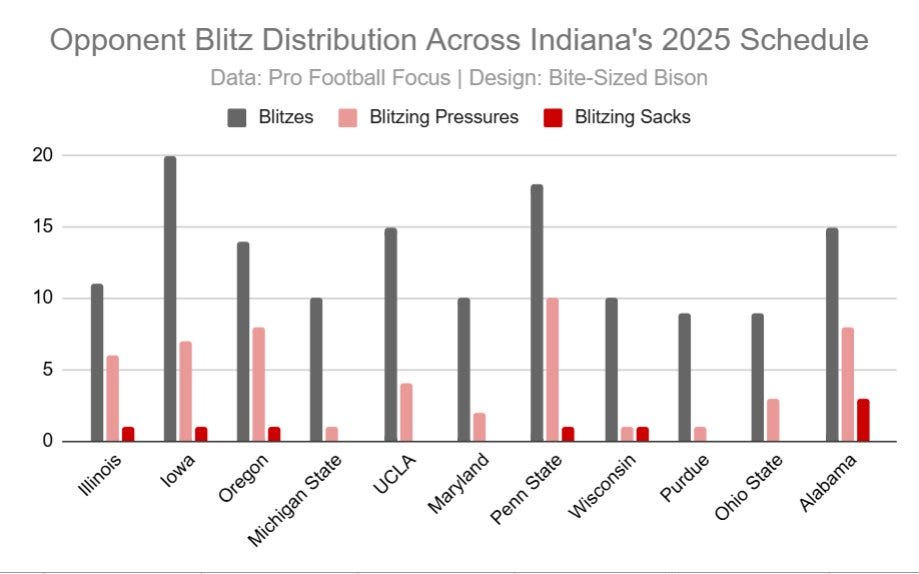
Oregon is very intentional about its blitzes, because its defense is so multiple. For example, it blitzed James Madison 19 times (!) but only blitzed Texas Tech 8 times, because Texas Tech’s offense was not good and James Madison couldn’t match the Ducks on an individual level. In total, the Ducks rank 31st in total blitzes.
This is an area where Indiana’s offense is growing. Teams are struggling to defend Indiana’s offense because it is – once again – multiple. Iowa blitzed Indiana hard in Week 5, and teams – including Oregon, relatively speaking – copied thereafter. When Alabama began the game blitzing, with serious success in Indiana’s first offensive drive, Mike Shanahan turned to RPO (13 rushing attempts), inside zone runs (15), and screens (3) to force Kane Wommack to pull back. Once Shanahan countered the blitz, Alabama struggled to find ways to meaningfully defend the pass, and when it did blitz, Mendoza went 9-for-10 for 167 yards, 3 TDs, 0 INTs, and 9 conversions. He also scrambled for 27 yards. This was very similar to how Shanahan countered the Ohio State blitz (much less pressure than Bama, to be fair).
Inside zone is a common rushing scheme to run out of RPO because inside zone is RPO-friendly. The chart below shows that in its last four games, Indiana has been running more out of RPO. Focusing on the Hoosiers postseason games, Shanahan called a new peak of RPO against Ohio State, most likely to add some misdirection to the running game against a defense that focused on maintaining structure and controlling the field. Inside zone was only run on half of the RPO carries. That was different against Alabama, which was dialing up more blitzes (as noted above). A higher proportion of the RPO calls were inside zone.
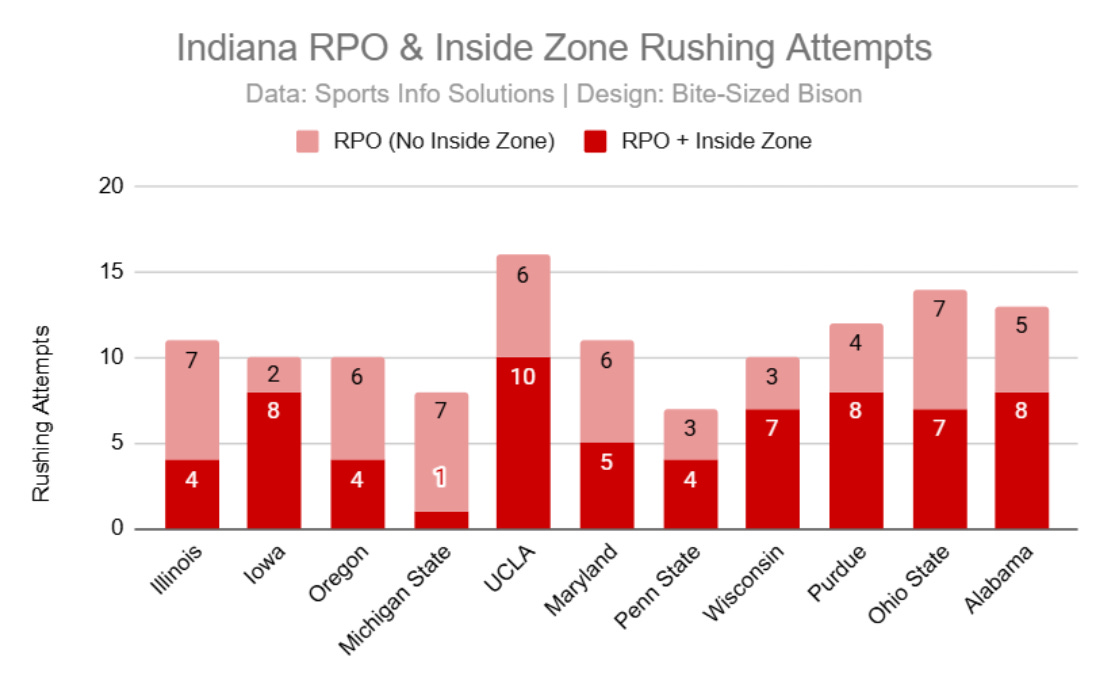
Against Oregon, it would not be surprising to see an approach more similar to the Ohio State game, where Shanahan mixed in some rushing concepts within RPO calls. This would favor some additional carries for Kaelon Black, as Roman Hemby is the zone-focused ball carrier.
Does Oregon’s more developed passing attack find increased success?
For Oregon, the passing attack has rounded into shape after a mid-season sputter, which included a passing performance against Indiana that ranked in the 12th percentile in EPA/pass. TE Jamari Johnson and WR Jeremiah McClellan have found roles in the passing offense that now owns at least six regular pass-catchers. Most notably, though, TE Kenyon Sadiq is healthier than he was in Week 7, when he caught just 2 passes for 21 yards. He, as the TE, is the biggest star in the Oregon passing game, which is different for Indiana this season.
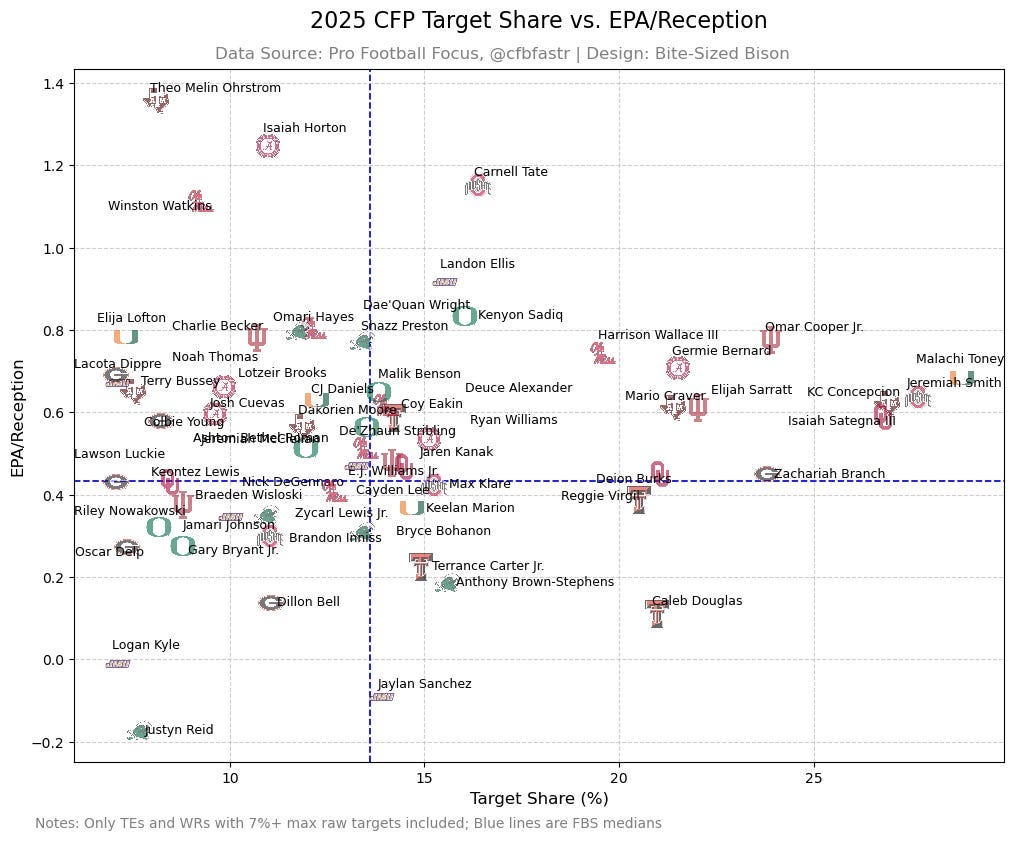
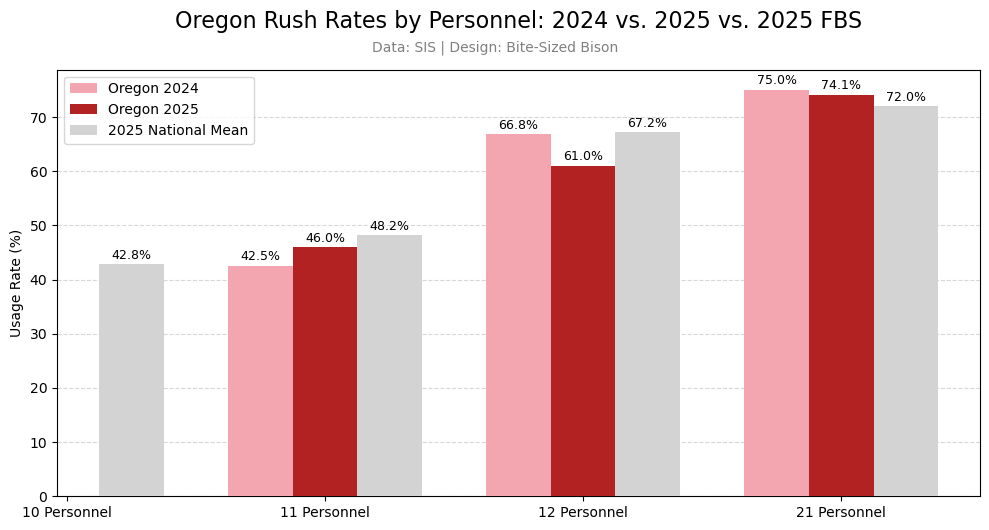
Oregon is also one of the most multiple offenses in its personnel packages. With a second TE growing into form, OC Will Stein can add more 12 personnel into the fold, which he’s done at a rate above the FBS average. But most notably, Oregon runs a ton more 21 personnel (2 RBs, 1 TE) than the FBS average. The chart below is the same one from above but is used here aagin.
This is not necessarily different than Week 7 – RBs Jordon Davison and Noah Whittington got plenty of touches in that game – but it does exacerbate the individual responsibilities on Indiana’s defense, now that several playmakers are producing. Stein really leverages setting up mismatches with his personnel packages. For example, Oregon only rushes out of its 2-TE sets 61% of the time, well below the FBS average, and, given how often Oregon runs 2-RB sets, it’s only a notch above the FBS average in rush rate out of 21 personnel. This makes life difficult for a defense, especially the LBs and SAFs.
Indiana’s 3-LB sets have developed since these teams last met, with Isaiah Jones forcing his way into a more persistent role. With Indiana lining up just three defensive linemen more often now, this opens up the opportunity to play three LBs and the Rover, Devan Boykin, who graded as the best Indiana defender against Alabama. That matches up better with the athleticism and personnel packages of the Oregon offense, so if Indiana can get pressure out of 3-DL sets, that opens up a lot for Haines. That’s easier said than done, especially after getting just 7 pressures on Ty Simpson in the Rose Bowl.
Does a revitalized Indiana OL do to Oregon what it did to Alabama?
Mike Shanahan noted going into the CFP that Indiana’s offensive line is back to near-full strength, and we saw what that means against Alabama. Redshirt freshman Adedamola Ajani stepped in for RT Kahlil Benson, and the two rotated in the second half – Ajani out-snapping Benson on pass-blocking snaps, 22-2. The Hoosiers also had 15 snaps where it used a new package of plays featuring utility OL Zen Michalski as an extra lineman. Indiana ran out of that package 13 times and passed twice.
So Indiana leveraged every lineman who saw significant snaps in 2025. It will be interesting to see if Indiana continues with this effort, and if it does, if it will work against the Oregon defense. 4.3 yards/carry was the 5th-most Alabama had surrendered all season and the most since Week 6.
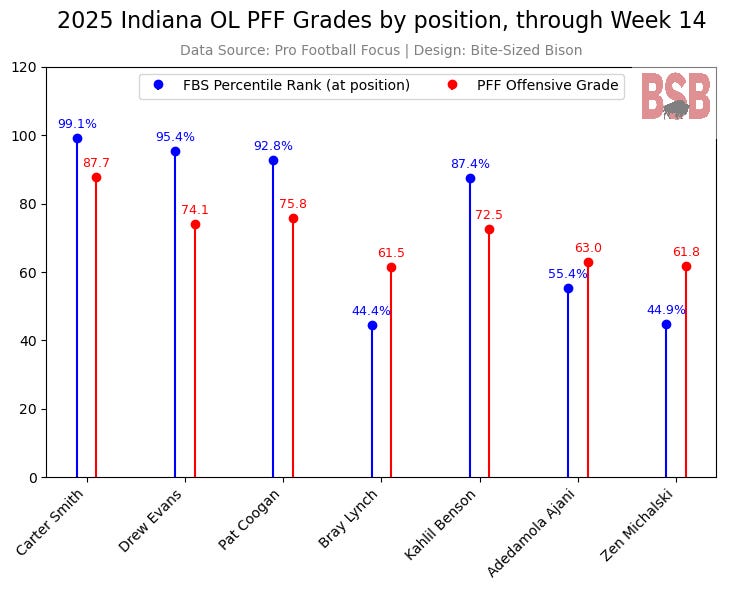
Ajani playing at RT is also notable because Benson had a rough day in pass-blocking against Oregon in Week 7, allowing 4 QB pressures and committing 2 penalties. It wouldn’t be surprising to see Ajani start there again.
Can Indiana stay clean?
Indiana remains one of the cleanest teams in the nation, in terms of mistake-free football.
The Hoosiers lead the nation in turnover margin (+18), thanks in part to losing just 8 turnovers (3rd-lowest nationally).
They have the second-fewest fumbles (6) and the fewest fumbles lost (1). They’re also tied for the 23rd-fewest INTs (7).
They lead the country in third-down conversion rate (56.5%), which has aided them to the 4th-best conversion rate. They also score on 91.2% of red zone possessions (17th nationally).
They rank 8th in net drive starting field possession, according to bcftoys.com.
They’ve had zero kicks blocked or returned for scores.
Nico Radicic owns the 10th-best field goal percentage nationally (89.5%) and still has yet to miss an extra-point attempt (145-for-145) during the Cignetti Era.
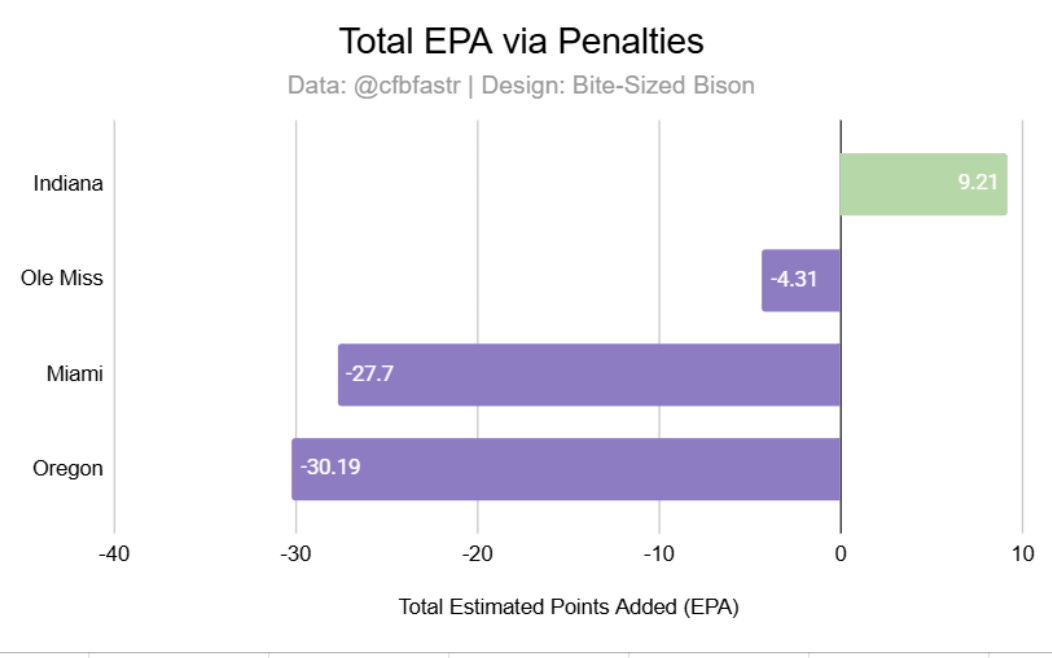
But what really pops is how Indiana has avoided costly penalties. The Hoosiers have committed just 50 penalties as a team (ranked 8th nationally), and just 11 (!) of those are defensive. Below is how the CFP Semifinal field shakes out with penalties:
Indiana: 50 for 380 yards lost
Ole Miss: 79 for 752 yards lost
Oregon: 71 for 703 yards lost
Miami: 95 for 782 yards lost
Putting the penalties into the context of games, this is how much penalties have helped or hurt each of the remaining teams this season:
One of the things that made the offensive performance the first time around especially impressive was the fact that IU had to overcome 7 (!) pre-snap penalties -- six false starts and one delay of game. I'm expecting to see that go away tomorrow.
Wasn't Mendoza sacked on the first play of the game against Alabama?