

Rose Bowl Preview: Alabama
Prepare for Indiana's Rose Bowl (!) matchup against the Alabama Crimson Tide with a look at what BSB is watching for!


The fact that Curt Cignetti’s Indiana Hoosiers are squaring up against former Tom Allen assistants — Kalen DeBoer, Kane Wommack, Nick Sheridan, and Dave Ballou — for the program’s first Rose Bowl appearance since the 1967 season is almost too poetic.
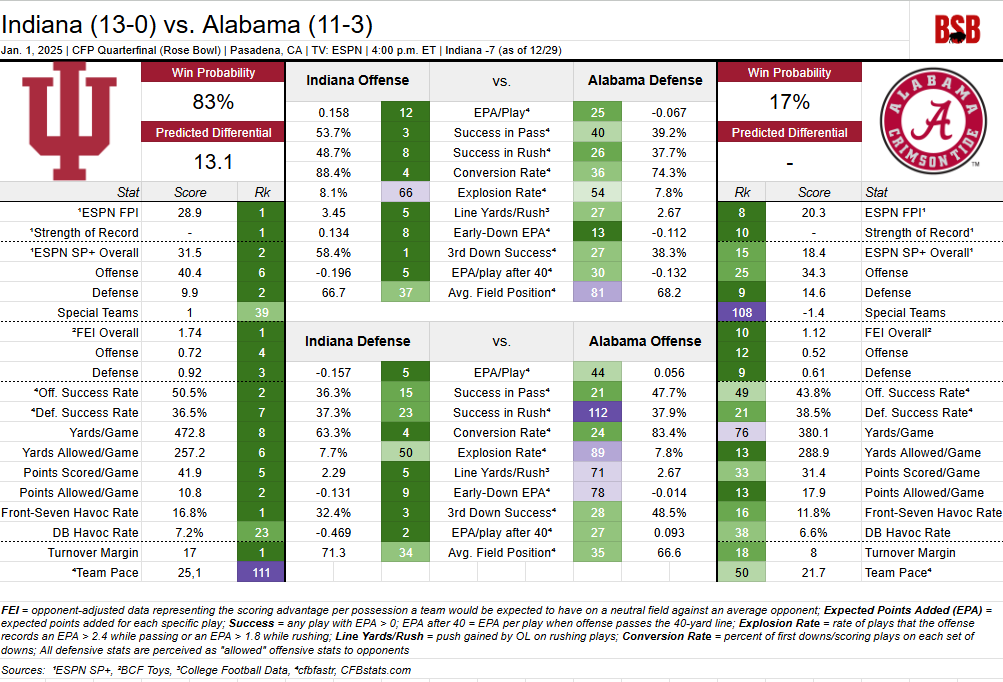
But now, a Rose Bowl appearance isn’t enough. Bite-Sized Bison’s win probability model (using SP+ data) shows an 83% chance that Indiana wins this game, with a projected scoring margin of 13.1 points in Indiana’s favor.
While SEC fans clamor to prove that a schedule ranked 19th-toughest by SP+ is astronomically easier than Alabama’s schedule, ranked 8th by SP+, Indiana’s statistical and schematic profiles line up favorably with Alabama’s. We’ll take a look at a few of those concepts below.
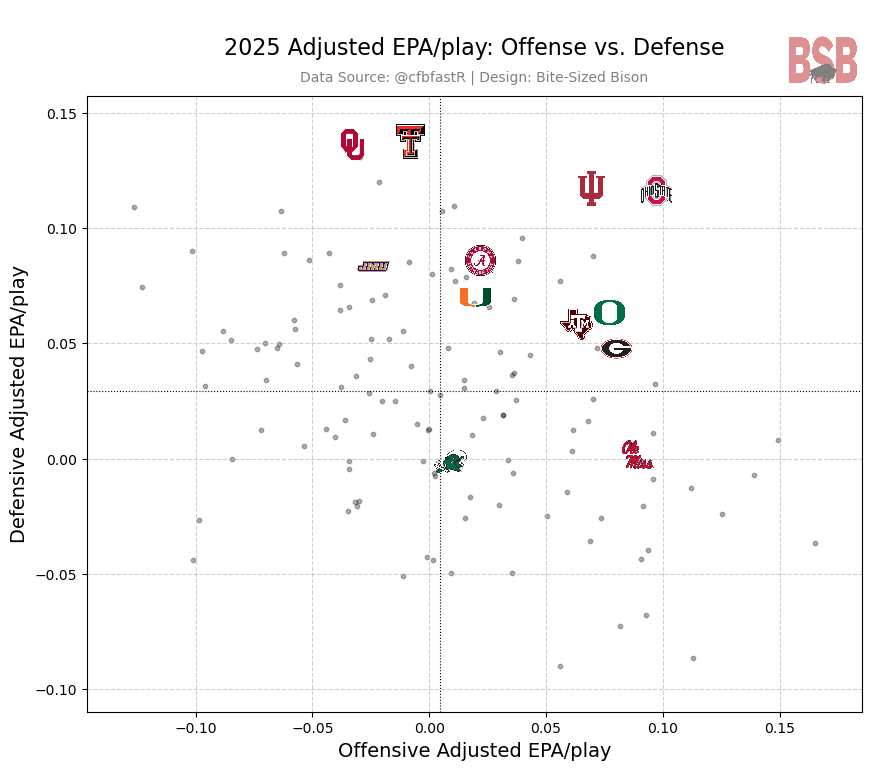
If you missed BSB’s overall College Football Playoff Preview, make sure you visit that to understand why I preferred this matchup against Alabama for Indiana over Oklahoma — as well as a look into what might lie ahead for either of these teams.
Advanced Stat Preview (The Chart)
Observations:
Explosion Rates: Kane Wommack noted that he believes explosive plays and turnovers will decide the game, and when you look at explosion rates — on either side for either team — there is a real volatile environment for explosives. Neither team has put together the best season-long explosive resume. That’s somethign to keep an eye on.
Alabama’s Defensive Early-Down EPA: Indiana is the 8th-best on early downs, meaning they stay on schedule offensively. This Alabama defense will be one of the best Indiana has seen — if not the best — at disrupting that effort. The Hoosiers could see some longer third downs.
Alabama Special Teams: Alabama has missed 7 field goals (ranking 108th in field goal percentage). It’s allowed 10 yards per punt return (97th). It’s one of 36 teams that has allowed a kickoff return TD. And it ranks 117th and 78th in average kickoff return and punt return, respectively. Indiana has a heavy advantage in this phase.
How do these teams look with some rest?
Both teams have reason to be optimistic after some rest. It will have been nearly two weeks since Alabama’s game against Oklahoma, and Indiana hasn’t played for nearly a month (Dec. 6).
For Indiana, it will have been time to get healthy for several players — RT Kahlil Benson, WR Omar Cooper, K Brendan Franke — as well as some additional rest for players like WR Elijah Sarratt and LG Drew Evans, who had just returned after recent injuries. Most notably, Mike Shanahan said this week that the OL will be back to near-full strength.
Alabama is in a similar spot, with several players needing rest, including RB Jam Miller and others, but the most notable return is DL LT Overton — a versatile DE with 6.0 TFLs and 4.0 sacks so far in 2025.
Does it rain?
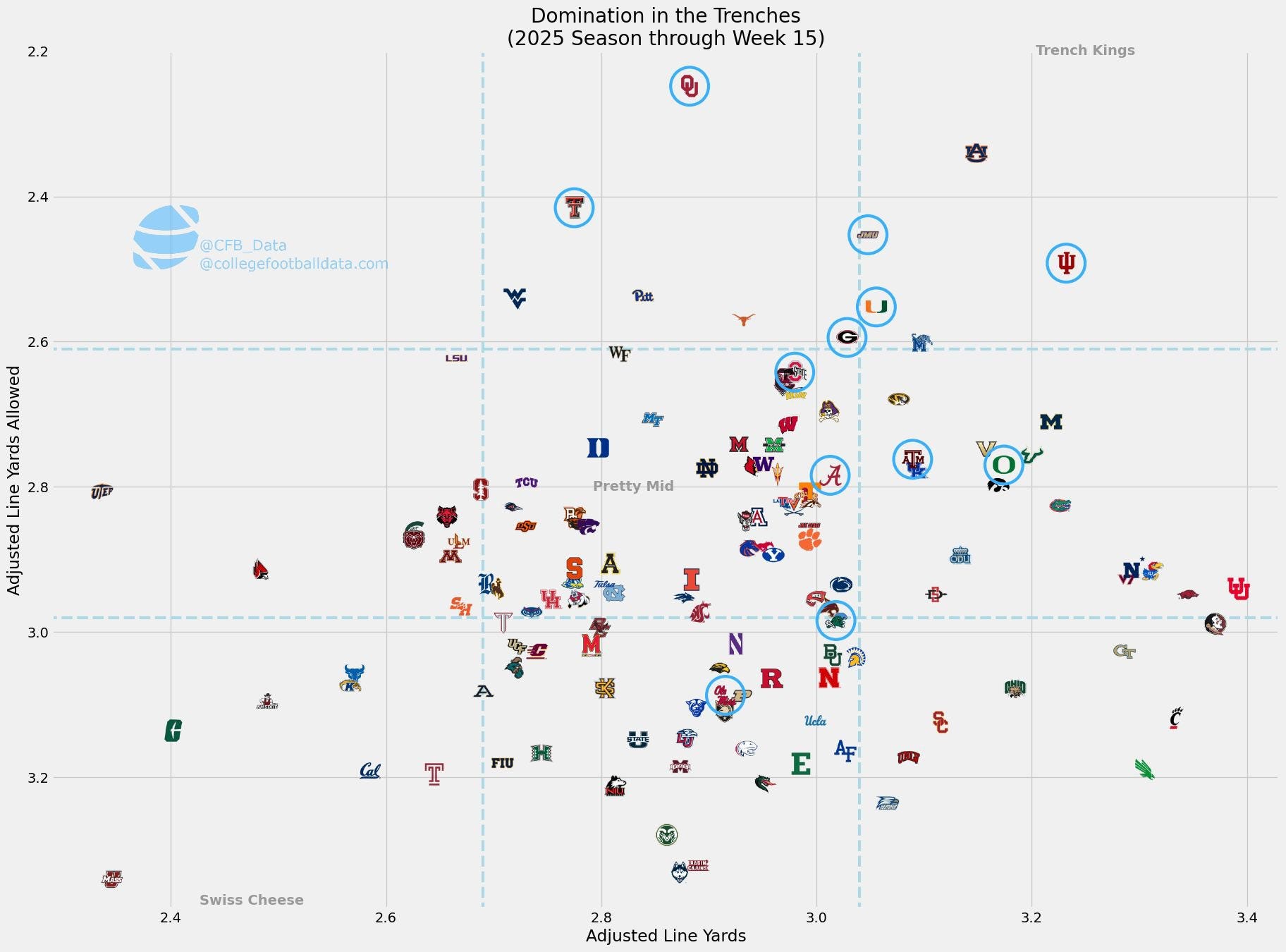
As I write this, there is a 90-100% chance of rain on game day, depending on the source, with roughly a 30-40% chance of rain during the actual game. Rain is often overrated in terms of how it influences passing attacks, as it needs to either be in high volume or paired with windy conditions and/or low temperatures to truly influence games, but if it does dampen passing games, it likely favors Indiana.
Rainy games place an increased focus on the trenches, and, unbelievably, that’s a winning formula for the Hoosiers, according to Bill Radjewski’s opponent-adjusted line yardage metrics:
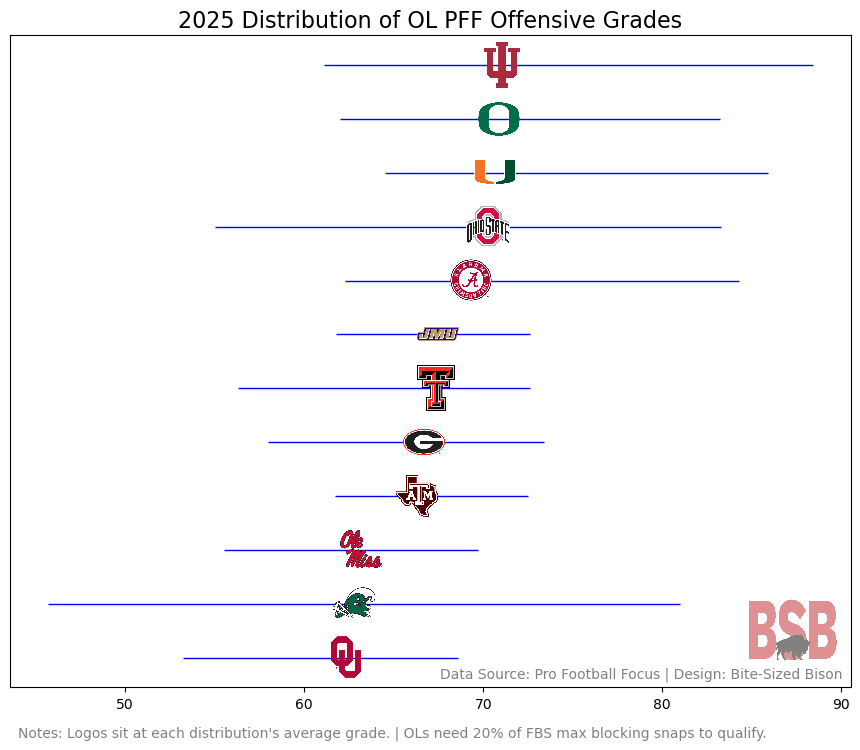
For a more subjective perspective, Indiana also leads the CFP field in PFF OL grades:
Can Indiana slow the Alabama passing attack?
Alabama really struggles to run the football. It’s ranked 112th in rushing success rate and ranks 120th in rushing yards/game (110). It’s also totaled just 25 rushing yards in its last two games.
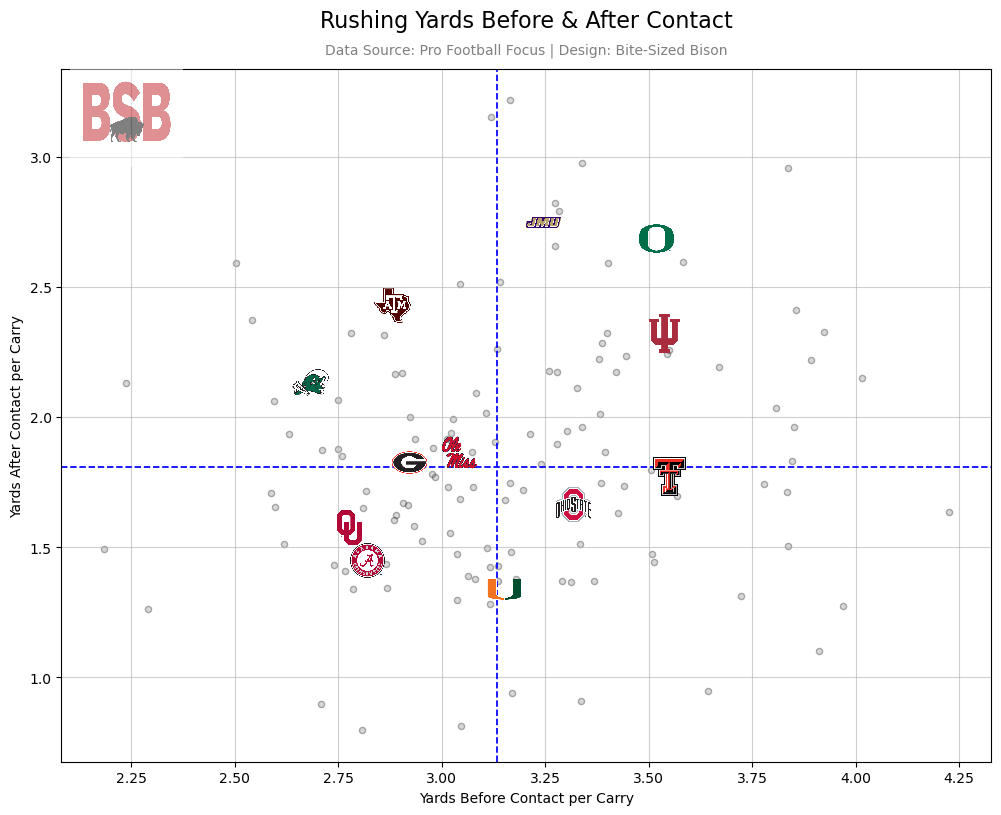
Indiana’s rushing defense fits in with the toughest rush defenses Alabama has seen this season (Oklahoma and Georgia), and in the four games Alabama played against those two teams, it amassed 1.98 yards/rush.
So Indiana will need to slow the passing attack, which is no surprise given that Kalen DeBoer is leading this offense. In 2019 at Indiana, DeBoer schemed a passing attack that ranked 13th nationally in success rate, despite a rough OL and a rushing attack that also ranked outside the top-100 in yards/game.
Before the Oklahoma game, this is how Ty Simpson and the Alabama offense profiled:
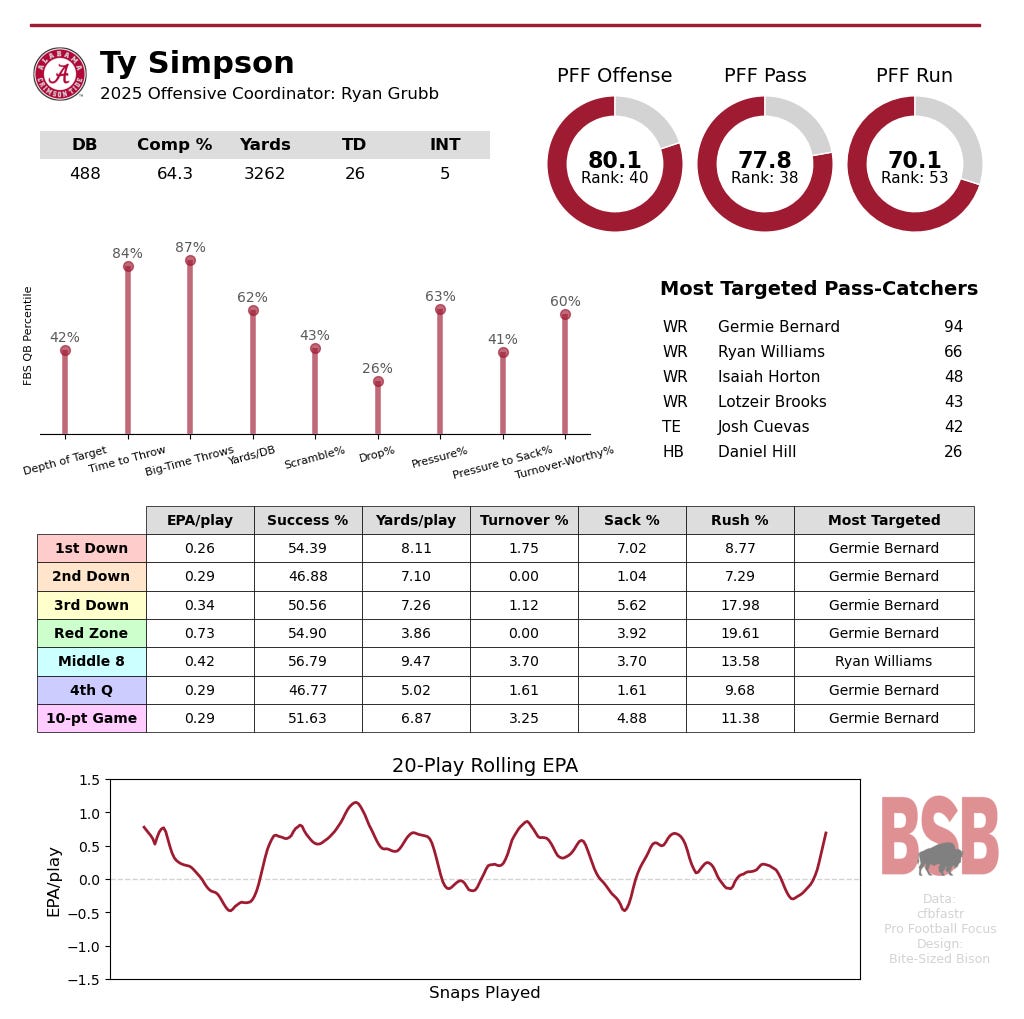
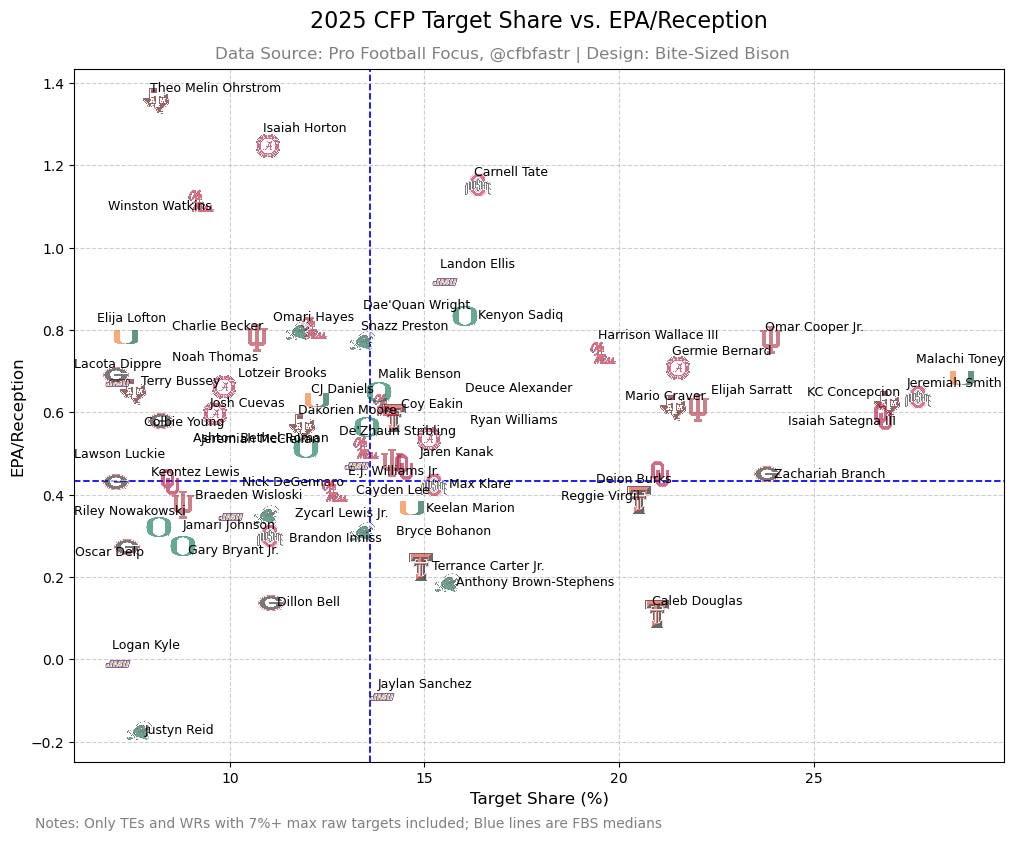
What really sets this Alabama passing attack apart from previous passing games Indiana has played, as Bryant Haines noted in his preview press conference this week, is the depth at receiver. Indiana has played some talented receiving duos — Jeremiah Smith and Carnell Tate (Ohio State), Nick Marsh and Omari Kelly (Michigan State), Trebor Pena and Devonte Ross (Penn State) — but the closest Indiana has gotten to this collection of receivers has been a beaten up Oregon receiving corps, an under-performing Illinois receiving corps, and the Ohio State receiving corps.
95% of Alabama’s personnel packages are 11 or 12 personnel, with the 40th-most 11 personnel sets, meaning DeBoer and OC Ryan Grubb really like their WRs, which round out a dynamic passing attack with their varied skillsets. The Alabama receivers shown in this chart will offer a true challenge for the Indiana defense.
The good news for Indiana is that Haines’ defense is naturally built at an advantage against this Alabama offense. The Tide rank just 92nd in Sports Info Solutions’ Points Earned/play metric against Cover 3 coverage schemes. Indiana ranks 3rd nationally in the amount of Cover 3 it runs.
Ty Simpson has also shown a tendency to struggle when pressured. Where Mendoza ranks 2nd by PFF when under pressure, Simpson is graded 45th. In his last three games, he’s been pressured 10+ times in each game, sacked a total of 10 times, and his receivers have also dropped 12 passes in that span.
Will Alabama blitz Indiana often, and, if so, how will Indiana fend it off?
Indiana fans may remember when Kane Wommack was the DC in Bloomington, particularly in 2020. He used creative disguising and blitz packages to generate lots of havoc for his safeties (shoutout Jamar Johnson). That defense ranked 13th nationally in turnovers forced and 2nd in interceptions. It was 2nd in DB havoc rate and 19th in overall havoc rate.
However, the blitzes were very selective, not the more consistent rush Indiana fans are used to seeing from Bryant Haines’ defensive-front focused attack. We’re seeing the same thing in 2025, with Wommack at Alabama. The Crimson Tide rank 123rd nationally in passing plays where it’s sent 5+ rushers. See how Alabama’s blitz rate against Power Conference opponents compares to the blitz rate Fernando Mendoza has seen against Power Conference opponents:
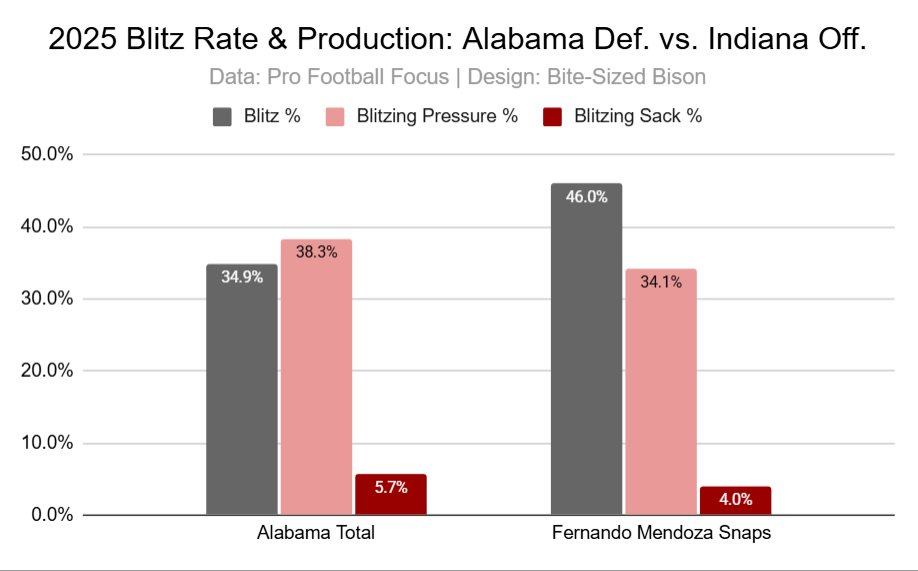
Note: Blitz Rate = Percent of dropbacks defenses blitzed; Blitzing Pressure Rate = percent of a defense’s blitzes that resulted in a QB pressure (same for Sack Rate)
Against Power Conference opponents, Fernando Mendoza has been blitzed on 46% of his dropbacks, which is the 4th-most among FBS starting QBs, but he’s graded 13th among them and has thrown 58% of his TDs against those blitzes. Mendoza also has the 10th-lowest pressure-to-sack ratio against blitzes, meaning even when he feels pressure from blitzes, he avoids sacks, which is why he’s been sacked only 5 times when blitzed. Below is how the blitzes have been distributed across the schedule:
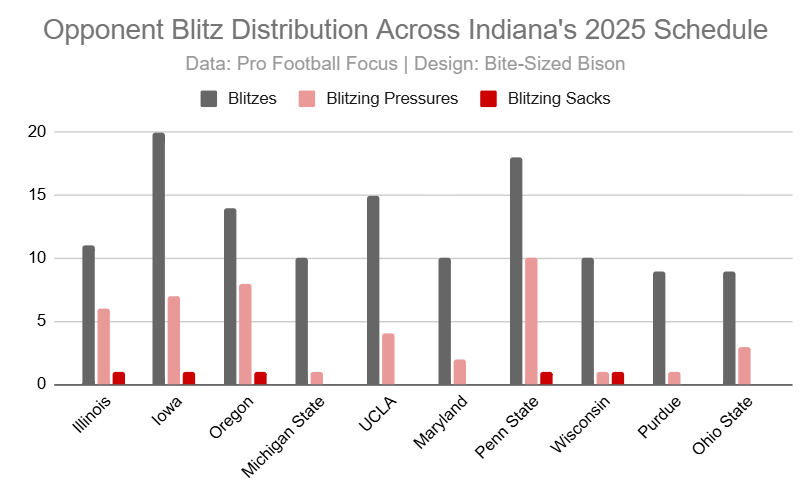
Iowa set the blueprint for Indiana’s opponents early in the season — blitzing Indiana is the best way to get it off schedule in the passing game. It blitzed IU on 67% of its dropbacks but ultimately surrendered the game-winning TD because it couldn’t match up in the secondary. Oregon (57% blitzed pressure rate), Penn State (56%), and Ohio State (33%) found the most pressure through the blitz — though PSU’s success came against an Indiana OL that was collapsing to injury.
Alabama is coming off of its best blitzing performance as a defense this season — 10 pressures (3 sacks) on 21 blitzes — albeit against a pretty dismal Oklahoma OL and offense. Wommack has dialed up 10+ blitzes in each of Alabama’s last three games, but overall, this season, the blitz hasn’t been ultra-productive for the Tide. Blitzes have only resulted in two INTs while surrendering 7.7 yards/attempt (49th-highest). But, as the chart shows below, Alabama’s LBs will need to get involved to generate any sort of pressure on Mendoza.
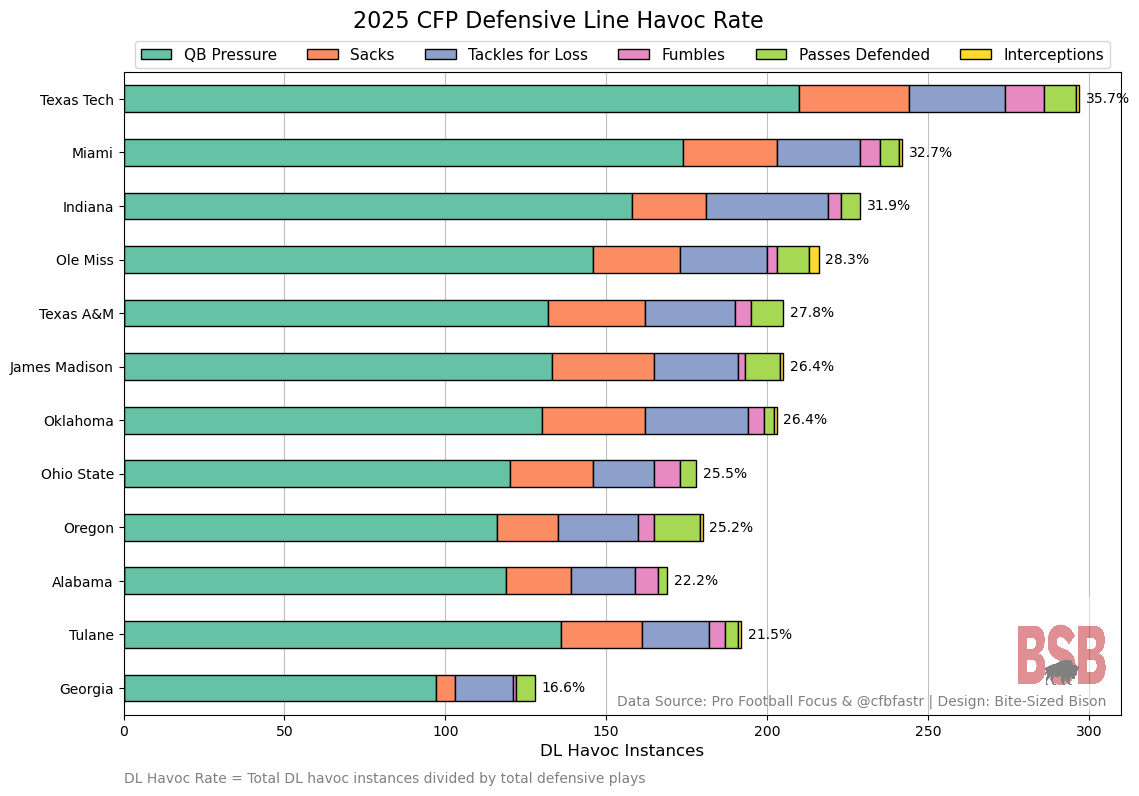
With Wommack, there will certainly be simulated pressures and timely blitzes that will get Indiana off schedule, versus generating consistent havoc throughout the game, but every blitz will be a gamble against Indiana’s passing attack.
Can Indiana achieve offensive balance?
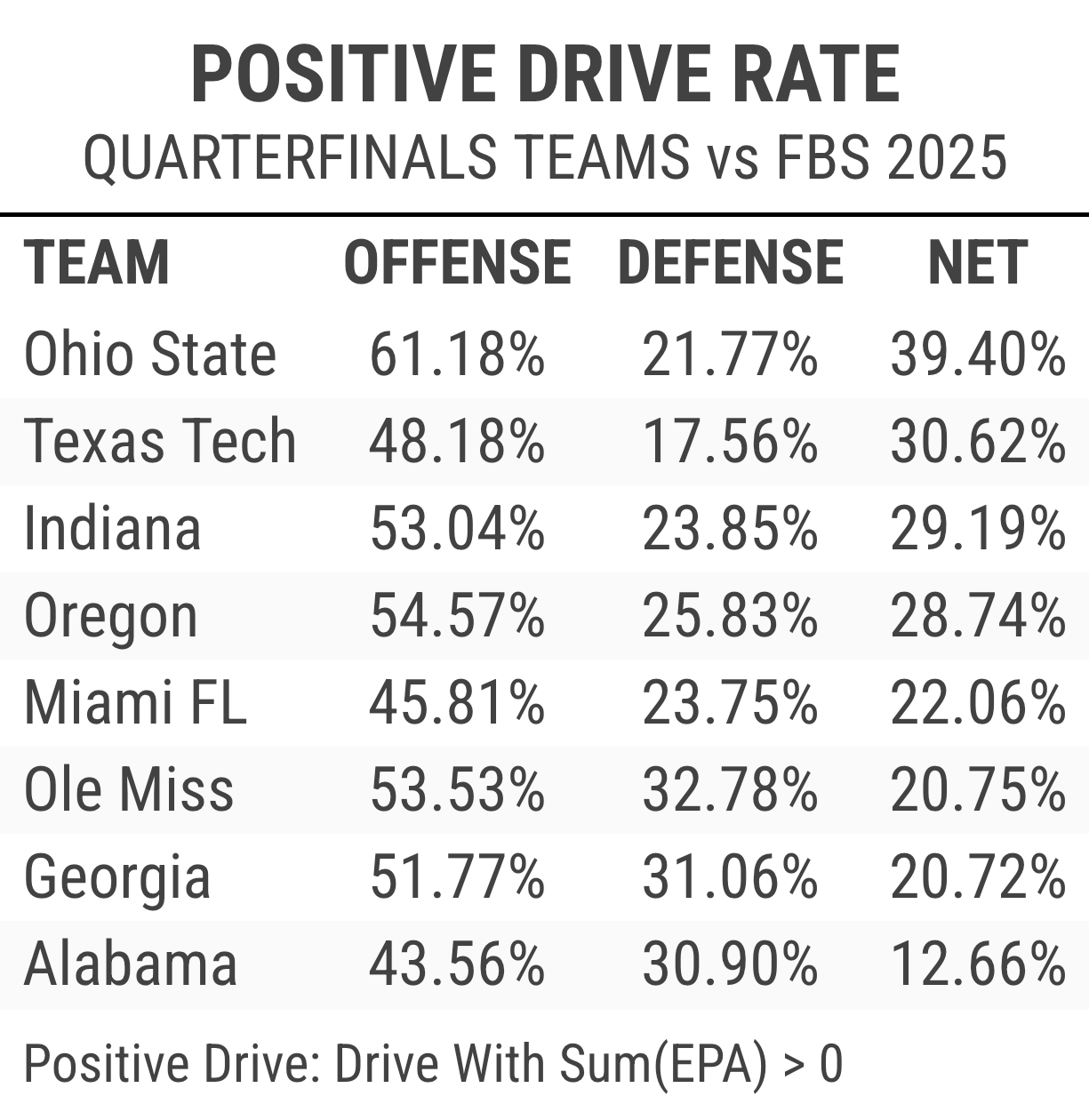
Indiana and Alabama, as well as many other teams across the country, have worked to limit possessions in each of their games, shrinking the margin of error for the opponent. This is why the Indiana-Ohio State matchup was as low-scoring as it was — just six legitimate second-half possessions.
That makes conversion rates and positive drive rates imperative. Thanks to our friend at CFB-graphs.com, Parker Fleming, we can see how Indiana’s positive drive rate compares to Alabama’s, as well as the remaining CFP teams.
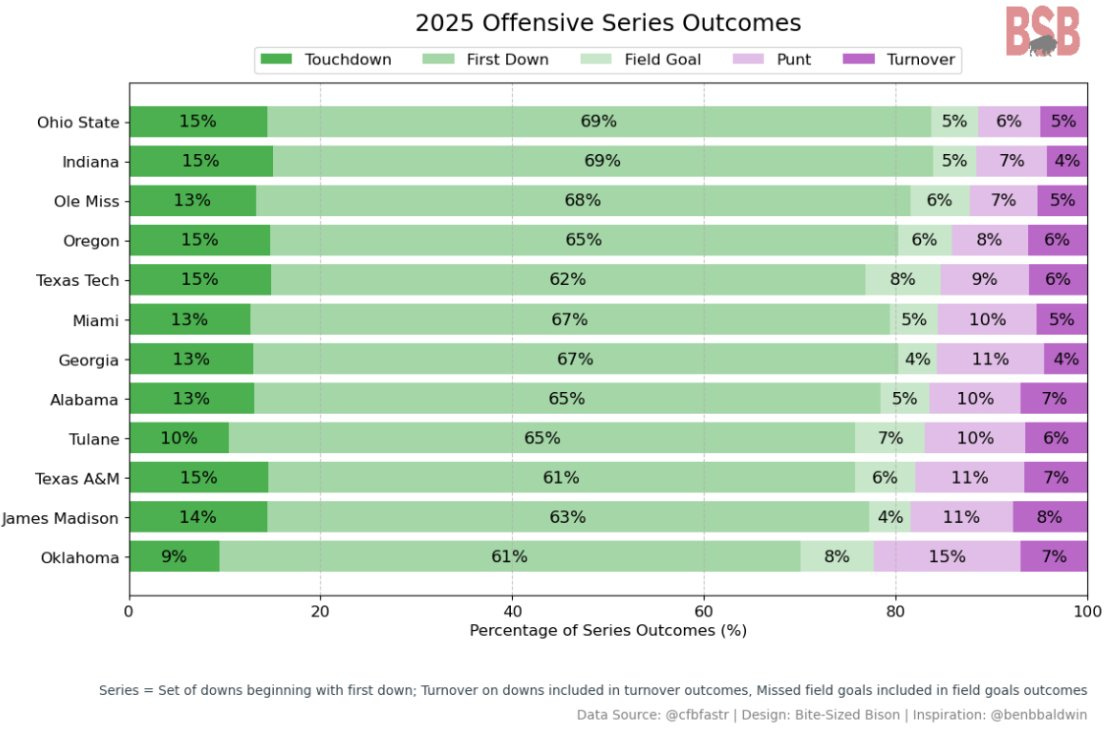
The chart below also shows offensive series outcomes for the CFP field.
In order to do this, though, an offense needs to run the ball effectively. Alabama ranks in the top-30 defenses by rushing success allowed but will, as the EPA/rush chart shows below, surrender some ground by expectation.
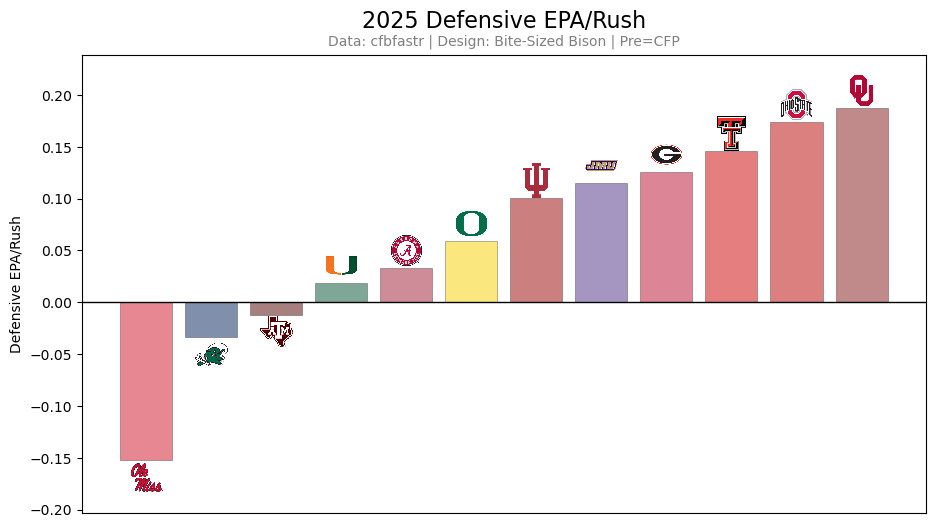
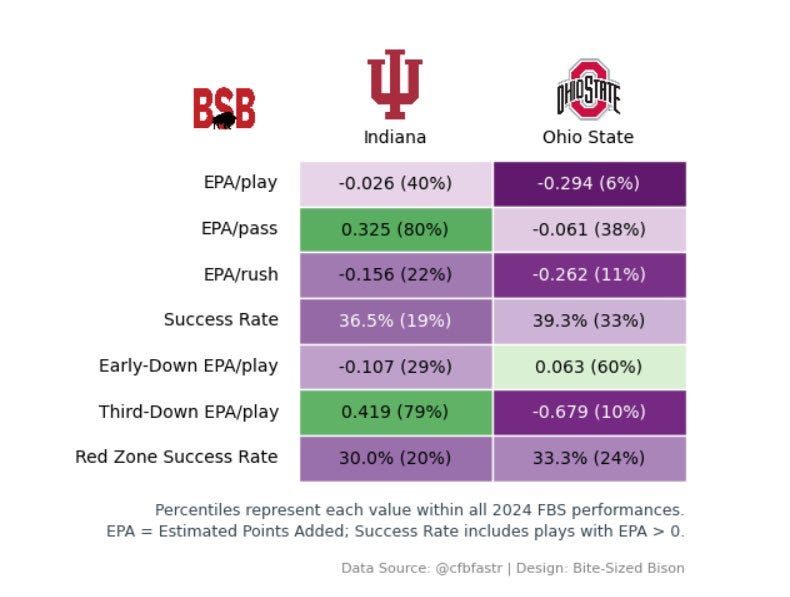
Indiana actually ran the ball effectively enough against Ohio State, at 3.5 yards/carry, even though it was analytically rough. Both Roman Hemby and Kaelon Black averaged 4.0+ yards/carry.
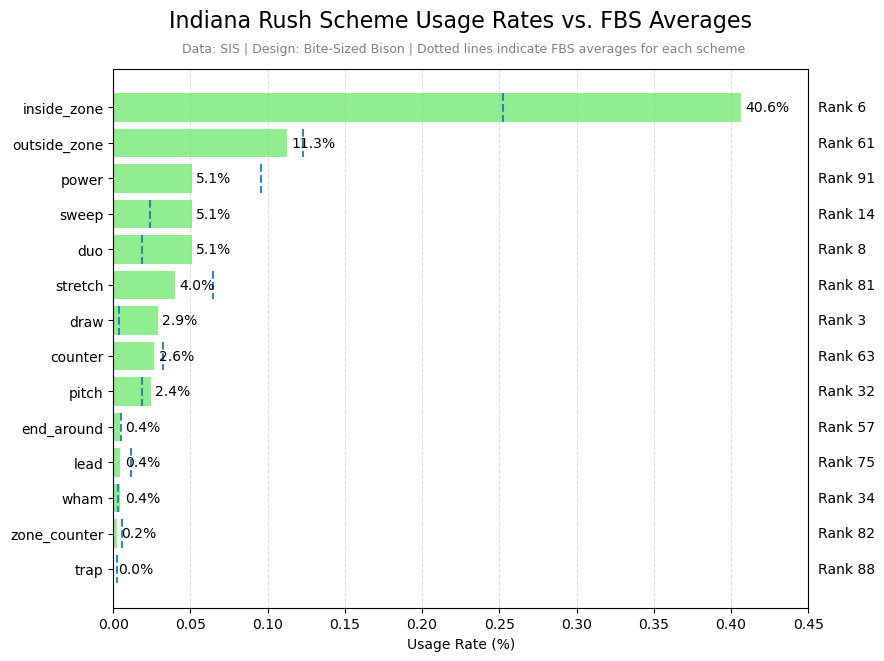
What is most encouraging for Indiana in the running game is that Alabama ranks 87th by SIS in EPA/rush allowed against zone and duo run blocking schemes — as well as 4.1 yards/carry allowed against those schemes. Those are the foundation of the Indiana rushing game.
Wommack’s adjustment may result in some stacked boxes, leaving one-on-one matchups with Indiana receivers and some YAC opportunities for Omar Cooper, who ranks 30th nationally in YAC/reception (7.1).
How does Indiana overcome the loss of Stephen Daley?
Indiana is down to its third DE opposite Mikail Kamara, after Stephen Daley suffered a knee injury in the moments after the Big Ten Championship game. I discussed this dilemma in a recent BSB (linked here), and Bryant Haines has since confirmed much of what was noted in there — Daniel Ndukwe will step up when needed, but this will mostly be addressed with schematic adjustments.
The two primary looks I think Haines might run with are:
A 3-3-5 set
The 3-3-5 somewhat eliminates the urgent need for a second DE by using 3 DLs, 3 LBs, and 5 DBs. The 3 DLs here would be Mario Landino, Mikail Kamara, and one of Tyrique Tucker and Hosea Wheeler, who have split reps in the A-gap throughout the year. This would offer an opportunity for Isaiah Jones to work opposite Kamara, moving up and down as an edge presence at outside LB. This set would also feature Devan Boykin at Rover, allowing Indiana to remain in Cover 3 but also keep the coverages multiple, which is what made them so successful against Ohio State. A blitzing Rolijah Hardy would also be dangerous in his set. What’s also attractive about this set is that, since Alabama is a pass-heavy offense, Indiana can drop one of Jones or Hardy into a more DE edge position and have close to its original 4-2-5 look.
A multiple 4-3 look
This set would place more emphasis on the DL and remove the Rover. The personnel combinations are really endless here, with Ndukwe involved at DE, or simply adding one of Tucker or Wheeler to the trio of DLs from the 3-3-5 set. This can all happen with the three LBs still on the field and maintaining the option for Cover 3. We will absolutely see this look from Haines because the interior DL is so central to what his defense does. We might even see this look more than the 3-3-5.
Some other schematic adjustments Haines might employ at times are:
Playing Devan Boykin or Amare Ferrell closer to the box or even the LOS to bolster LB assignments and simulated pressure. This would be especially helpful in 3-3-5 sets.
Some 4-LB sets, with Kaiden Turner added in or Mikail Kamara in a standing position. This could offer some interchangeability between a 4-3 and 3-4 look without substitution or even in post-snap. This is a fairly traditional method for multiple defenses.
Some 5-DL sets, with several DTs stacked along the line. After all, the interior DL is Indiana’s strength on defense.
Additional simulated pressures, with LBs and SAFs (particularly Rover) bolstering the rushing look. Indiana will need to maintain its pressure while also stopping the run and covering Alabama’s pass-catchers, all without its top two DEs opposite Kamara. One way Haines has been able to do this is with simulated pressures, making the QB’s confusion at the snap feel like pressure. This will be an integral part of the defensive gameplan this week.
Whichever set Haines goes with will likely depend on circumstance and offensive personnel. Alabama runs a ton of 11 personnel, which leads me to believe the 3-3-5 could be a good option, but that removes much of the interior DL havoc Haines has created in his two seasons in Bloomington. A 4-3 might be what he goes with in shorter yardage or late-down situations, in particular.
Thank you as always for this informative and concise information. Your schematic adjustments to compensate for the absence of Daley/Wyatt mirror my own thoughts. I suspect it will be based on down and distance. My fear has been that Ndukwe couldn’t hold up vs the run game with his hand in the dirt. I have visualized flipping Kamara back to SDE and moving Jones in at STUD with 5 db’s because Bama is pass first.
I believe Special teams are critical as will the Run game.
Who ever thought an IU football team would find itself matched vs Bama in a game of such significance?
Go Hoosiers
Thank you for this Taylor - just awesome! Headed to LA today...rain or shine, I don't care. I've been waiting a long time for this. Go Hoosiers!