

Spring Position of Interest: CB2
With 2024's starting CB2 in the portal and Indiana seeking improvement opposite D'Angelo Ponds, what does the competition look like between the top three other CBs?

Readers might remember when I noted D’Angelo Ponds’ size, at 5-foot-9, 170 pounds (before 2024), and how it might not translate to the Big Ten. Well, that’s a non-factor now, it seems. Ponds, if he wasn’t the best CB in the conference, was a top-5 CB in the Big Ten – graded No. 1 among starting CBs by PFF, allowed the fewest yards per reception (8.2), allowed the 7th-lowest reception rate (53.3%), and amassed the 7th-most PBUs (7). He did this all while being targeted the 5th-most times among starting CBs in the conference. In coverage against Michigan, Ohio State, and Notre Dame, he was targeted 12 times, allowed 6 catches for 52 yards, and recorded 2 PBUs and an INT.
Ponds is here, and he’s the best CB on the team. The question for the Indiana CBs room heading into the 2025 season is who will step up at CB2?
In 2024, Indiana’s defense was stellar, ending the season ranked 19th in EPA/play allowed and 15th in explosion rate allowed. The front, and the pressure it created, was helpful for Indiana’s secondary and likely masked some shortcomings – that Notre Dame exposed in the CFP – for most of the season, but Indiana’s cornerbacks, when tested, were solid. Much of the CB improvement is also thanks to Indiana CB coach Rod Ojong, who was named to the AFCA’s 35 Under 35 and received the highest non-coordinator raise on staff ($250k) this offseason.
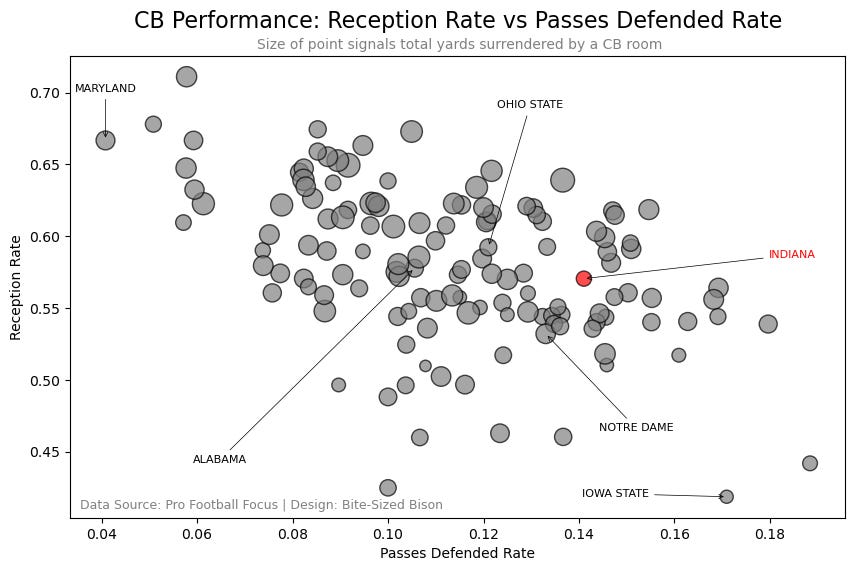
Note: Reception Rate = % of targets completed, Passes Defended Rate = % of targets resulting in PBU or INT, Size of points = total yards allowed by CBs
Teams want to be in the bottom-right corner of this chart. The quick interpretation suggests that Indiana’s CBs were above average in their abilities to make plays on their respective targets and that they were roughly average in terms of allowing targets to be caught (more on this soon). The size of the Indiana point suggests that Indiana was extremely effective at limiting yardage on passes targeting its CBs, especially when comparing to its nearest neighbors on the chart.
If you’re curious about where Indiana’s CBs room finished in each of these categories:
Reception Rate: 57th
Passes Defended Rate: 28th
Yards Allowed: 12th
Jamier Johnson, who has since entered the transfer portal, did a lot of work in shoring up the position, which didn’t have much depth in 2024. In his first full season as a starting CB, he graded 28th of 36 qualifying CBs. Relative to the 18 current Big Ten teams, that is nearly equal to Indiana’s leading starting CB in 2023 (Kobee Minor, 27th) and far better than its CB2 in 2023 (Jamari Sharpe, 36th).
As a result, Indiana’s CBs room saw significant positive change from 2023 to 2024. Below is where Indiana ranked in the FBS in positive change between seasons, in each of the categories discussed above.
Change in Reception Rate: 55th (-1.5%)
Change in Passes Defended Rate: 49th (+1.1%)
Change in Yards Allowed: 35th (-295 yards)
What these numbers don’t tell is how schematics aren’t necessarily geared toward optimizing these specific metrics. For example, against Michigan in 2024, Indiana was comfortable surrendering production in the passing game because the Wolverines couldn’t beat Indiana through the air. And in most cases in 2024, Bryant Haines didn’t mind surrendering completions, as long as the DBs got the receivers on the ground quickly. So when looking at additional metrics, the positive change within the CBs room is actually staggering.
Change in Yards per Reception Allowed: 2nd (-6.32)
Change in YAC per Reception Allowed: 3rd (-2.82)
The CBs showed this improvement while also being targeted 33 more times than they were in 2023 (a change ranking 28th-most in the FBS).
And it’s still not good enough. Even with Johnson’s improvements on his side of the field, Indiana still needs to find more production from the CB2 spot. That’s clearly what it intends to do this spring, after it brought in Amariyun Knighten (Northern Illinois) and Ryland Gandy (Pittsburgh) to compete with Jamari Sharpe for CB2.
The Position Best Prepared for the Future
Besides QB, it’s probably CB.
There wasn’t much depth in the CB room in 2024, especially if Jamier Johnson didn’t hold out as long as he did before suffering an injury in the last few games of the season. Jamari Sharpe stepped in and played decently, but after Sharpe, it was Cedarius Doss, JoJo Johnson (who transferred to Bowling Green), and two true freshmen.
Now, Indiana has four juniors, all with significant experience and some upside yet to be tapped. It would be surprising if D’Angelo Ponds left for the Draft after the 2025 season, given concerns around his size, and behind the juniors are four talented freshmen — three of which each had several other SEC and Big Ten offers — still developing under Rod Ojong. So the room is currently looking healthy for 2026 too.
Juniors: D’Angelo Ponds, Jamari Sharpe, Amariyun Knighten, Ryland Gandy (Gandy is listed as a redshirt sophomore on the IUFB roster, but that seems like a possible error)
Freshmen: Dontrae Henderson (redshirt), Jaylen Bell, Zachery Smith, Seaonta Stewart
There’s a real possibility that a man left out in that group of juniors transfers following Spring Camp, but there’s no guarantee.
Competing for CB2
The three juniors after Ponds will likely be competing for the CB2 spot, and each has grounds for a claim.
Jamari Sharpe
Since his redshirt freshman season in 2023, Sharpe has played a lot of snaps for Indiana — 750 to be exact (234 in 2024). As noted above, during the 2023 season, he graded 36th among 40 qualifying CBs on the current 18 conference teams (via PFF).
There was some growth in his coverage between 2023 and 2024, despite the reduced snaps. In 2023, Sharpe allowed a reception rate of 65% (17-of-26) for 18 yards per reception against Power 5 opponents. In 2024, it was 42% (5-of-12) for 12.6 yards per reception.
His 2024 production can be characterized as polarizing. He stepped up against Michigan, allowing just 12 yards on a 2-for-5 reception rate. But his performance against Notre Dame in the CFP was rough; in addition to a 3-for-4 reception rate (51 yards), he shared significant responsibility for two big plays — a 44-yard reception that led to a TD and the 98-yard TD run by Jeremiyah Love (failed to take the sideline to seal the edge as the play-side CB, which would have allowed a trailing Ponds to make a tackle).
Sharpe has potential and plenty of football ahead of him, just like the other two juniors listed here. He ranked in the top-900 in the Class of 2022 out of Miami and was recruited by Jason Jones, who is now at Alabama with Kane Wommack. He just suffers from displaying his lumps early on as he develops. It will certainly require more than he’s shown, though, in order to win the job.
Ryland Gandy
Gandy, a transfer from Pitt, offers really high upside. He graded 113th among starting Power 4 CBs in 2024, just behind Jamier Johnson, at 105th, but his potential in coverage makes him a very attractive addition to the room. He finished 2024 in the 76th percentile of CBs, with a 51.9% reception rate allowed (28-of-53). That was better than D’Angelo Ponds (53.3%). That doesn’t mean he’s flawless, though. I wrote this about Gandy following the winter transfer period:
“He plays with great length (even at just 6-foot) and has great athleticism in space to make athletic plays in coverage. A legitimate knock on Gandy, though, is that he struggles with physicality – 3rd among P4 CBs in missed tackles (15) – which is not something Indiana has struggled with at CB in the last decade or so. Surely, the coaches are looking for improvement there from Gandy in the spring.”
That struggle with physicality shows itself in coverage too, where he allowed the 4th-most yards per reception (19.4) among starting Power 4 CBs in 2024. He allows big plays.
Gandy has something to prove in Mellencamp Pavilion this spring, and he needs to prove it to win the job.
Amariyun Knighten
Knighten is partially responsible for one of the most iconic moments in Northern Illinois history, as he caught and returned the INT that set up NIU’s game-winning field goal against Notre Dame in South Bend in early-2024.
He doesn’t quite have the coverage ceiling of Gandy but hasn’t seen the coverage lows of Sharpe either. He allowed a 60% reception rate (26-of-43 targets) between 2023 and 2024. A fun fact about Knighten is that he played as a starting CB against Kurtis Rourke (Ohio) in 2023, allowing receptions on 3 of 3 targets but just for 18 yards.
He tackles very well. He didn’t miss a tackle in 2024, and his 8.8 yards per reception allowed ranked in the 6th percentile of FBS CBs (300+ snaps) in 2023 — his redshirt freshman season.
Who Will Win the Job?
I don’t know! That’s what makes this position so interesting. Any of these three could win it, or it could be a rotating position during the season, based on priority and situation. It seems like a possibility that one of them could fill in at Rover at times too.
This seems like one of those positions that sharpens in focus during Spring Camp.
This is how I see either of these three winning the CB2 role:
Jamari Sharpe simply needs to show consistency still unseen over a resume of 750 snaps.
Ryland Gandy needs to show more physicality, both in the run game and in coverage, and limit big plays. Competing against Indiana’s WRs should convey this pretty quickly.
Amariyun Knighten needs to boost his play-making ability in coverage and prove his physicality in person. He is my lean for winning the job.
Great analysis. I love reading your work.
The game moves so fast that I can’t keep up with all of the moving players. I try to focus on the linemen but now I’ll watch the corner backs more closely. That is until you write about the next position and then I will want to focus there.😉