

Week 11 Preview: Penn State
Prepare for Indiana's Week 11 matchup against the Penn State Nittany Lions with a comprehensive BSB Preview!

As Indiana ends its final quarter of its regular season schedule, it is analytically the most dominant team in the country. Brian Fremeau of bcftoys.com charted the top teams’ individual game ratings, and Indiana (and Ohio State) clearly have the best resumes in the FBS.
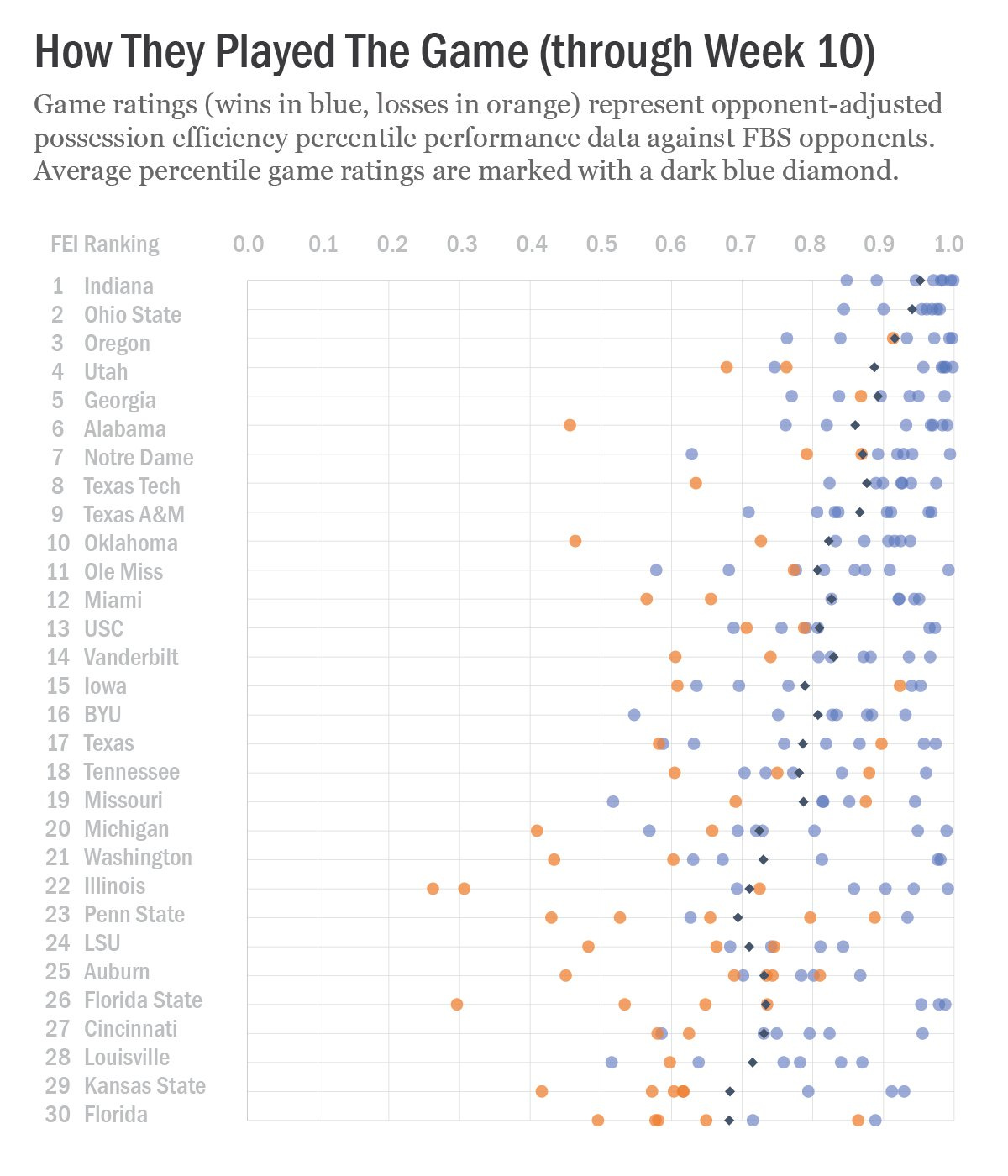
Source: Brian Fremeau
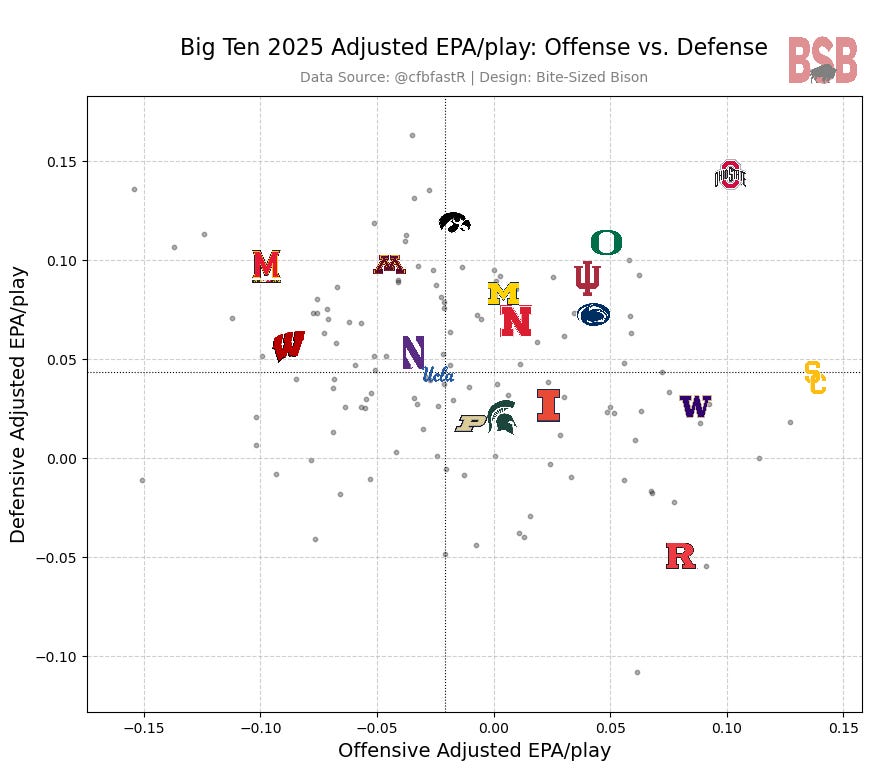
An additional note from the chart above is related to Penn State. The Nittany Lions are ranked 23rd in FEI ratings (the order of that chart) and are also ranked 22nd in each of SP+ and FPI ratings. With the majority of preseason variables removed from these algorithms, these ratings are primarily resume- and performance-based at this point, so the computers still like Penn State — to an extent. The reason for this, at least what the above chart shows, is that while Penn State dropped two tough games against UCLA and Northwestern, it still performed fairly efficiently in its losses to Oregon, Iowa, and Ohio State. When adjusting for opponent, Penn State really isn’t that far away from Indiana on a per-play basis either.
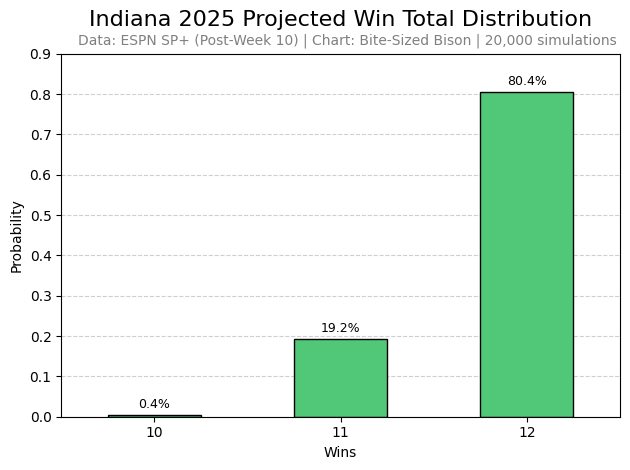
This will be Indiana’s toughest remaining opponent standing between the Hoosiers and not only a potential Big Ten Championship bid but also an undefeated regular season.
In this preview:
Opponent Overview
Advanced Stat Preview (The Chart)
QB Profiles
Penn State OL Preview
Penn State Key Contributors
EPA Distribution by Scenario
What BSB is Watching For
Opponent Overview
Penn State went all-in on this season. The Nittany Lions were a preseason favorite — if not the favorite — to win the national championship. James Franklin and his staff did everything it needed to do during the offseason: 1.) retained the 33rd-most production from 2024 (63%, via SP+), 2.) bulked up with talent at WR, 3.) bolstered a strong OL that I ranked No. 1 in the conference during preseason, 4.) shelled out the highest assistant salary ever to pull DC Jim Knowles from Ohio State (after failing to hire Bryant Haines), and 5.) built a solid, balanced environment for one of the better experience-to-talent QBs in the FBS.
But after dropping a competitive, double-overtime home game to Oregon in Week 4, Penn State went on to drop its next two conference games to UCLA and Northwestern, bringing its record to 3-3 and effectively ending any hope at a title. James Franklin was fired, Terry Smith was promoted in the interim, and things have not gotten much better for the Nittany Lions. PSU has dropped its first two games under Smith — albeit against two strong teams, in Iowa and Ohio State — and lost its starting QB, Drew Allar, to a broken ankle the same week Franklin was let go. Now, they welcome Indiana for Penn State’s first home game without Franklin at the helm.
This Penn State team, however, should not be overlooked. This is still a team comprised of the 10th-highest 247Sports Talent Composite rating, and the coordinators — Knowles and OC Andy Kotelnicki, who was responsible for the Jalon Daniels breakout at Kansas in 2023 — remain. Smith has also been at Penn State overseeing the CBs since 2014, as long as Franklin was the head coach (now longer). Penn State is not throwing in the towel.
Advanced Stat Preview (The Chart)
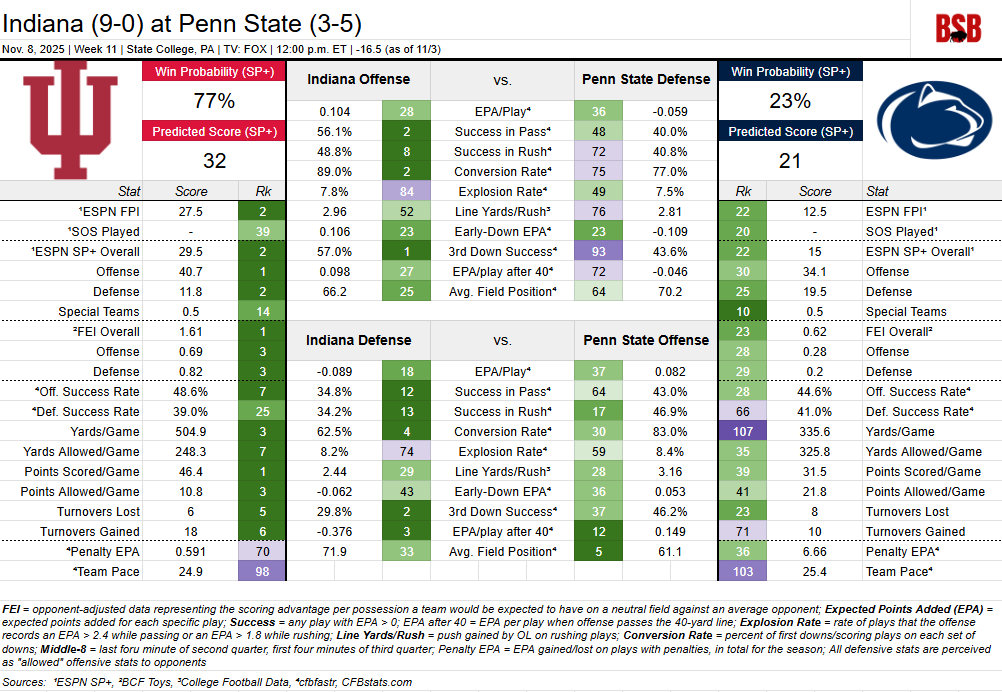
Some Observations:
Indiana’s Explosion Rate: Indiana has seen its explosive play rate skyrocket recently, now ranked 84th after spending most of the season outside the top-115. The Hoosiers recorded 18 explosive plays in the last two weeks (UCLA and Maryland), which matches its total from the previous four games (Illinois, Iowa, Oregon, Michigan State). The only explosive play to not eventually result in a touchdown — if it didn’t score a touchdown itself — was the 52-yard catch-and-run by Charlie Becker against Maryland, which resulted in a somewhat uncharacteristic decision to kick a field goal at the 2-yard line.
Indiana’s Line Yards/Rush: Indiana tumbled in offensive line yards/rush this week, falling from 6th to 52nd (more on that later in this newsletter).
Penn State Special Teams and Starting Field Position: There is one reason why Penn State is 5th in special teams nationally — blocked kicks. The Nittany Lions’ best special teams contributor is its kicker, Ryan Barker, who’s connected on 11-of-12 field goals, none from further than 49 yards out. Plus, PSU is outside the top-70 in both kickoff return and punt return coverage per kick. Combined with a fairly average punter, it gives Penn State average starting defensive field position. But Penn State has blocked 4 kicks, good for the 2nd-most nationally.
Penn State Defensive Conversion Rate: Both offensively and defensively, conversion rates can mean different things for different teams. For Penn State’s defense, it means that it allows its opponents to lean on them in the trenches (see the 76th-ranked line yards/rush allowed). PSU has held just one Big Ten opponent beneath 4.5 yards/carry (Northwestern). Then, the pass game tears them up, with the 22nd-highest first down rate in the country (22.9% of passes have been first downs against PSU).
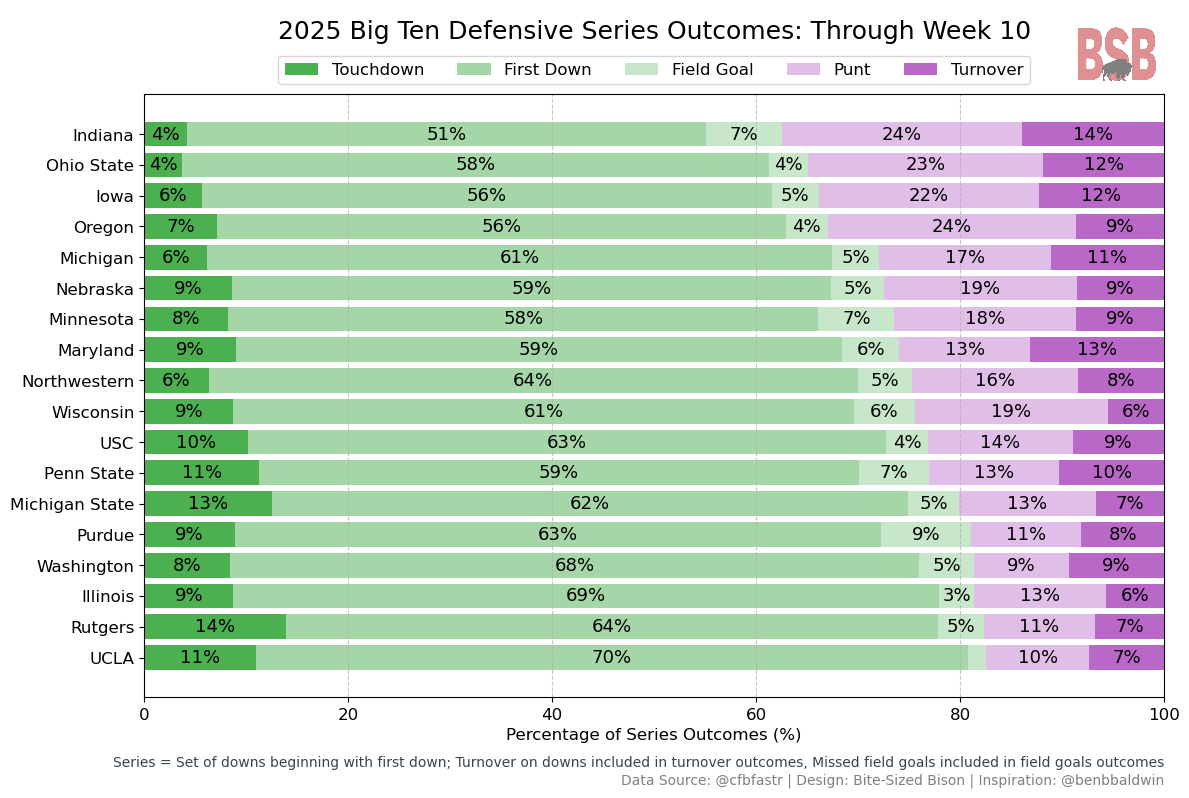
There’s also this…
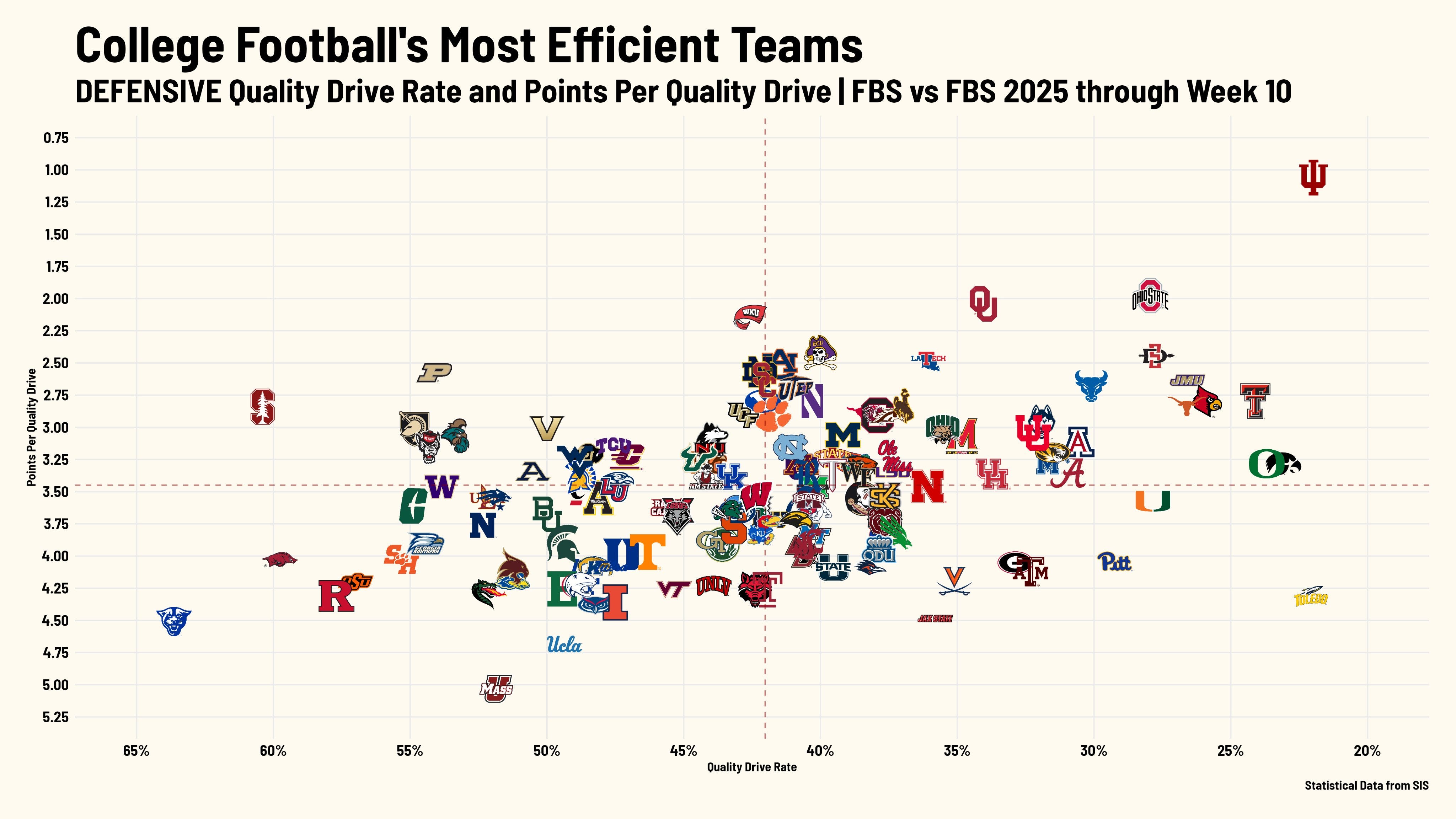
Source: Parker Fleming
QB Profiles
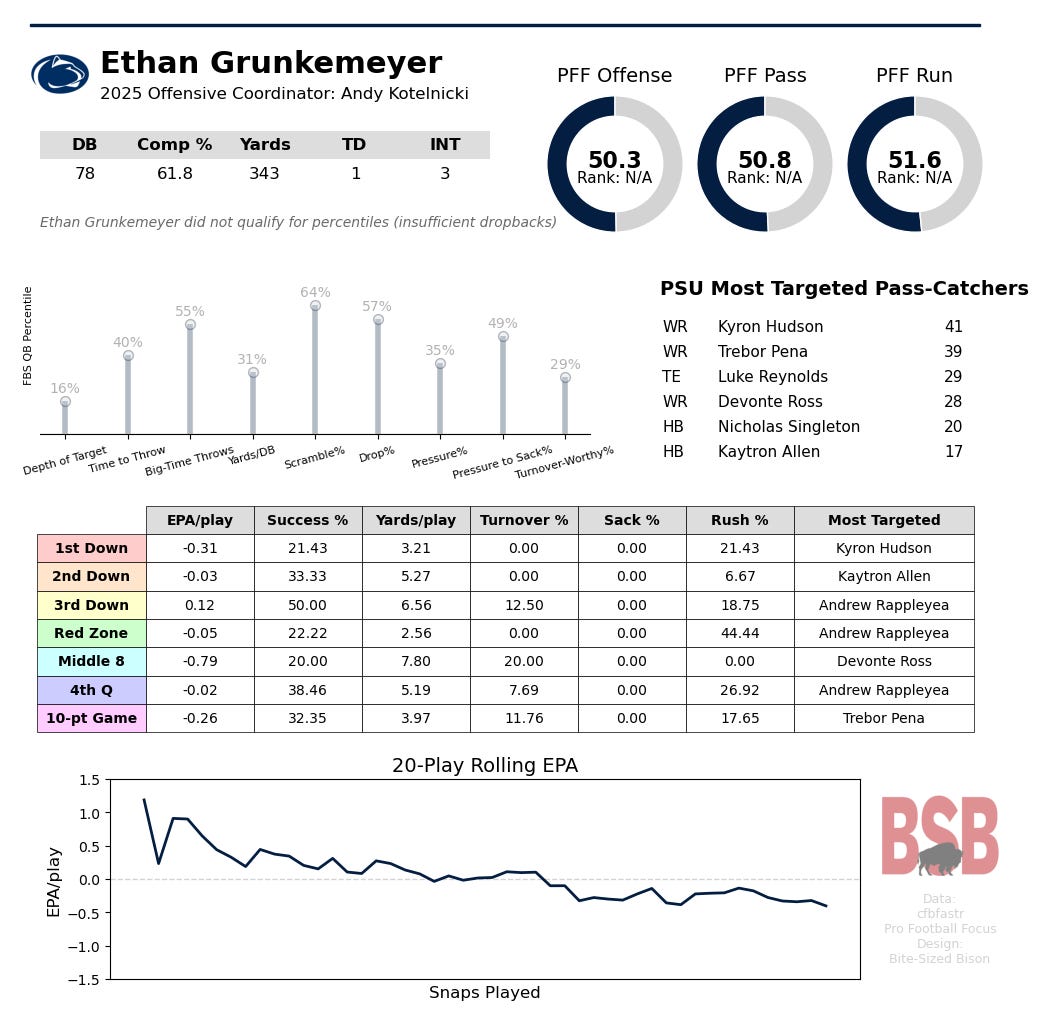
Observations:
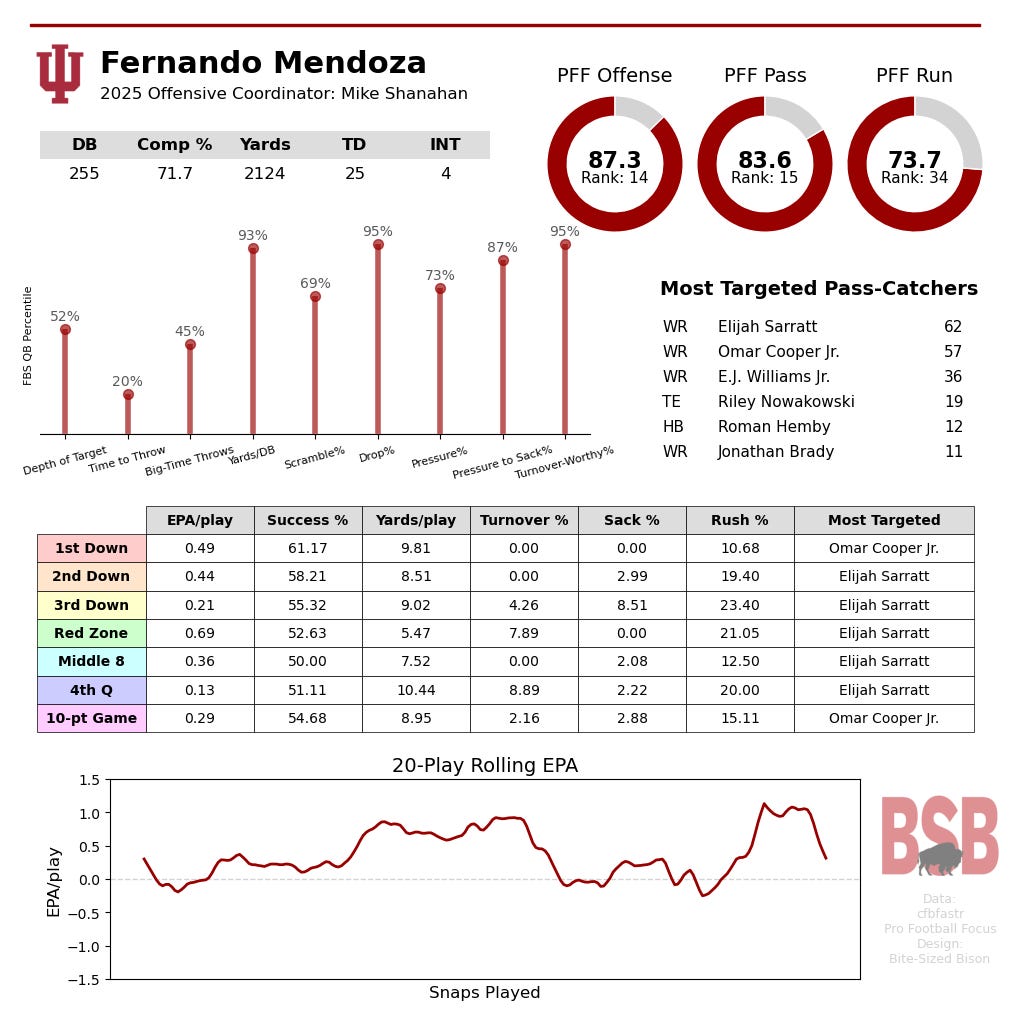
Ethan Grunkemeyer should be an effective QB at this level, but he’s still young — as the No. 7 QB in the 2024 class. Before taking over as the starter two games ago, he had just 16 dropbacks of experience.
Grunkemeyer has been most successful on third downs, where Penn State ranks 37th in success rate. On first down, though, he’s really struggled.
Grunkemeyer ranks 4th among Big Ten QBs in turnover-worthy play rate, as he’s committed three turnover-worthy plays, all of which were intercepted.
The redshirt freshman has actually felt a decent amount of pressure already, as he’s been pressured on 33% of dropbacks so far. On those dropbacks, he’s graded very poorly, completing just 50% of passes at only 5.6 yards/attempt. He’s been much better when facing blitzes, completing 70% of passes at 7.2 yards/attempt. However, he’s been pressured more often when not blitzed, so there should be room for QB pressure without blitzing for Indiana’s defense, which is helpful when playing an offense featuring several pass-catchers.
Penn State OL Preview
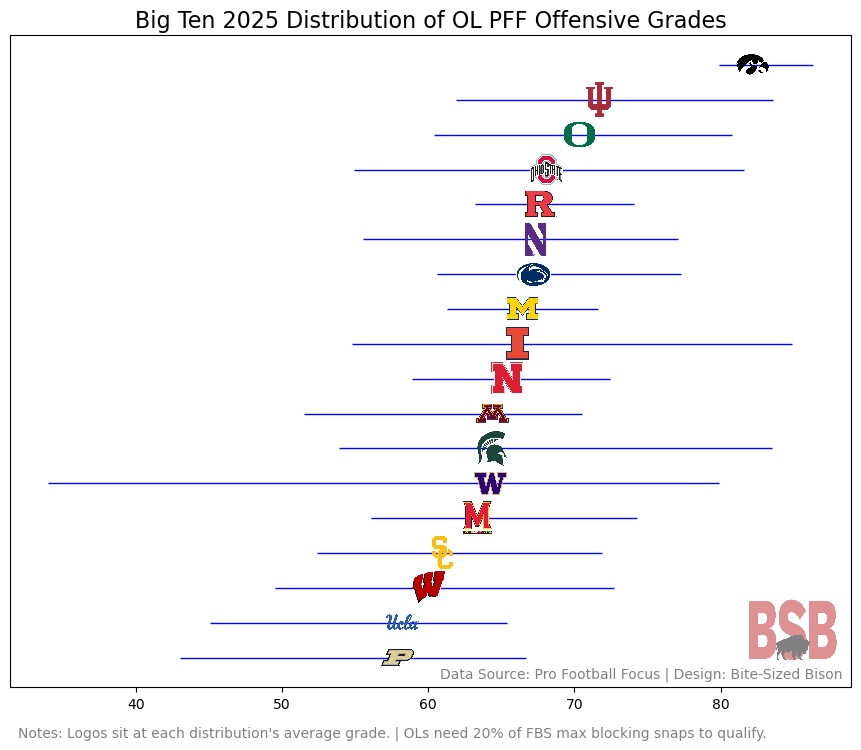
Notes:
Penn State ranks 11th nationally in pass blocking, but the Nittany Lions’ QBs have combined for the 8th-most pressures felt in the Big Ten.
The offense does not run well to the right. Nearly all of its rushing success is found to the left — 68% of designed yards from the left side, only 12.9% on either shoulder of the RG. PSU’s most consistent rushing direction is on either shoulder of its LG Olaivavega Ioane. They average 6.2 yards/carry when running toward him.
Penn State Key Contributors
RBs Kaytron Allen & Nic Singleton: Like Jalen Berger a couple weeks ago, Kaytron Allen is also old enough for me to have covered his high school recruitment as the No. 12 RB in the 2022 class. He was highly coveted, and he’s been more valuable than even expected then. Since his true freshman season, he’s never carried the ball fewer than 167 times, and he’s averaged 5.3 yards/carry for 3+ years. He’s broken the 3rd-most tackles among Big Ten RBs and earns the 9th-most yards after contact. Nic Singleton has been right there with Allen since 2022 too, averaging 5.5 yards/carry and eclipsing 1,000 yards twice. The duo is also the most-targeted backfield through the passing game too. These two RBs have kept Penn State’s offensive floor much higher than it could’ve been in the last few seasons.
TEs Luke Reynolds & Khalil Dinkins: Penn State has a lot of involved receivers that can impact games, but the TEs are a particular matchup to watch this week. Reynolds is one of the most-targeted TEs in the conference and ranks 6th among Big Ten TEs in catches (21). He’s also a very effective run blocker. Dinkins has been getting more involved recently as well, as PSU runs more 12 personnel. Terry Smith has said that he wants to get TEs more involved off play action, meaning these two will be running routes this weekend and could be a tough matchup for Indiana.
DE Dani Dennis-Sutton: Dennis-Sutton is the 2nd-highest graded DE Indiana will have played this season (Oregon’s Teitum Tuioti is the first). While he is the leading pass rusher on the team, he’s tied for the team lead in sacks, with only 2.0. Penn State has generated plenty of pressure but just hasn’t gotten home, and Dennis-Sutton is part of that story, as he is 2nd among Big Ten DEs in QB hits (8) — a split second short of many more sacks. That’s not all he does, though. He’s second on the team in TFLs, with 5.5, and leads Big Ten DEs with 3 forced fumbles. He primarily lines up on Carter Smith’s side of the defense, which would also place him close to backup guard Zen Michalski.
LB Amare Campbell: The North Carolina transfer LB has unsurprisingly been one of the primary producers on PSU’s defense. He was one of the best LBs in the ACC in 2024, including recording the 2nd-most sacks among ACC LBs (6.5). He can really do it all, but what made him supremely dangerous at UNC was his pass-rush ability. But so far at PSU, Campbell hasn’t been used as often in pass rush, and he hasn’t been as productive either — just 24% pressure rate on 25 pass-rush snaps compared to 39% on 59 pass-rush snaps at UNC in 2024. He will undoubtedly be active in pass rush against Indiana, one of the most blitzed teams in the country.
SAF Zakee Wheatley: Wheatley came into the 2025 season as one of the most experienced safeties in the country, and he’s spent his entire career at Penn State, including a career-best season under Tom Allen in 2024. Like Amare Campbell at LB, Wheatley can do anything asked of him, but he’s undergone a schematic change between seasons too, playing more snaps in the box or on the LOS rather than in coverage — which he also does well, with 3 INTs last year. It’s resulted in leveraging his strengths as a tackler (second on the team, with 56 tackles) and a physical playmaker (4th among Big Ten safeties, with 17 plays individually blown up). He’s graded up there with Louis Moore and Devan Boykin as a top-four safety in the conference.
EPA Distribution by Scenario
The chart below shows the proportionate distribution of plays by EPA values in each of the four basic phases on offense and defense — Passing, Against the Pass, Rushing, and Against the Rush. These can show us how teams are finding their success on either side of the ball.
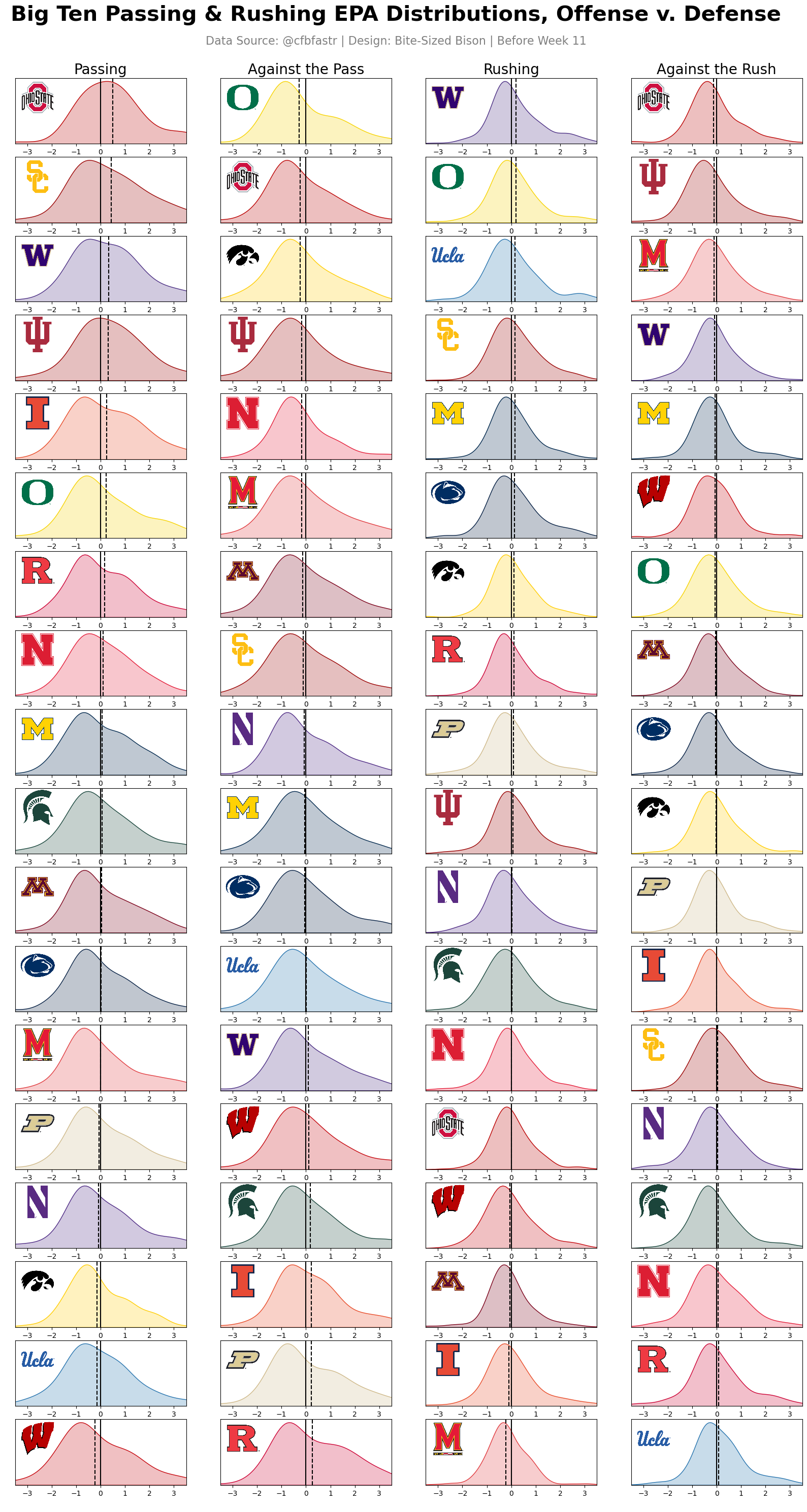
Penn State Rushing: What stands out about Penn State’s rushing curve is the sharper drop on the negative side. The Nittany Lions push forward. Not only are they 28th in line yards/rush, but they also allow the 17th-fewest TFLs — against Indiana’s defense that is 2nd in the nation in TFLs.
Penn State Against the Pass: Penn State’s curve here suggests what was noted previously — they haven’t surrendered a ton of yardage through the passing game (rank 32nd in yards/attempt allowed), but they surrender high-leverage passing success (21st-highest passing first down rate). The playbook against PSU is to establish the run to take bigger swings in the passing game. Ohio State proved this last week (nearly to perfection), by averaging 5.1 yards/rush and throwing just 23 times with Julian Sayin, completing 20 of those passes for 316 yards and 4 TDs.
What BSB is Watching For
Can Indiana win the strength-on-strength against Penn State’s rushing attack?
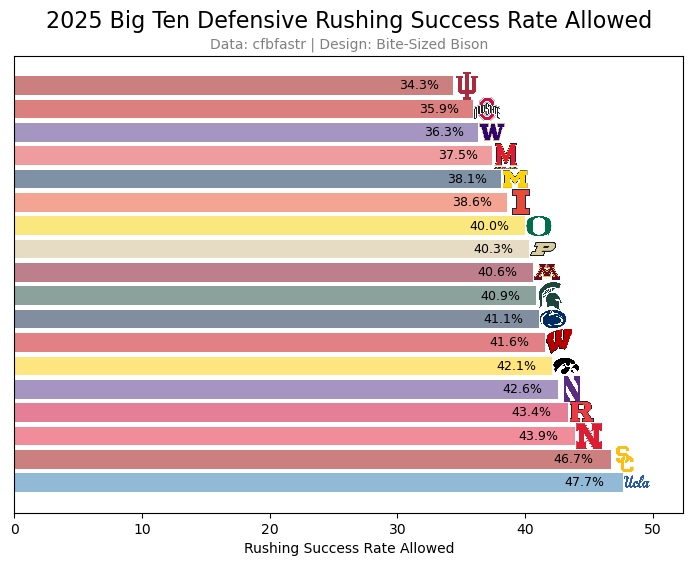
Indiana is typically okay surrendering some success through the air, but on the ground? That doesn’t fly in Bloomington. The Hoosiers rank 13th nationally in rushing success rate allowed and (as the chart below shows) rank No. 1 in the Big Ten.
Penn State’s identity has been in its offensive balance all season long, but with the loss of Drew Allar and the early struggles of Ethan Grunkemeyer, it’s been difficult for Penn State to remain balanced, especially with the talent of Kaytron Allen and Nic Singleton in the backfield. The Nittany Lions are now 17th in rushing success rate offensively.
But the Nittany Lions get very few explosives from their rushing attack, something that has been part of the both losses an Indiana Bryant Haines defense has suffered (Notre Dame and Ohio State in 2024). The Nittany Lions simply don’t lose yardage. Both of these trends can be seen in the charts below — 1.) yards before and after contact, 2.) short-yardage rushing success.
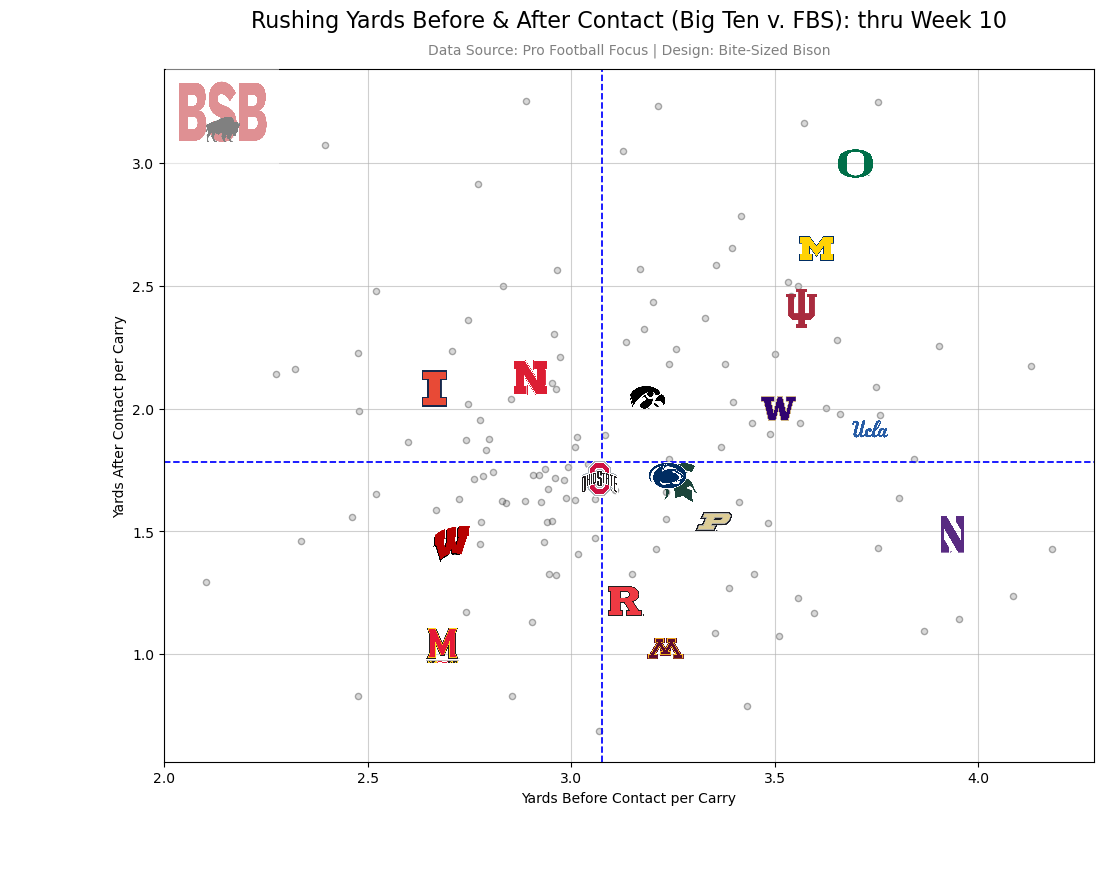
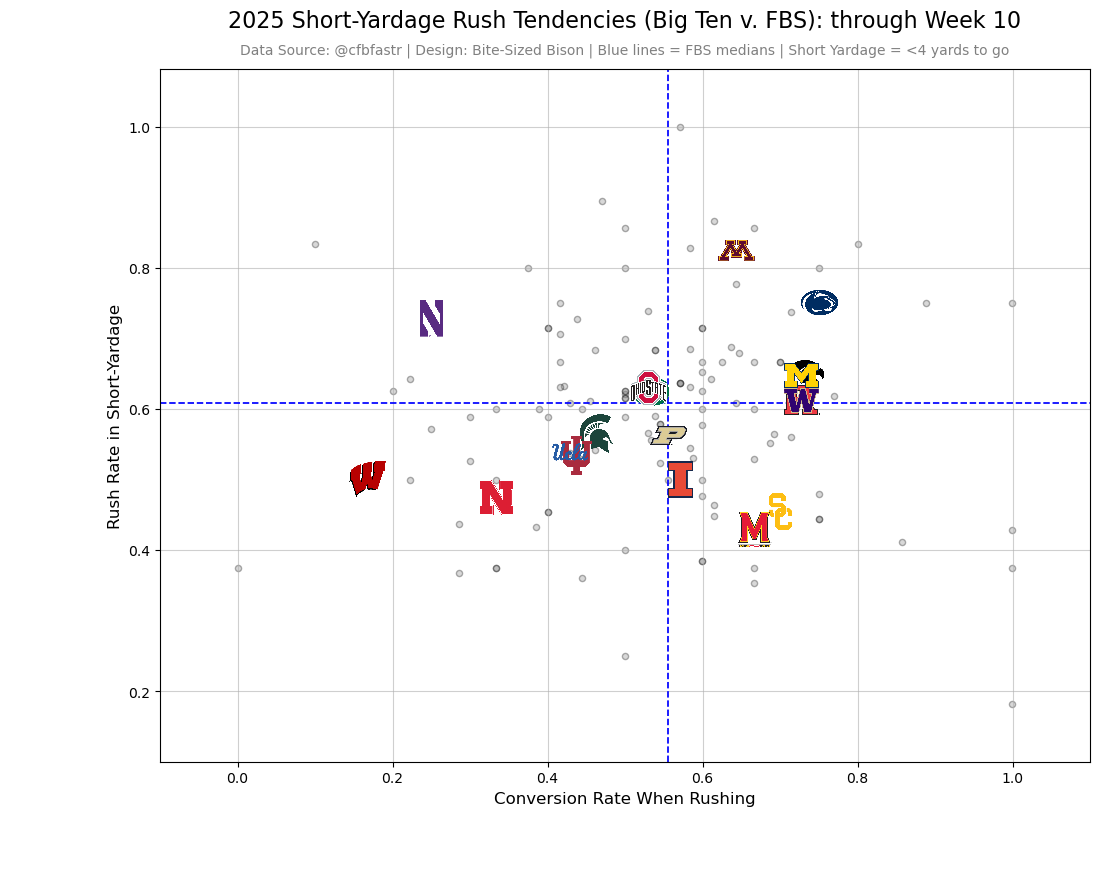
This is what makes Penn State such a dangerous red zone offense — where it’s scored 18 rushing TDs to just 5 passing TDs.
Penn State just logged 1.8 yards/carry against Ohio State, which is second to Indiana in rushing success rate allowed in the Big Ten. If Indiana limits Penn State to anything near that, this game may not be close.
Is Indiana’s sudden run-blocking dip here to stay?
Indiana’s OL had been bullying opposing defensive fronts for most of the season within Mike Shanahan’s run-blocking scheme. But against Maryland — one of the most DL-heavy defensive attacks on the schedule — Indiana faltered a bit. The Hoosiers were averaging 3.46 line yards/rush going into Week 10, but it gained -0.36 line yards/rush against the Terps. That’s almost a 4-yard change per rushing play!
I wrote in the Week 10 Recap about how Shanahan turned toward an edge-focused rushing attack mid-game, which paid off in a big way — 270 of Indiana’s 367 rushing yards.
It’s uncertain whether this can all be credited to the loss of LG Drew Evans (most likely not), but that is the lasting change from last week to this week, save for Penn State’s ability to cause havoc from its DL (mostly in pass pressure, though):
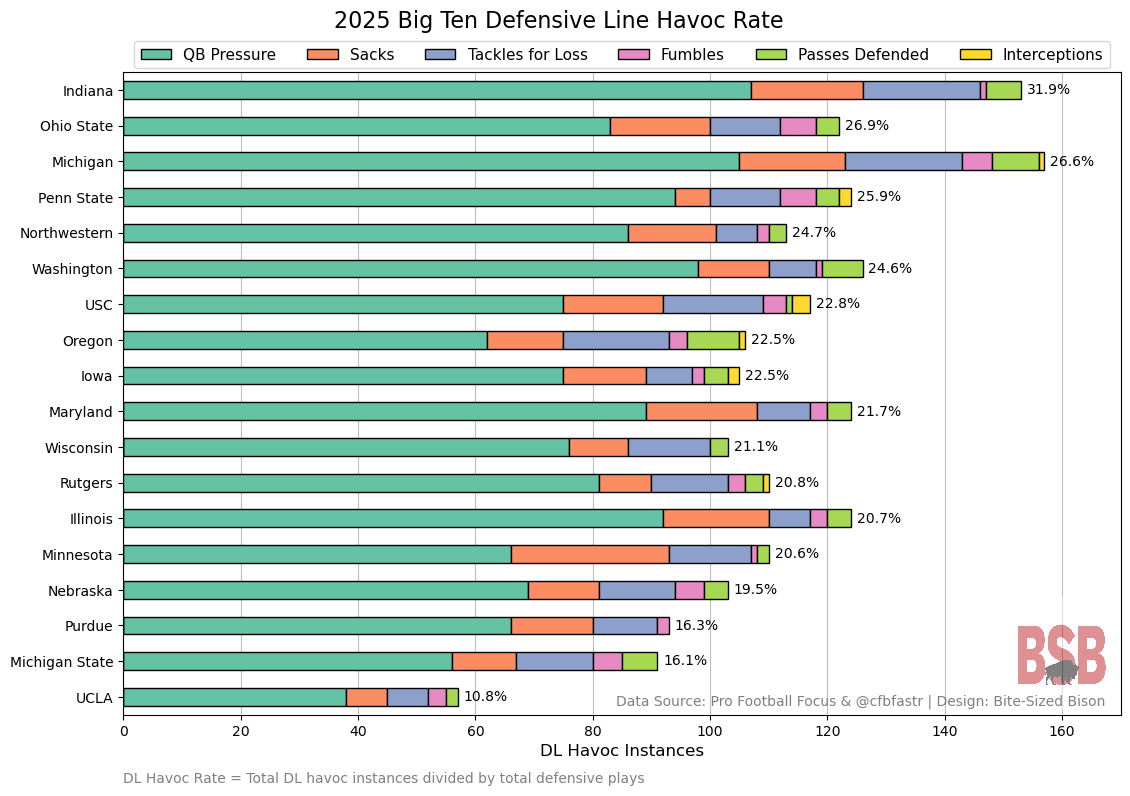
For an offense that has a history of struggling in short-yardage rushing scenarios, losing the better of two guards isn’t ideal for the interior OL, but running effectively against Penn State’s front could put some of that concern to rest — at least for the duration of Evans’ absence.
Will Penn State actually pass the ball?
Interim HC Terry Smith told the media earlier this week that the Penn State offense plans to pass the ball downfield, but there’s suspicion amongst PSU fans and media that this will actually happen.
As noted above, Penn State’s strength is in its running game. Even when Drew Allar was throwing passes for this team, he was not necessarily excelling.
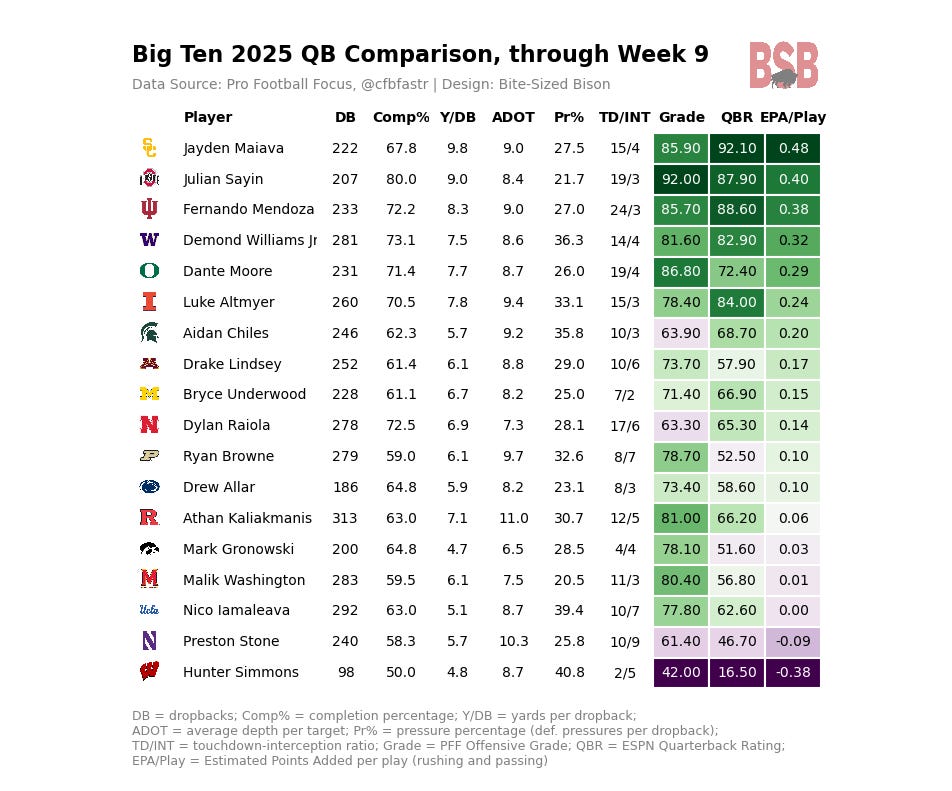
Since Ethan Grunkemeyer took over following Week 7, the Nittany Lions rank 109th in passing success rate. Grunkemeyer has gone 34-for-57 (59.6%) for 238 yards, 0 TDs, and 3 INTs while averaging the shortest depth of target in the Big Ten (4th-shortest in the FBS), at 5.8 yards downfield. In that same span, Penn State owns the 14th-best rushing success rate against Iowa and Ohio State (though with just 1.8 yards/carry against OSU).
No team Indiana has played has beaten Bryant Haines with a one-dimensional attack. Notre Dame, of course, had the 98-yard TD run, but other than that, it averaged 2.8 yards/carry in the CFP, and Ohio State average 4.0 yards/carry (its 4th-worst of the season) but with the most complex passing attack Indiana has seen thus far under Cignetti. Both needed the passing game to win, and Penn State will too. Where will the passing success come from? Below is the Big Ten target share-to-EPA/play chart:
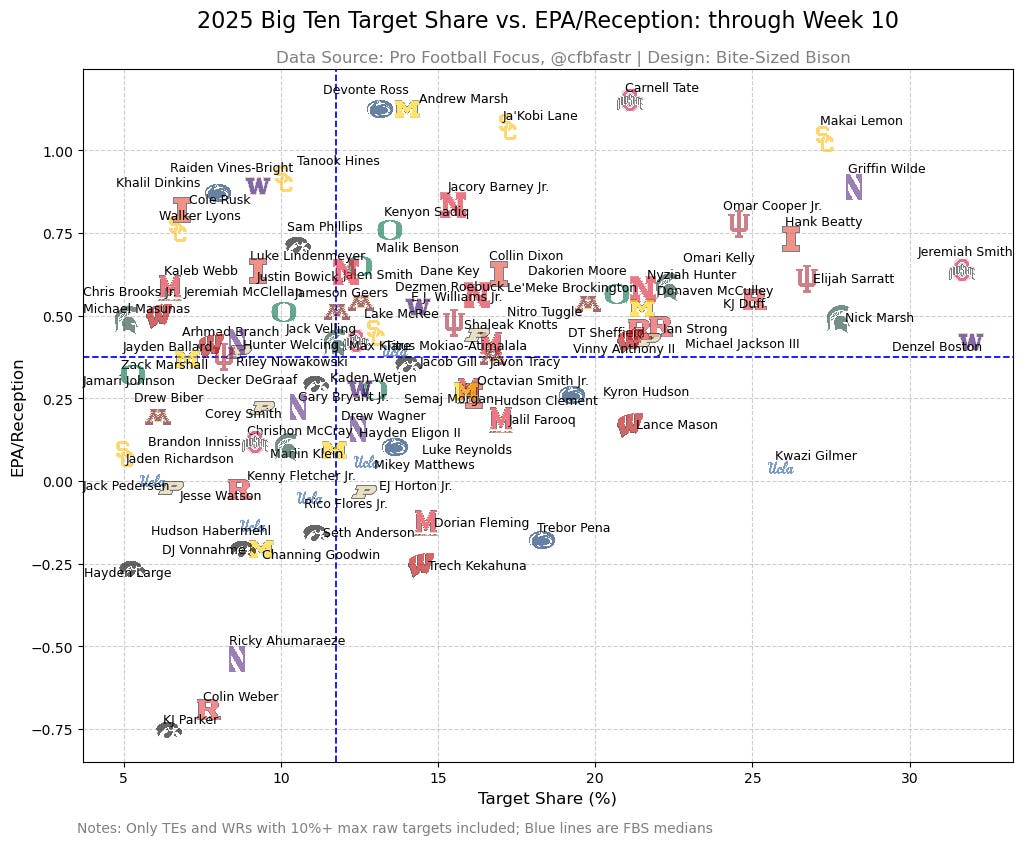
Penn State’s most-targeted receiver in the last two games, Trebor Pena, has caught 6-of-11 targets for just 30 yards; Troy transfer WR Devonte Ross has caught 7-of-9 targets for 41 yards, and RBs Nic Singleton and Kaytron Allen have combined to catch 9-of-11 targets for just 45 yards. Penn State’s lone consistent deep target since Grunkmeyer took over — Kyron Hudson — has caught just 1 of his 7 targets (16.6 average depth of target). All of those pass-catchers (Penn State’s leading receivers during this span) have combined to average 5.8 yards/catch.
However, much like Maryland last week, the baseline threat of spreading the ball out in the pass game is real. 10 receivers have been targeted by Grunkemeyer during Penn State’s last two games, and Terry Smith expressed a desire to target the TEs more often this week — built off play action — so Penn State clearly wants to get Indiana’s LBs in conflict, much like Maryland was able to do last week.
Does Indiana see more of the same from Jim Knowles?
Penn State DC Jim Knowles is a familiar face for this Indiana offense. Strangely enough, Indiana has also lost LG Drew Evans two weeks before the matchup this year too.
The woes for Indiana’s offense against Ohio State last season have been well documented: the Hoosiers were not prepared to communicate in Ohio Stadium, and — in tandem with some complex blitz packages Knowles dialed up — those struggles left Indiana’s offense lost. Kurtis Rourke was sacked a season-high 5 times, and Indiana finished in the 3rd percentile in EPA/dropback.
Knowles knows how to generate pressure on opposing QBs, and Indiana currently has a vulnerability at guard — once again. Can Mike Shanahan scheme a passing attack in the face of that defensive front?
Additionally, does Shanahan find success on the ground like he did against OSU in 2024? When removing sack yardage and yards lost by James Evans’ dropped punt, Indiana finished with 141 rushing yards (4.4 yards/carry) and within the 65th percentile for EPA/rush. Game script just made it difficult to stick with the rushing attack. Given the data previously noted in this newsletter, there should be room for Indiana to find a similar amount of rushing success against Penn State this week too.
How does Penn State change its offense this week?
The Penn State coaching staff has been trying basically everything it can to optimize its offense since Drew Allar’s injury. Last week against Ohio State, they created a package for slot WR Liam Clifford — brother of former Penn State QB Sean Clifford — which lined him up in new spots, including in shotgun as the QB three times. This didn’t result in much, but it did show a willingness to self-impose change.
StateCollege.com reported some notable observations during Penn State’s Wednesday practice, including intentional time away from the media’s view and new receivers, such as Trebor Pena, wearing wristbands — suggesting new installments may be in store for the offense.
What role do injuries play this week?
Indiana faced what seemed, in the moment, to be the greatest streak of injury concerns last week against Maryland. With Aiden Fisher already injured and sidelined, it was revealed that Drew Evans would miss the Maryland game as well. And during the game, Elijah Sarratt, Kaiden Turner, and Kahlil Benson all suffered injuries too. This comes after Kellan Wyatt’s injury two weeks before and Lee Beebe’s injury in the non-conference season.
But Curt Cignetti had good news in relation to the new injuries:
Evans will miss a few weeks, but his injury is not long-term.
Sarratt is day-to-day.
Fisher is optimistic to play this week.
Benson is expected to continue playing. He didn’t miss any scheduled snaps against Maryland.
Not much update on Turner or kickoff specialist Brendan Franke (hurt against Michigan State), but Cignetti noted that none of the injuries are long-term.
Ideally for Indiana, they’ll avoid any additional injuries to this list.
I always look forward to each newsletter. Like most old IU fans I have to remind myself that John Cappeletti and Joe Pa’s teams aren’t playing. Saquon isn’t playing either. That doesn’t mean they aren’t talented. IU has made great strides in the Ol this season. In the spring most of us were scared to death about Michalski being dependable anywhere in the front and Benson hadn’t been a “ball of fire” in his previous stint at IU. OL play down the stretch is critical. I have nightmares of Michigan, OSU and ND manhandling the interior last year after the injury bug hit. The Hoosiers are “so close” I don’t want injuries to derail their chances. Hopefully Haines and the fellas can sow some confusion and doubt on the mind of their young qb.
I keep waiting for Staes to make a contribution in the pass game. Teams may try to target Sarratt and Cooper but Williams is emerging and Hemby may still be a factor in the pass game.
Couple "I wishes" going into this one. I wish this was at home and we played in Madison, instead. I wish that we had Drew Evans, as I just don't trust Michalski and I think Drew might be more irreplaceable than Fisher or Sarratt. I wish the bye was this week in general - we could use the time to get healthy. Team is on the precipice of going perfect, as I am pretty drastically not phased by their last two opponents. Been as anxious this week for a regular season game as I can remember under Cig... and yet logically I think most likely outcome is us owning this game. Final I wish.. I wish I was watching Oregon @ Iowa right now with a comfy win behind us :)