

Week 11 Recap: Penn State
Now that the dust has settled, let's take a deeper look at Indiana's win against Penn State.

Indiana owned just a 52.1% postgame win expectancy — win probability as all essential stats are locked but shuffled to different points in the game — in its 27-24 win at Penn State on Saturday. That’s by far the lowest PWE of Indiana’s season (next-lowest was 92.9% against Old Dominion). This checks out because, if someone had told most Indiana fans the following would be true, there may have been some concern:
Roman Hemby was IU’s leading rusher, with 55 yards.
Charlie Becker was the leading receiver.
Fernando Mendoza would throw 1 touchdown.
Ethan Grunkemeyer would complete 71% of his passes.
Indiana’s OL would allow 3 sacks and 8 TFLs.
Elijah Sarratt would not play.
That’s obviously cherry-picking, but the collection of those events is not exactly how Indiana has found victory this season. These teams were throwing haymakers for 60 minutes.
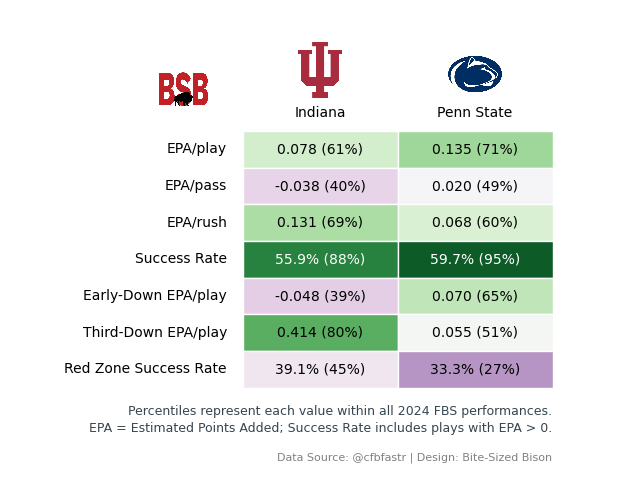
Yet, thanks to a gutsy offensive drive late in the fourth quarter — and to Omar Cooper’s left big toe — Indiana flipped its fortunes from a 7.1% win probability to the program’s first win in Happy Valley.
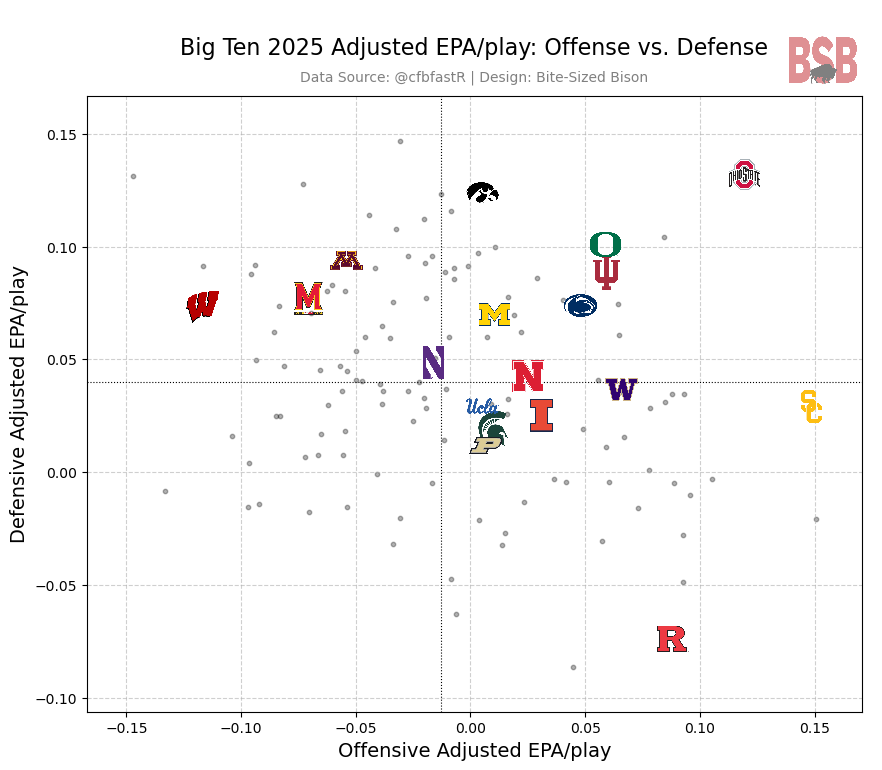
There is now a 98.6% chance that Indiana finishes the season undefeated — according to BSB’s win probability model using SP+ data.
The Hoosiers have two of the worst teams in the conference left on the schedule…
Indiana Offensive Snap Counts & Grades
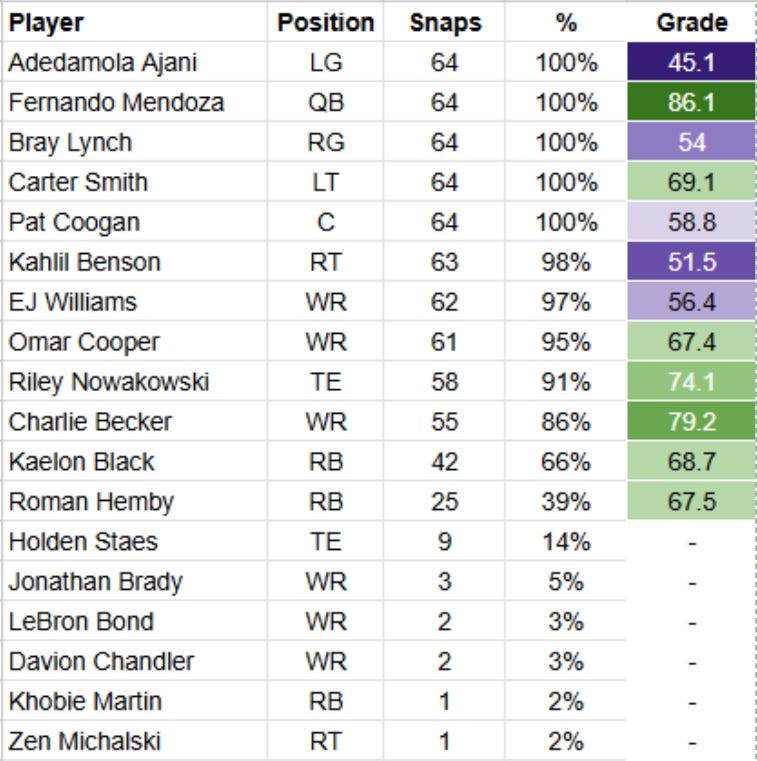
Observations:
This game is not won without Charlie Becker, the improbable leading receiver for Indiana. Becker is one of the final additions to the program by the Tom Allen administration. Indiana earned his commitment over Iowa and Northwestern in the 2024 class, and Becker was one of just eight commits/signees to be retained by Curt Cignetti’s staff after evaluation. The 6-foot-4, 209-pound Tennessee native burned his redshirt in 2024 while contributing to special teams, where he also starts in 2025. Before catching 7 of his 9 targets for 118 yards (including a ridiculous ball along the sideline during the game-winning drive), Becker was known for being a developing wideout who was an occasional favorite downfield target for Shanahan and Mendoza — 5 of his 16 targets this year were 20+ yards downfield, and he ranks 5th among Big Ten WRs in deep-ball catch rate (60%). He showed much more than that Saturday, while also recording second 50+ yard play in as many weeks. With opposing secondaries giving Omar Cooper nearly all of their attention (6 catches for 32 yards and a TD on 9 targets against PSU) during Elijah Sarratt’s absence, Becker can really find some opportunity on the perimeter.
Adedamola Ajani got his first career start and full-game reps at LG, replacing Zen Michalski as Drew Evans’ backup, and it went about as well as one would expect against a team with the talent and scheme of Penn State. Ajani surrendered 5 QB pressures (a lot for an interior OL) and was also Indiana’s lowest-graded run-blocker in the unit.
Kahlil Benson is battling through his lower leg injury. He was removed from the game for a snap after being rolled up on, but he came right back in. Whether it was related to the injury or not (surely it was to some extent), Benson logged his worst pass-blocking performance of the season, allowing 7 pressures and a sack. This is becoming a trend with Benson — who’s allowed 16 pressures to Indiana’s three toughest edge-rushing opponents (Iowa, Oregon, Penn State). In reference, Carter Smith surrendered just 1 pressure to those opponents. Once the postseason arrives, this will be something to watch.
Riley Nowakowski continues to be a wildcard in this offense, as he ran a season-high 27 routes (second-most of his career). He was much more involved in the passing game and held a monopoly on the TE role for a game when Shanahan went heavier with 11 personnel than 12. Nowakowski’s highlight was his 29-yard reception on a deep post route on Indiana’s game-winning drive. He had never been targeted that far downfield in his career.
Kaelon Black out-snapped Roman Hemby this week, which is a bit unusual. However, Hemby out-touched Black 13-12. Black did a majority of the blocking in the backfield (12 blocking snaps to Hemby’s 2).
Since his 109-yard game two weeks ago, EJ Williams has been targeted just 6 times on his 59 pass plays. He’s caught 4 of those targets for 31 yards.
Davion Chandler has played in three games now. It wouldn’t be surprising to see him cut off at the 4-game mark for his redshirt. LeBron Bond has long burned his redshirt a this point.
Indiana Defensive Snap Counts & Grades
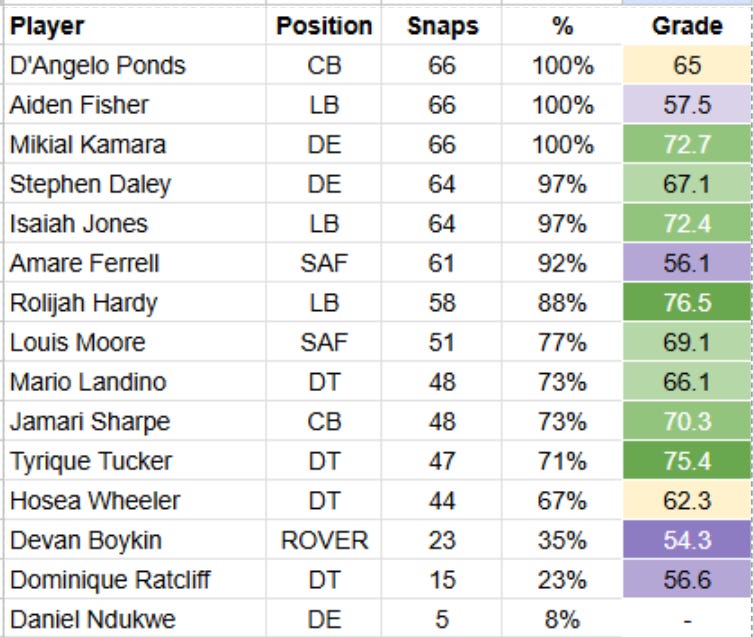
Observations:
Indiana’s DBs played fewer snaps this week, given the offensive philosophy of Penn State. There were more single-safety looks — Louis Moore played just 77% of snaps, Devan Boykin played 35%. But this shows how much this staff values D’Angelo Ponds. Ponds played every defensive snap, even if he wasn’t lined up across from a receiver. For example, Jamari Sharpe played 73% of snaps (48 total), and all but 2 were in the traditional CB alignment. Ponds, though, played 18 more snaps than Sharpe and lined up at CB for just 44 of his 66 snaps. Ponds is a unique anchor to this defense.
In conjunction with the point above: Indiana played very front-heavy this week against a Penn State offense that likes to run — and run physically. Indiana’s defensive linemen (save for Dominique Ratcliff and Daniel Ndikwe) all set season-highs in snaps played this week. This is particularly notable for the DTs, who each played 40+ snaps (a lot for DTs) Stephen Daley upped his season-high by 21 snaps — the biggest difference in this group. Aiden Fisher, Isaiah Jones, and Rolijah Hardy were essentially on the field at all times. The trio played 94.9% of available snaps.
It can’t be denied that Mikail Kamara isn’t finding the box score as often as he was in 2024. He’s 14th on the team in tackles (18), 8th in TFLs (4.0), and tied with William DePaepe for 8th in sacks (1.0). But Kamara is influencing games. He generated a season-high 8 QB pressures this week and averaged 5.5 pressures generated against Illinois, Iowa, Oregon, and Penn State. PFF produces a Pass Rush Productivity metric that seeks to measure pass pressure generated on a per-snap basis (favoring sacks) to get a better idea than raw pressure numbers can allow. Kamara leads all Big Ten DEs in the PRP metric, even with a single sack, and he’s 19th among FBS DEs.
Stats & Takeaways from Week 11
Northwestern is now the losingest program in the FBS, as it lost its 716th game this weekend, passing Indiana’s 715th.
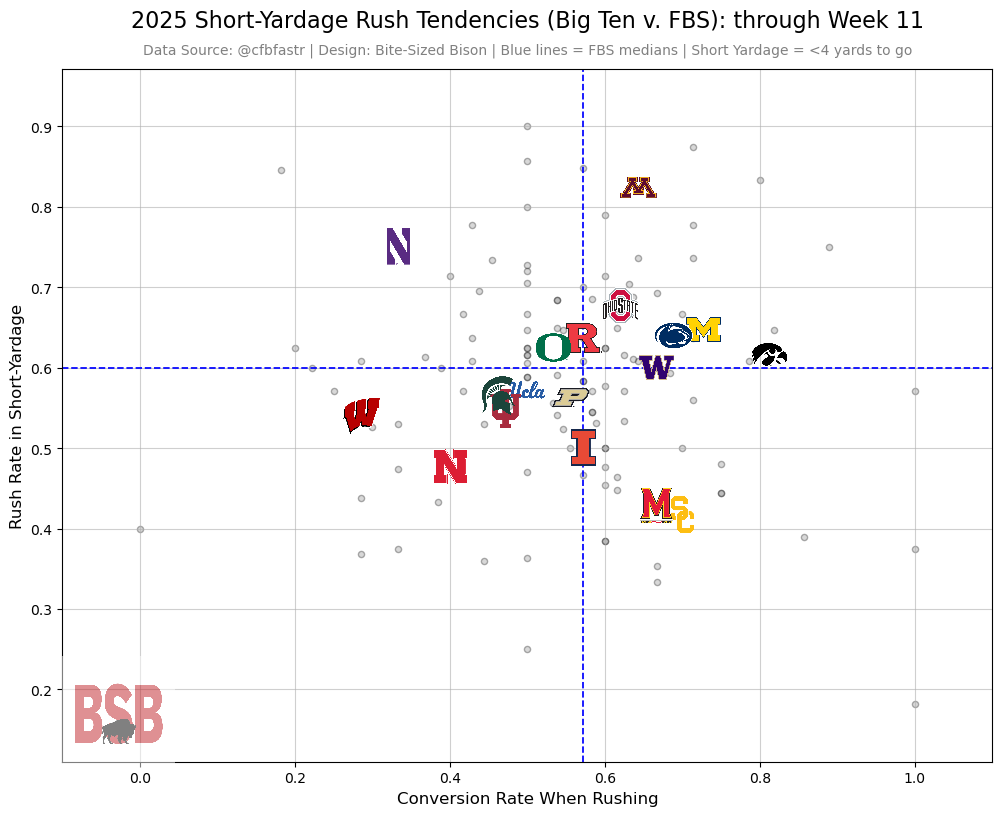
Mike Shanahan’s toughest task during the mid-to-late portion of the schedule has been scheming the rushing game — both to account for what Indiana has on its OL and to keep the scheme fresh as the season goes on. Within that is Indiana’s short-yardage woes. The Hoosiers rank 97th in conversion rate (47.0%) on rushes 3 yards or fewer from the first down or goal line. In their last four games, they rank 79th (50%). Shanahan’s attention to this phase has shown in many ways — adding Stephen Daley to the backfield, pulling Riley Nowakowski into the backfield (giving him the ball once), stacking blockers behind the interior linemen — but against Penn State, there were two new wrinkles: 1.) Giving the ball to Khobie Martin on 4th-and-1 (his only carry of the game), and 2.) a new Pistol package with both Roman Hemby and Kaelon Black in the backfield. Indiana converted on 4-of-7 short-yardage runs against Penn State, which is above its average conversion rate for the season.
As noted by the snap counts for DLs and LBs this week, the focus was on Penn State’s rushing attack, which ranked 17th in success rate coming into the game. Indiana held the Nittany Lions to the 60th percentile in EPA/rush and to just 13 successful rushes on 33 carries. Most notably, Indiana stonewalled Kaytron Allen, who forced a season-second-low 4 missed tackles, gained no more than 7 yards on any carry, scored 0 TDs for the first time this season, and averaged 2.5 yards/carry (the 4th-lowest of his 51 career games). Nic Singleton broke open a 59-yard TD rush, but discounting that explosive, the RB duo gained 70 yards on the other 28 carries (2.5 yards/carry). Not discounting the explosive Singleton run, Penn State still had its 2nd-worst rushing performance of the season.
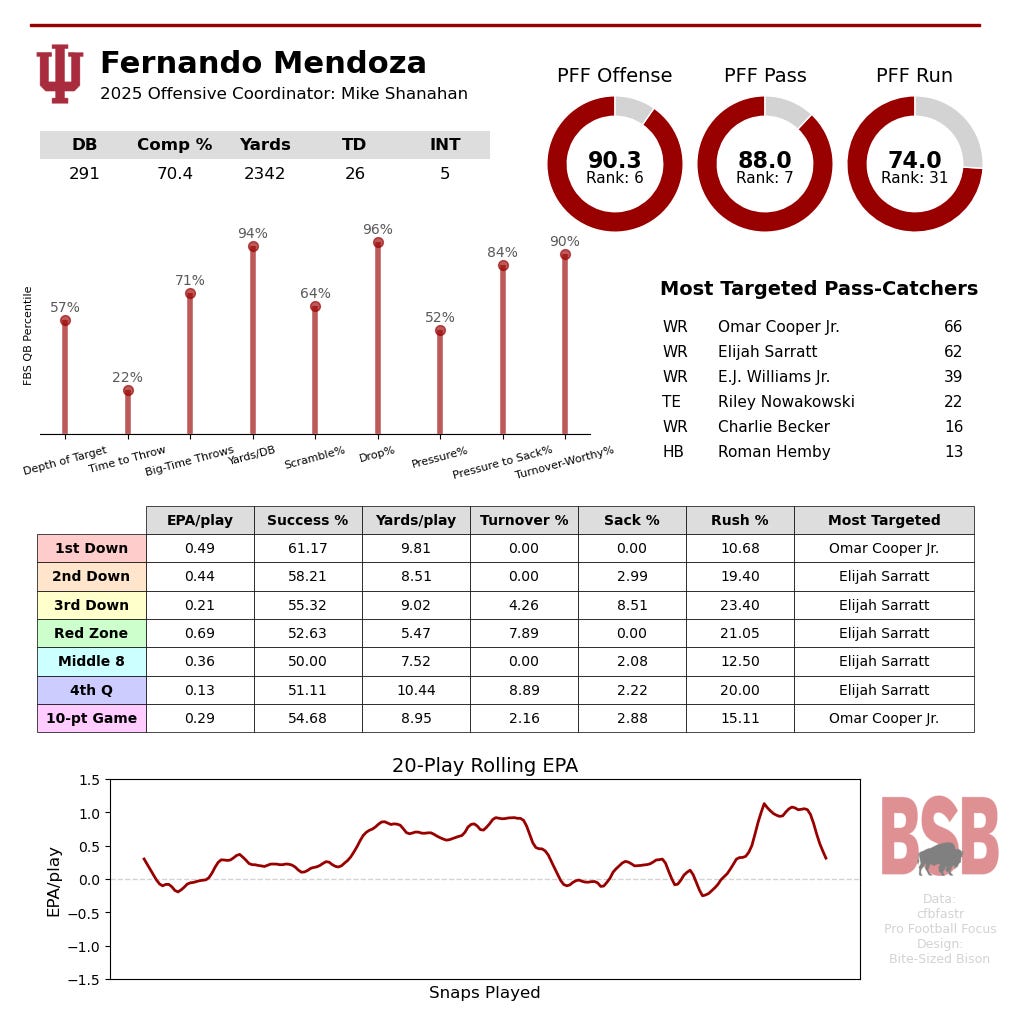
Fernando Mendoza felt a season-high amount of pressure this week. He was pressured on 50% (18) of his dropbacks and was blitzed on 20 of his dropbacks (resulting in 10 pressures). When under pressure, he was very effective, with an adjusted completion percentage of 77% for 86 yards, 1 TD, 0 INT, and 25 scramble yards on two carries. This is an area Mendoza has shown a ton of growth from Week 1 to Week 11, as he’s now graded No. 1 among Big Ten QBs (40+ pressured dropbacks) when under pressure.
Penn State HC Terry Smith said going into the game that he wanted to get the TEs more involved in the passing game, and they did. Penn State’s TEs combined for 8 catches for 58 yards. The only productive WR was Trebor Pena, who gained 99 yards on 6 catches, thanks largely to his 43-yard catch against Jamari Sharpe.
Indiana’s defense is beginning to break through with takeaways. After forcing two turnovers against Penn State, Indiana has now forced 10 turnovers in its last three games.
Fernando Mendoza QB Profile
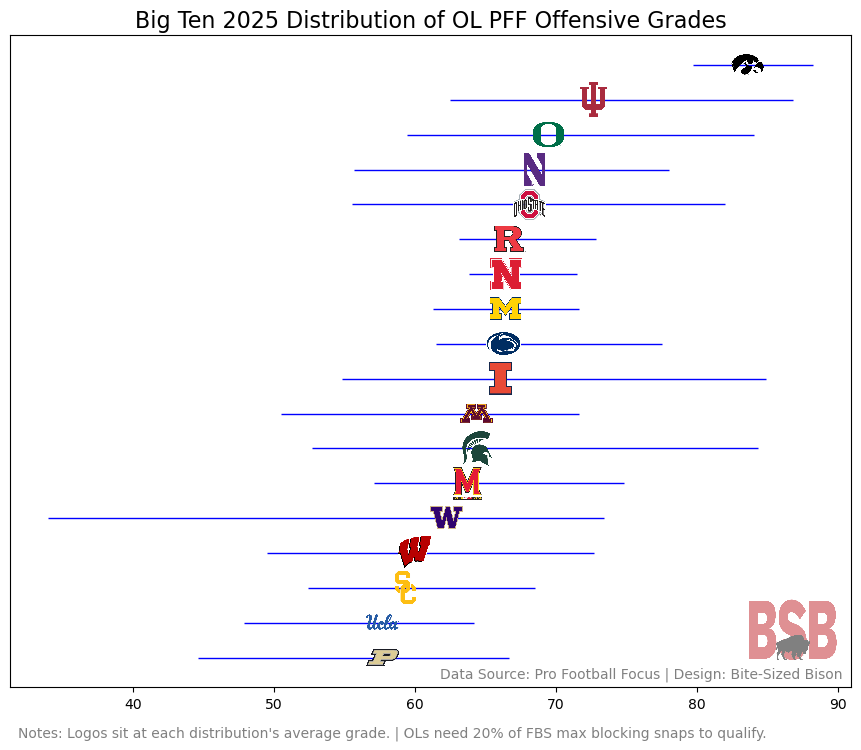
Offensive Line Production
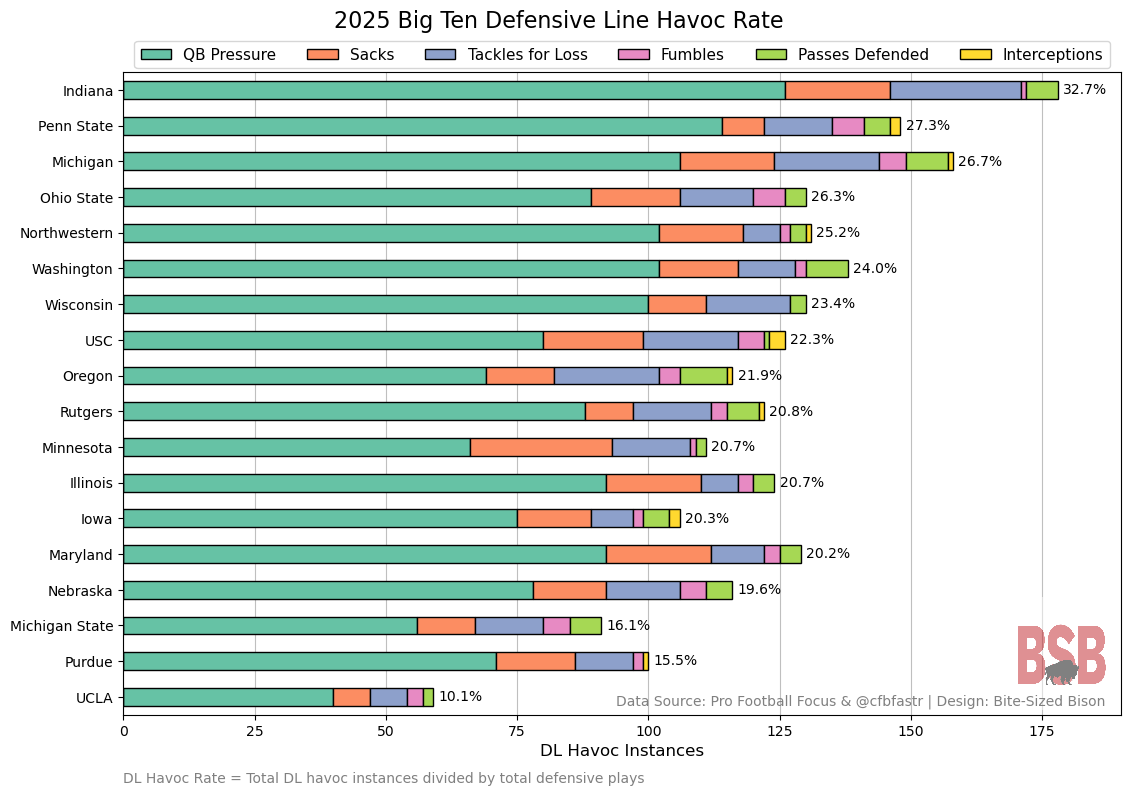
On the other side of the line, Indiana’s DL is causing a ton of havoc. The Hoosiers are really pulling away from the rest of the conference.
It seems like other teams routinely send 5, 6 or 7 guys on blitzes vs IU while IU rarely sends more than 4. Does the data back that up? PSU sent 7 on the game winning play.
I am still worn down by this game. I have a lot of angst about the OL going forward. I still have nightmares of the last games after the achilles injury at LG and trying to remedy it vs teams with talent. A quick review of Mendoza’s winning play seems to show the PSU blitzing corner well offside vs Benson. Toss in the official blocking Ponds on Singleton’s run… Anyway what a game.
IU will go as far in the playoffs as Mendoza can take them with the OL in a quandary.
Go IU