

Week 12 Preview: Wisconsin
Prepare for Indiana's Week 12 matchup against the Wisconsin Badgers with a comprehensive BSB Preview!


Indiana has a 98.6% chance to finish the 2025 season 12-0, according to BSB’s win probability model (using SP+ data). To do that, though, it needs to get through Wisconsin — who, despite its 3-6 record, few teams actually want to play. The Badgers are physical and finally picked up a big win (13-10 against then-No. 23 Washington) this past week, following a simply murderous schedule that ranks 2nd-most difficult nationally by FPI — SP+ No. 11 Alabama, No. 61 Maryland, No. 18 Michigan, No. 15 Iowa, No. 1 Ohio State, No. 3 Oregon, and No. 21 Washington since Week 3. There is no more tested team on Indiana’s schedule than Wisconsin.
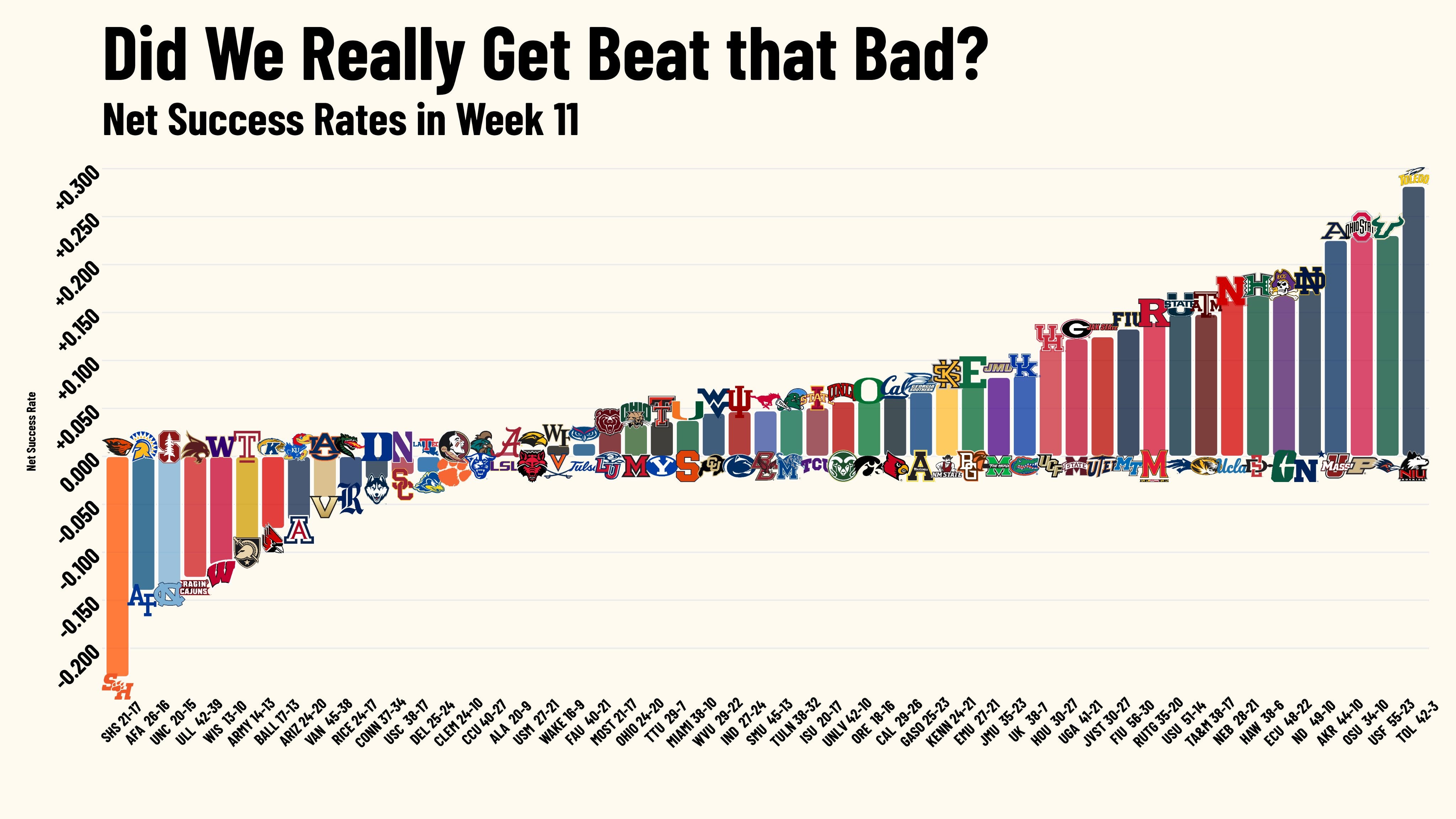
It’s important that Indiana does not give Wisconsin an inch Saturday. The Badgers finished the game against Washington with just a 19.2% postgame win expectancy and a significantly lower net success rate, yet pulled out the win.
Source: Parker Fleming
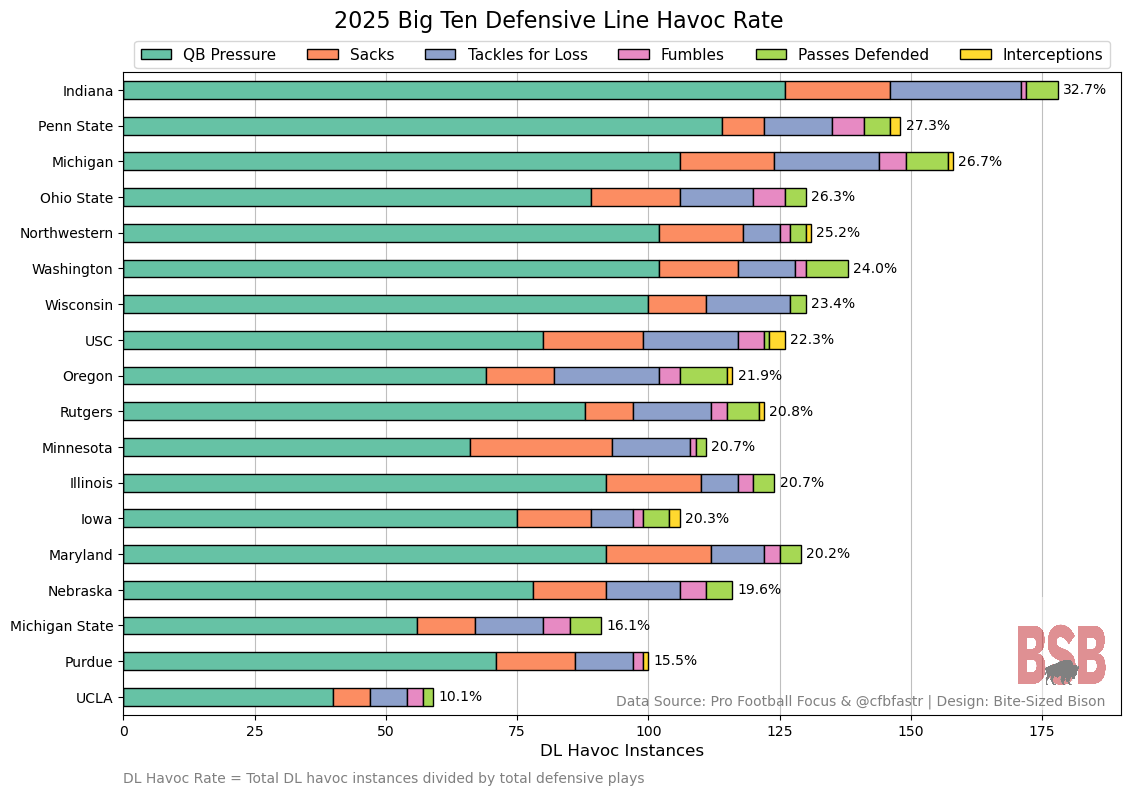
And among Wisconsin’s six losses, three finished with non-zero postgame win expectancies — Maryland (0.2%), Michigan (0.2%), and Oregon (0.1%). Each of those games finished with Wisconsin losing by no more than 17 (Maryland). This is because Wisconsin has a fairly strong defense and leans on its physicality (seen in chart below). Stalling offensively risks falling prey to the Venus fly trap, like Washington.
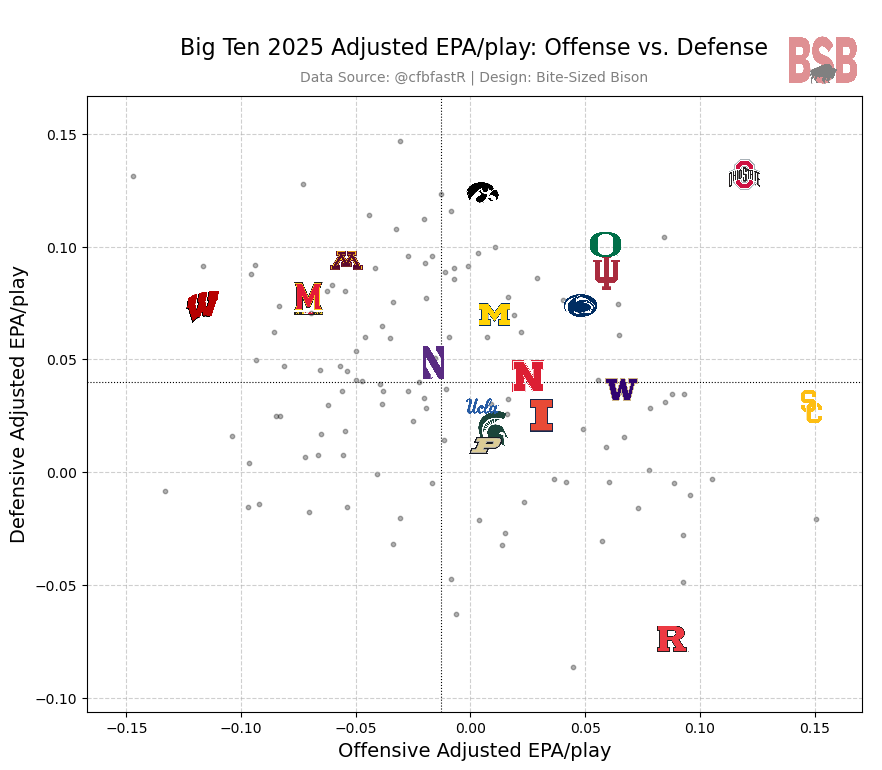
If Indiana can find consistent offensive success, even if just for one half, getting to 11-0 shouldn’t be a problem. But a -29.5 spread could be a bit generous if Wisconsin’s defense is legitimate.
In this preview:
Opponent Overview
Advanced Stat Preview (The Chart)
Wisconsin OL Preview
Wisconsin Key Contributors
EPA Distribution by Scenario
What BSB is Watching For
Opponent Overview
Luke Fickell — who was once on the same Ohio State defensive staff as Bryant Haines in 2012 — returns to Bloomington for the first time since 2021, when the Micah McFadden targeting call in that 38-24 loss to Cincinnati was a shockingly clear delineation between the 2019-20 seasons and what the Tom Allen Era would become. In his three seasons in Madison, though, Fickell hasn’t found much luck, as his current 2+ season record sits at 15-19.
Part of Fickell’s initial staff building process was letting Tom Allen hire away Wisconsin’s incumbent OL coach, Bob Bostad, who represented one of Allen’s best hires at Indiana and who remains Indiana’s OL coach today, building the offensive front across from Haines’ defensive front that combine to give Indiana its identity under Curt Cignetti.
Source: Bill Radjewski
Aside from letting Bostad go, Fickell brought along DC Mike Tressel from Cincinnati. Tressel — the nephew of legendary Ohio State coach Jim Tressel — was hired to Cincinnati’s staff in 2004 by Mike Dantonio and then followed him to Michigan State in 2006, where he remained for 15 seasons after being retained by Mel Tucker. He was then hired back to Cincinnati by Fickell in 2021. Tressel coached both MSU and Cincinnati to some of the best eras in both programs’ histories, including CFP appearances as DC — MSU in 2015, Cincinnati in 2021. Tressel’s defenses have been the most sustained successes during Fickell’s three-season stretch at Wisconsin, as the Badgers’ defenses have consistently been inside the top-35, according to FEI.
Fickell’s 3-3-5 scheme is similar to Old Dominion’s — which gave Indiana fits in Week 1.
But, as Cignetti noted earlier this week, Fickell has never had a chance on offense. He’s brought in three transfer QBs in each of his three seasons — Tanner Mordecai from SMU in 2023, Tyler Van Dyke from Miami in 2024, and Billy Edwards from Maryland in 2025 — and those transfers have combined for just 38% of Wisconsin’s dropbacks in those seasons. Wisconsin’s punter was its leading passer last week against Washington, after a 23-yard fake punt completion. True freshman QB Carter Smith became the fourth QB to play for Wisconsin this season.
This season in particular has been tough for Wisconsin, in term of injuries. Going into their game against Oregon two weeks ago, the Badgers were missing eight of the 22 expected Week 1 starters.
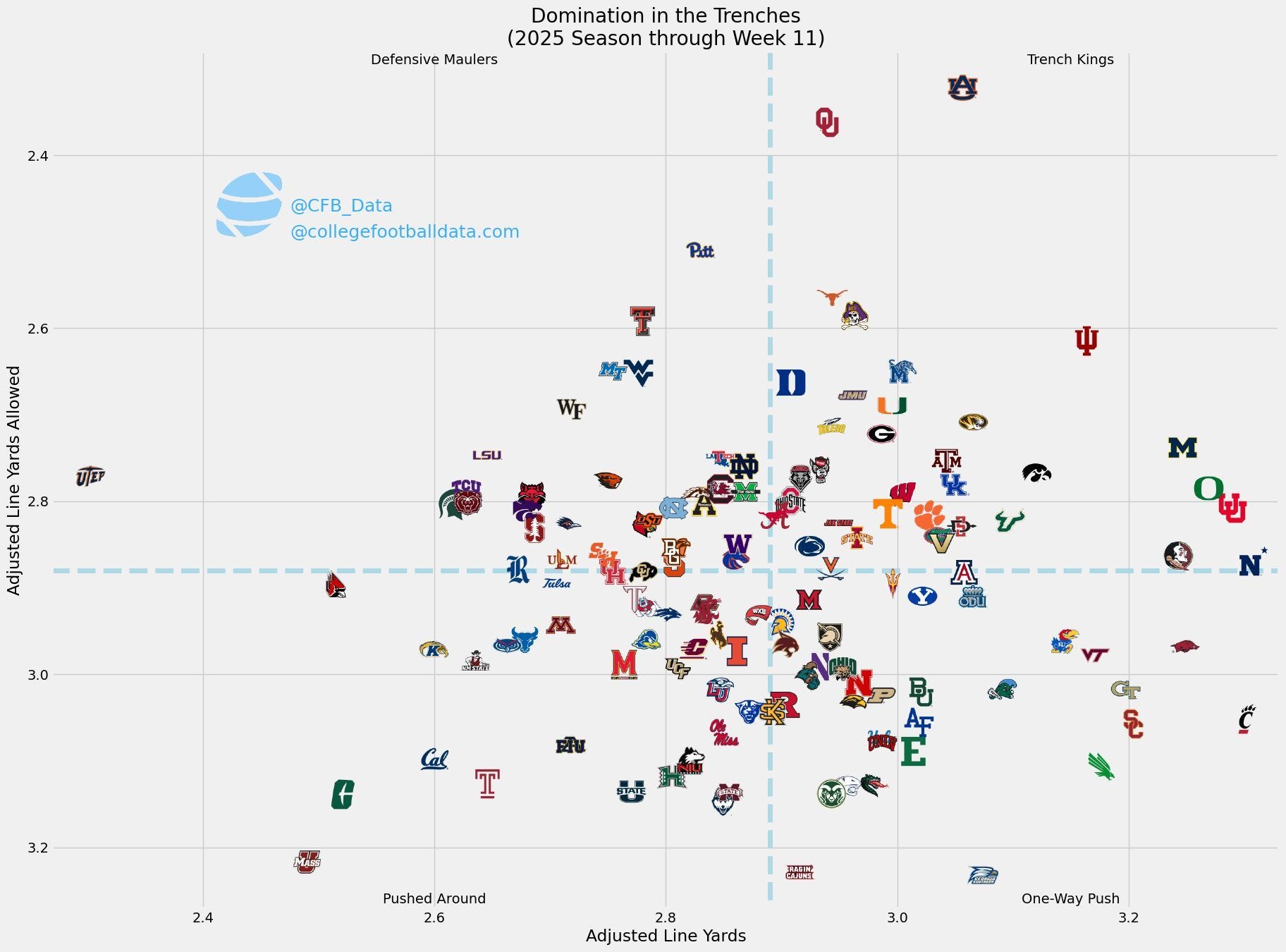
Regardless, the Badgers are a team focused on the trenches, which should always garner some semblance of success, but Wisconsin has been incredibly bad offensively, against some really strong defenses — none better than the one they’re traveling to play Saturday. But, as the graphic above suggests, this Wisconsin team is not to be taken lightly, as they’ve performed better in the trenches than Penn State, when adjusted for opponents.
Advanced Stat Preview (The Chart)
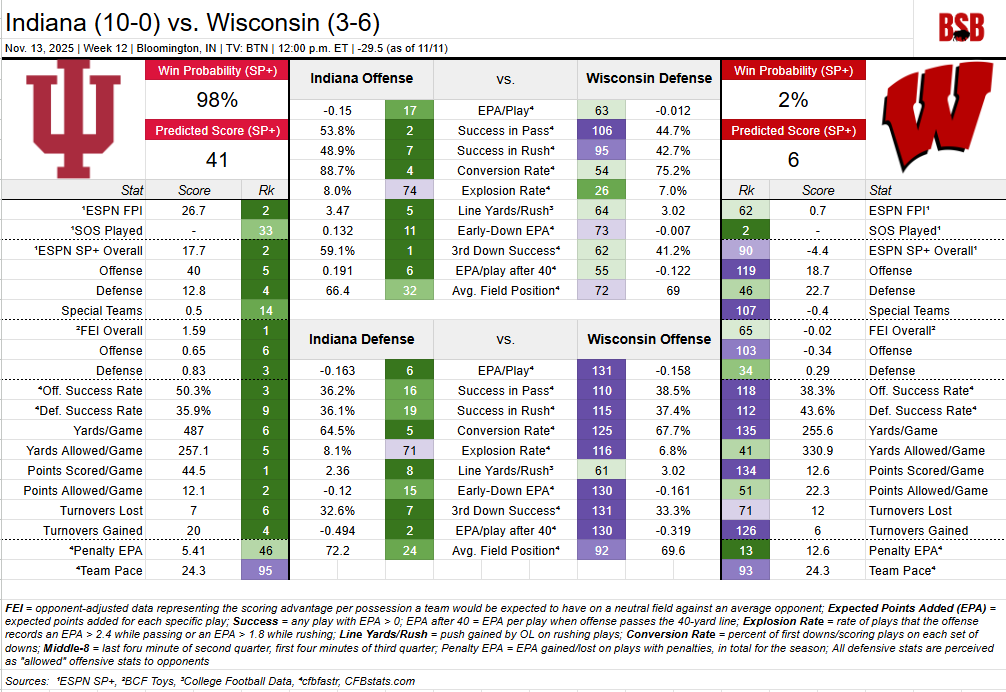
Some Observations:
Wisconsin’s Explosion Rate Allowed: Wisconsin has been effective at keeping opponents’ plays within expectation, as it ranks 26th in explosion rate allowed. It ranks top-50 in fewest plays of 20+ yards allowed.
Wisconsin’s EPA/play Allowed: Related to the last point, Wisconsin will allow success to opposing offenses (who wouldn’t against that schedule?), but it keeps plays within expectation, resulting in a slightly above average defense on a per-play basis. This is also seen in the yards and points allowed per game.
Wisconsin’s Penalty EPA: The Badgers have benefitted the 13th-most by penalties so far this season.
Wisconsin’s Turnovers Gained: While Wisconsin’s defense has played fairly well against a tough schedule, it hasn’t forced many turnovers — just 6 through 9 games.
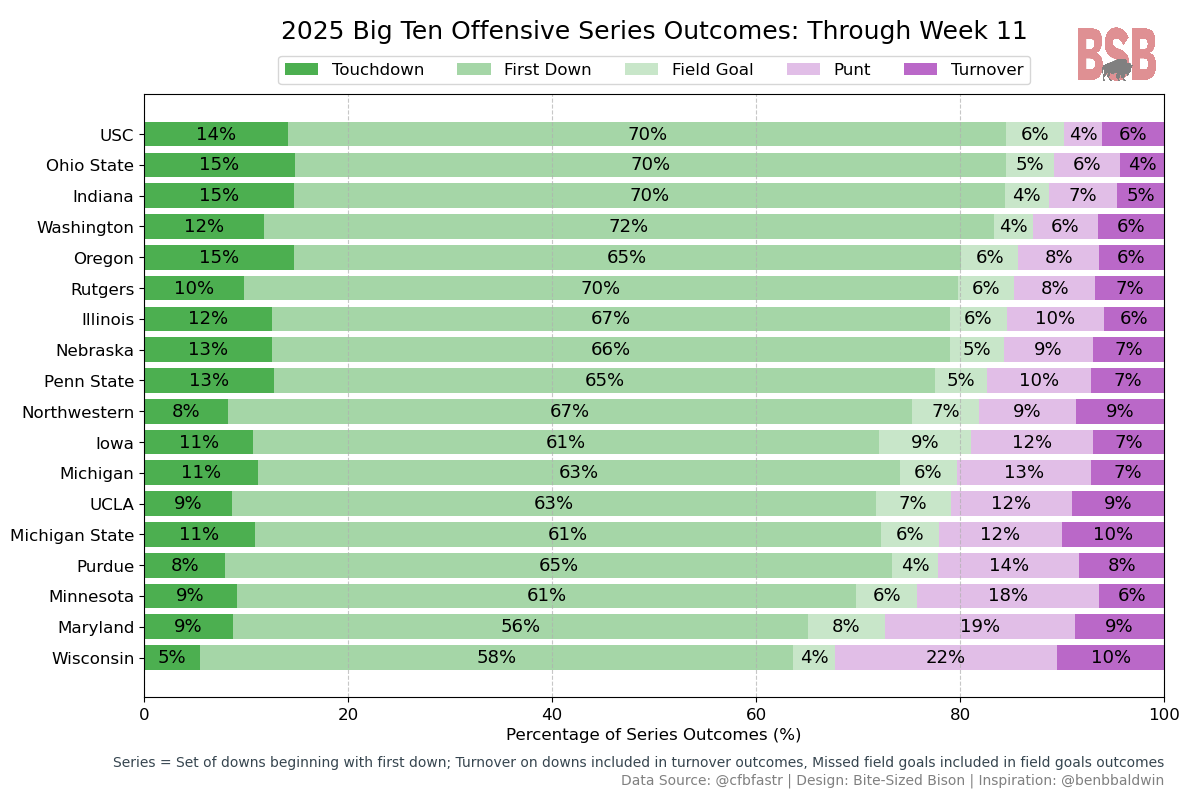
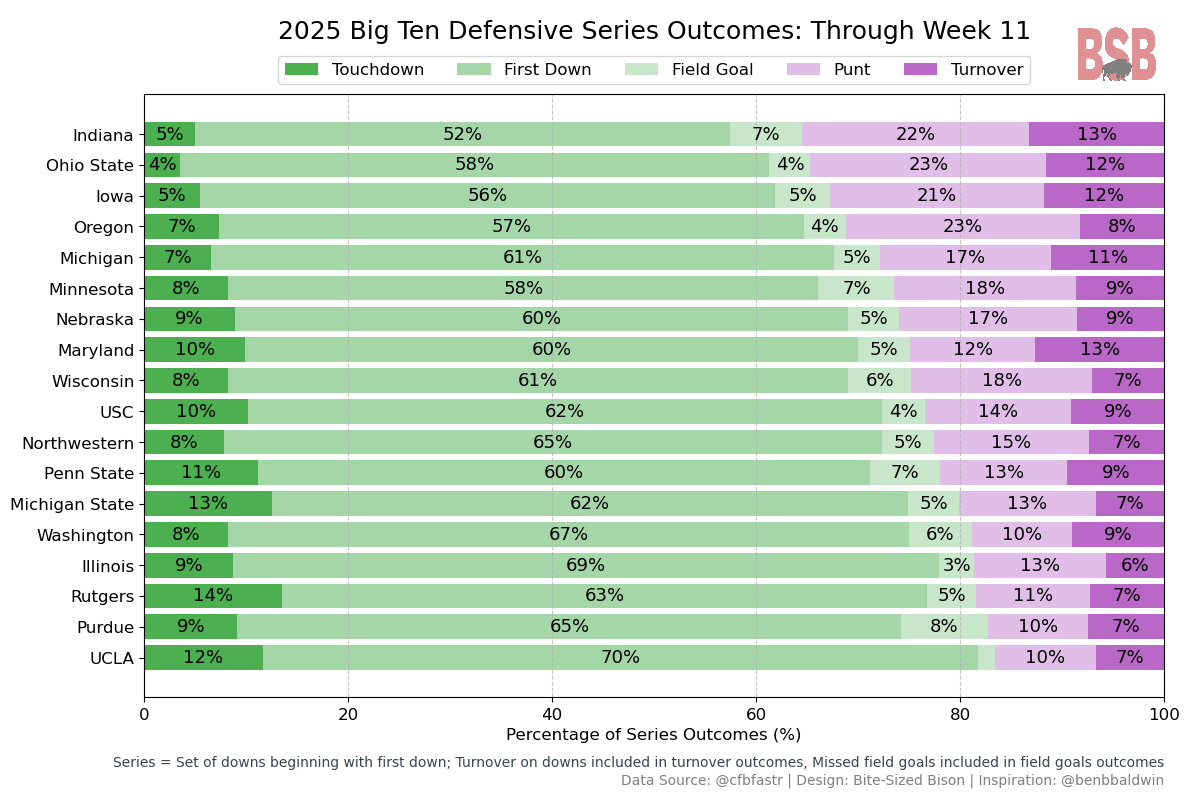
Wisconsin’s Conversion Rates: With Wisconsin ranking 125th in offensive conversion rate, 54th in defensive conversion rate allowed, and 71st (roughly average) in turnovers lost, nobody in the Big Ten has featured more punts in its games than the Badgers. They rank 20th among FBS teams in total punts, received or kicked, this season.
Wisconsin OL Preview
Notes:
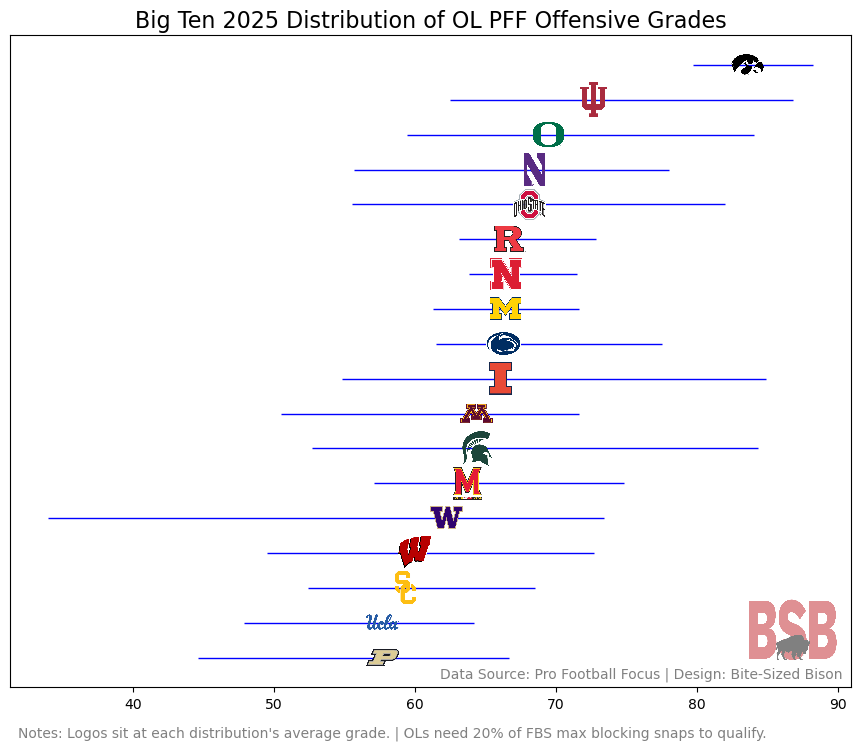
Wisconsin was doomed for this chart, which shows grades for execution. Executing against some of these defenses would be tough for any OL. This is the anchor of an offense that’s tried to find any way to run the ball, the catalyst for any offense aiming for balance.
Jake Renfro — the center who followed Luke Fickell from Cincinnati and was highly anticipated coming into the season — has been in and out all season, only playing four games, and recently underwent season-ending surgery. That’s an incredible loss for the unit.
Wisconsin only has one OL graded average or better in run-blocking scenarios, and it’s its starting LG Joe Brunner. Wisconsin has converted the most first downs on either side of Brunner, even though it averages just 4.0 yards/carry.
Wisconsin’s tackles don’t surrender too much pressure, but when they do, it typically results in sacks. RT Emerson Mandell ranks 5th among Big Ten tackles in most sacks surrendered, with 5, and LT Riley Mahlman is 8th, with 3.
The Badger front has its toughest task ahead, though, with an Indiana DL that attacks from the interior as aggressively as anyone in the country. There will likely be plenty of 5-DL looks in this one.
Wisconsin Key Contributors
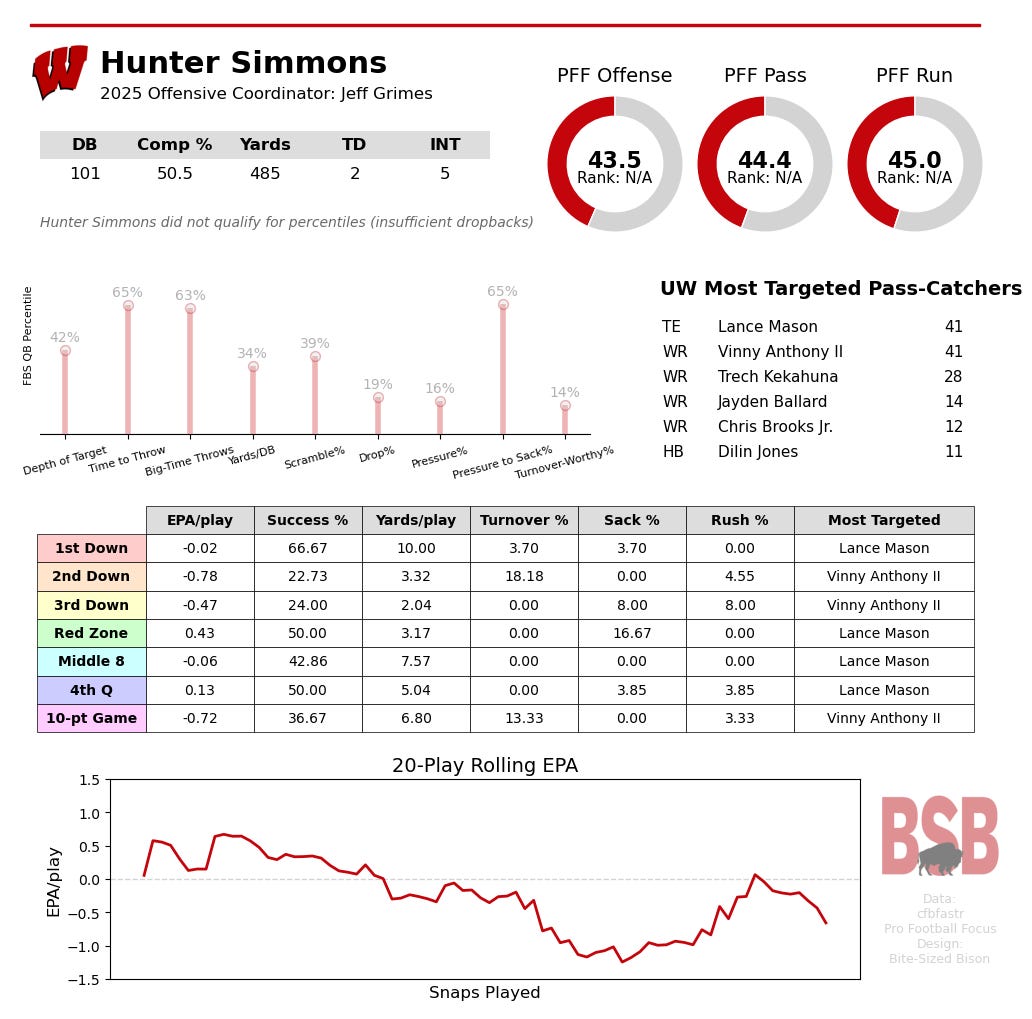
QBs Hunter Simmons & Carter Smith: After Danny O’Neil (Wisconsin’s Week 1 backup QB) went down with an injury against Washington, Luke Fickell turned to true freshman Carter Smith, who ran 15 times for 47 yards and Wisconsin’s only TD but also went 3-for-12 and was outgained by his own punter through the air. Fickell was non-committal earlier this week on his starting QB, and it’s likely because he knows, in order to beat Bryant Haines, he needs a QB who can pass the ball. That means it will likely be Southern Illinois, Week 1 QB3 Hunter Simmons starting in Bloomington. He’s been dreadful, so if he does start, there may be a short leash.
DE Mason Reiger: A former Mark Hagen product at Louisville, Reiger has become Wisconsin’s No. 1 pass-rusher after transferring this offseason, as he’s tallied 34 QB pressures, which is 2nd to Mikail Kamara among Big Ten DEs. He’s done this against some tough OL matchups too. With the way Wisconsin uses its depth at LB, Reiger is a schematic nightmare that will be a challenge for Indiana’s OL.
DE Sebastian Cheeks: Cheeks lines up on the opposite side of the line as Mason Reiger and will begin in either a two-point or three-point stance. Cheeks is 3rd on the team in TFLs and 2nd in sacks, and he owns a PFF Pass Rush Productivity just behind that of Stephen Daley. Indiana’s tackles will have tough assignments this week.
LB Mason Posa: A true freshman out of Albuquerque, LB Mason Posa has taken command of the starting role on the edge of Wisconsin’s defense in the last two weeks. Among all Big Ten LBs with 200+ snaps, he’s graded No. 1 by PFF. His game against Washington last week was much like Charlie Becker’s for Indiana, as he burst onto the scene with 11 tackles, 2.5 sacks (7 pressures), and 2.5 TFLs in just his second start.
EPA Distribution by Scenario
The chart below shows the proportionate distribution of plays by EPA values in each of the four basic phases on offense and defense — Passing, Against the Pass, Rushing, and Against the Rush. These can show us how teams are finding their success on either side of the ball.
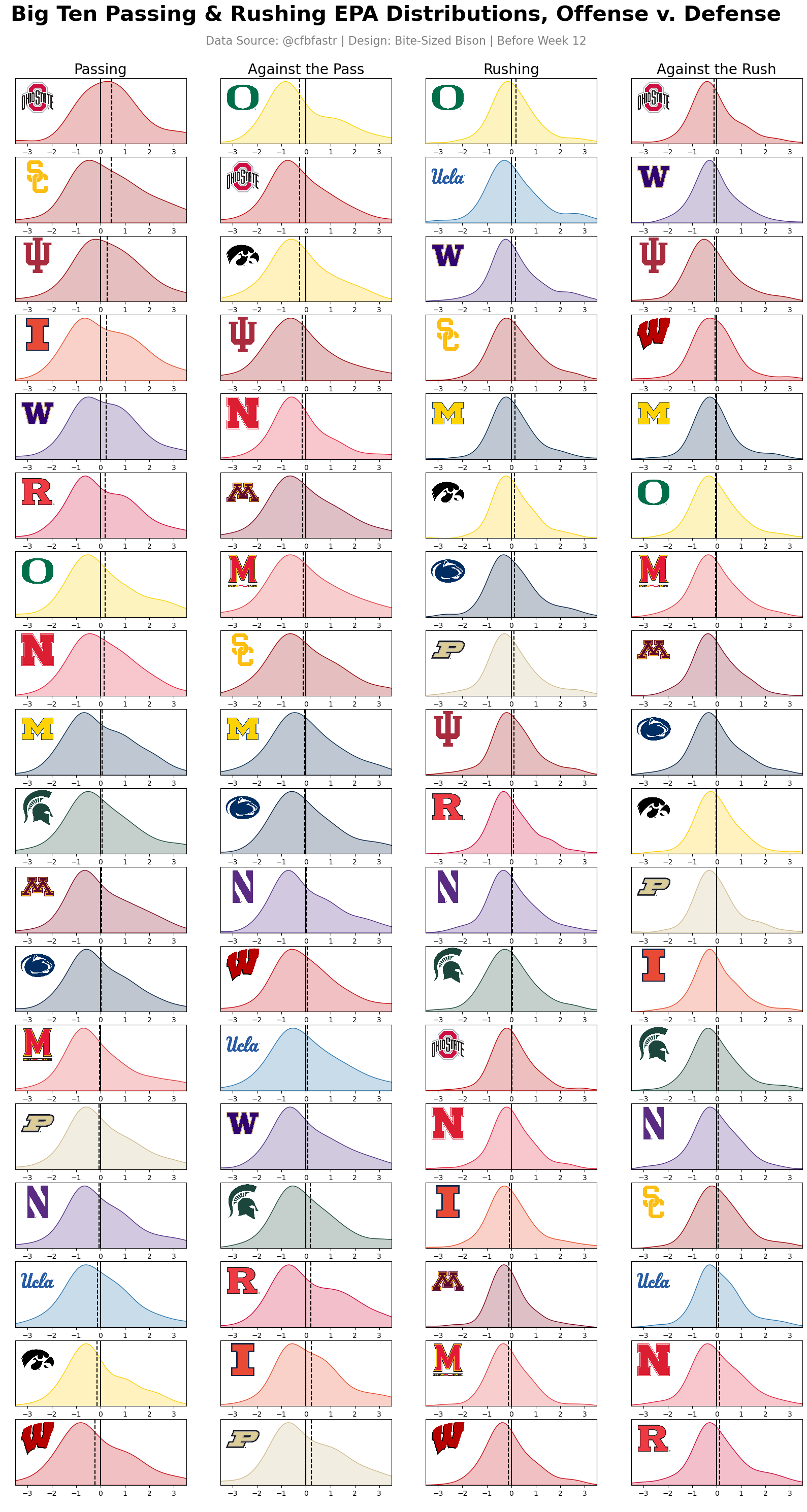
Wisconsin Passing: Wisconsin wants to be a balanced offense — run the ball and play off it for the pass, using play action — but the lack of continuity at QB and any real playmakers at receiver has left this Badger passing attack inconsistent. Wisconsin ranks 130th in passing yards per game with a 7-to-10 TD-to-INT ratio, and it shows in this chart. See the very negative peak and wide curve toward the negative axis, while there is a bump on the positive side, signaling occasional success.
Wisconsin Against the Rush: Limiting the rush was Wisconsin’s top priority for 2025, and it’s done so fairly well. The Badgers have allowed two teams to average 5+ yards per carry (Michigan and Iowa) but limited Alabama to 3.3, Ohio State to 3.5, Oregon to 4.5, and Washington to 3.2. While they do surrender plenty of success on the ground, in terms of expectation (EPA), it ranks 26th in rushing yards allowed per game. Indiana averaged just 3.5 yards/carry against Penn State, and when it ran 57 times at Old Dominion’s 3-3-5 scheme, ODU stood them up at times.
What BSB is Watching For
Can Indiana get out to an early lead?
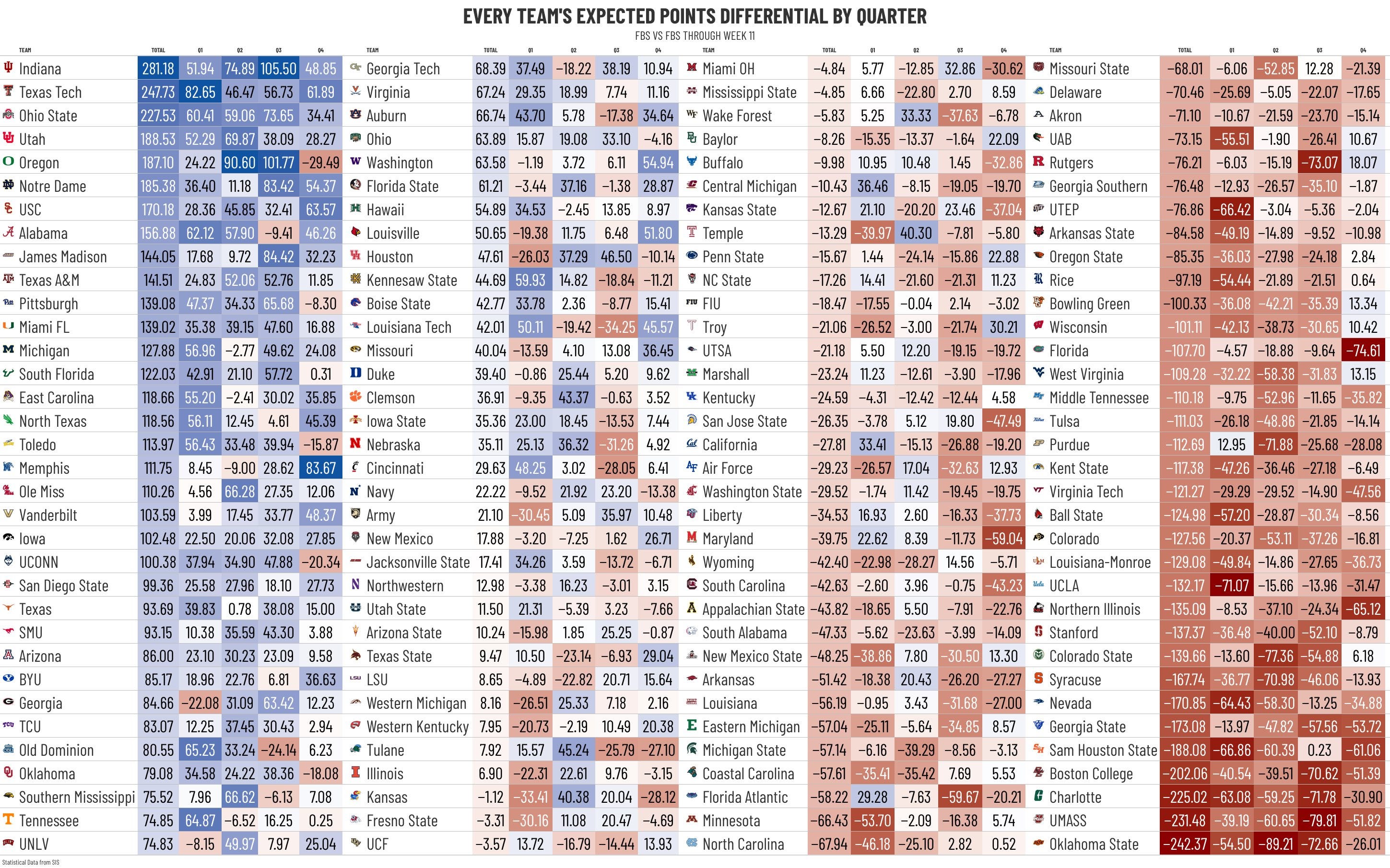
As noted at the top, you can’t give this Wisconsin team an inch because the Badgers will hang around. That means an early lead is imperative, which Wisconsin has been eager to give its Power 4 opponents so far — being outscored 108-10 in first halves. The chart below also shows that Wisconsin gets off to fairly awful starts.
Source: Parker Fleming
In the games where Wisconsin had a 0.0% postgame win expectancy — Alabama, Iowa, and Ohio State — it was outscored 61-0 in the first half. But for teams that didn’t build big leads by halftime — Oregon (7-0 at halftime), Michigan (10-7), and Washington (10-3) — they struggled to pull away in the second half.
That’s because Wisconsin doesn’t go away. After the scripted play window (roughly the first 15 plays of each team’s offensive drives), Wisconsin has actually been pretty solid defensively on a per-play basis:
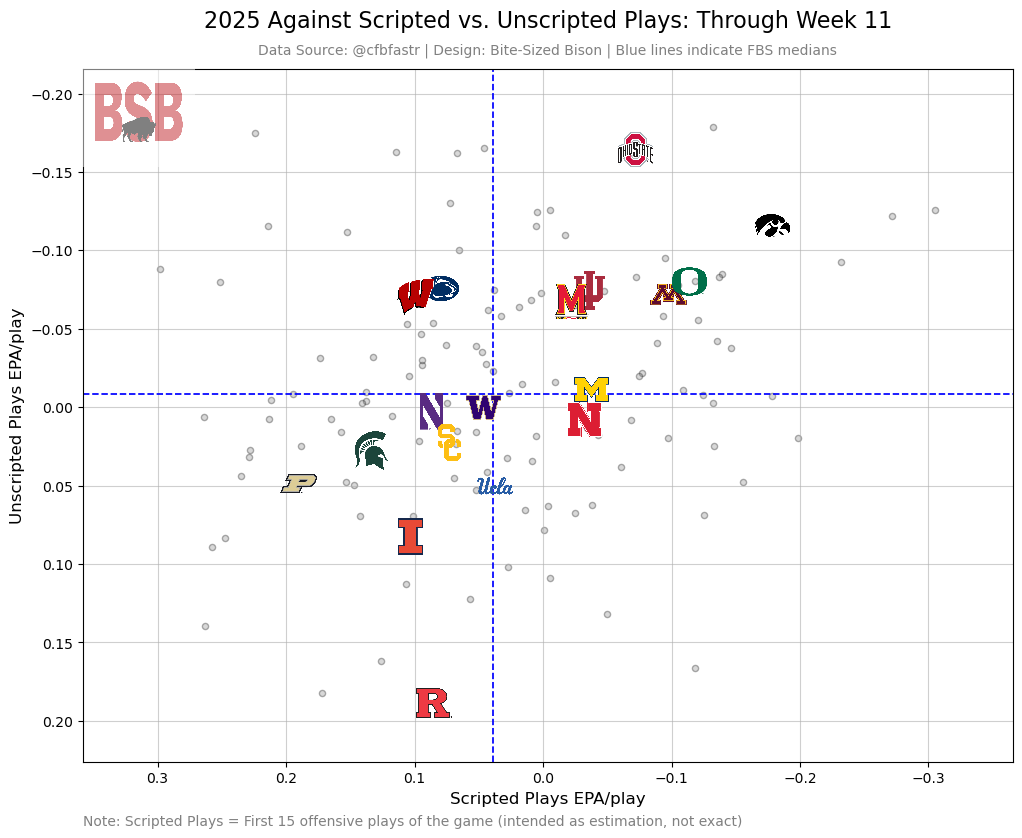
The Badgers simply don’t have the offense to make up a lead that is more than one score.
How does Indiana attack Mike Tressel’s 3-3-5 defense?
This is likely the closest scheme Indiana will play to the Old Dominion scheme in Week 1, which held the IU offense to its 4th-lowest yards/play (5.6) of the season, just behind Iowa (5.4), Penn State (5.3), and Oregon (4.8).
The 3-3-5 scheme Tressel uses rotates a cast of 10-12 players in the front seven alone, which — a lot like Indiana — makes its defense multiple and keeps the offense guessing. This type of scheme also makes it easy for the defense to put opposing guards into conflict, because of unusual fits, which is bad news for Indiana right now, with Drew Evans still out. This will be a good learning experience for Adedamola Ajani if Zen Michalski isn’t back.
The Hoosiers will run the ball, of course. They’ve run the ball the 6th-most in the nation, and they use the run to not only establish balance but also to control the clock and pace. But if Wisconsin can effectively defend the run, does Indiana give the ball to Fernando Mendoza more often?
Teams like to throw against Wisconsin, which is typically uncharacteristic for a Mike Tressel defense, but Ohio State threw 42 times (to 28 rushes), Alabama threw 30 times (to 22 rushes), and Iowa threw 25 times (its 3rd-most of the season).
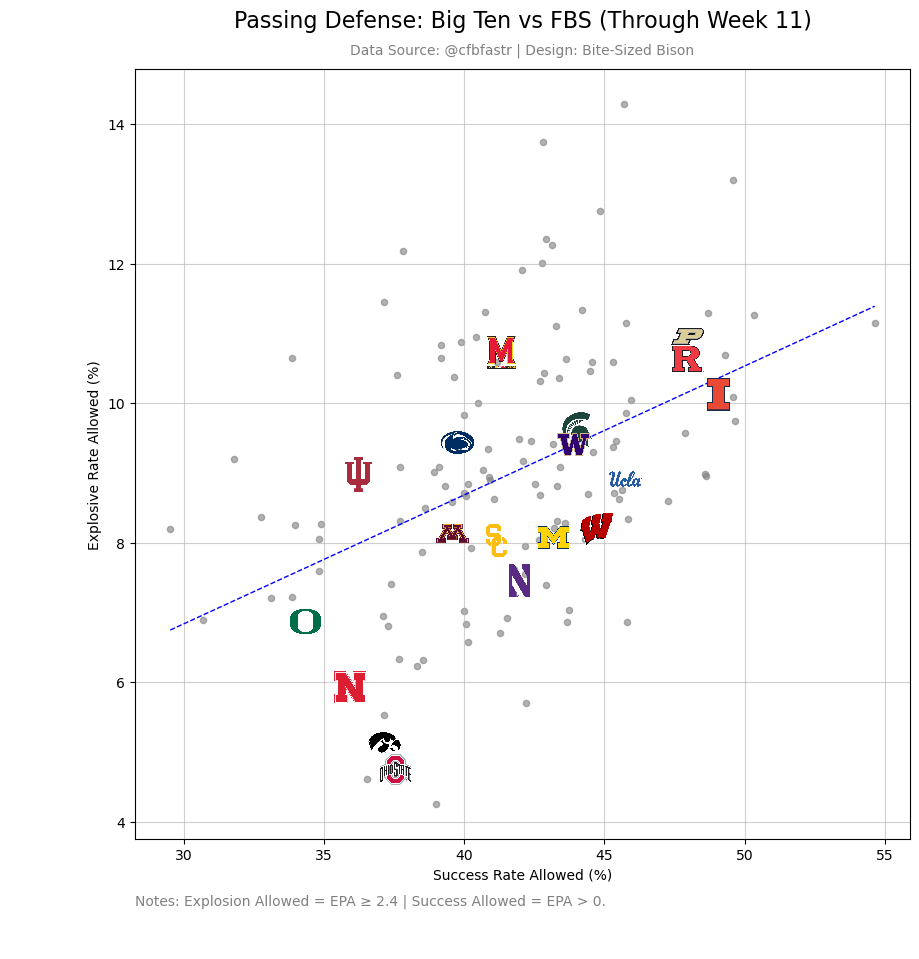
The Badgers rank 97th in passing yards/attempt allowed and outside the top-120 in DB havoc rate. The chart below reaffirms what has already been discussed: Wisconsin surrenders success in the passing game (5th-most in the conference) but not a ton outside of expectation.
How does Indiana handle short-yardage rushing situations offensively?
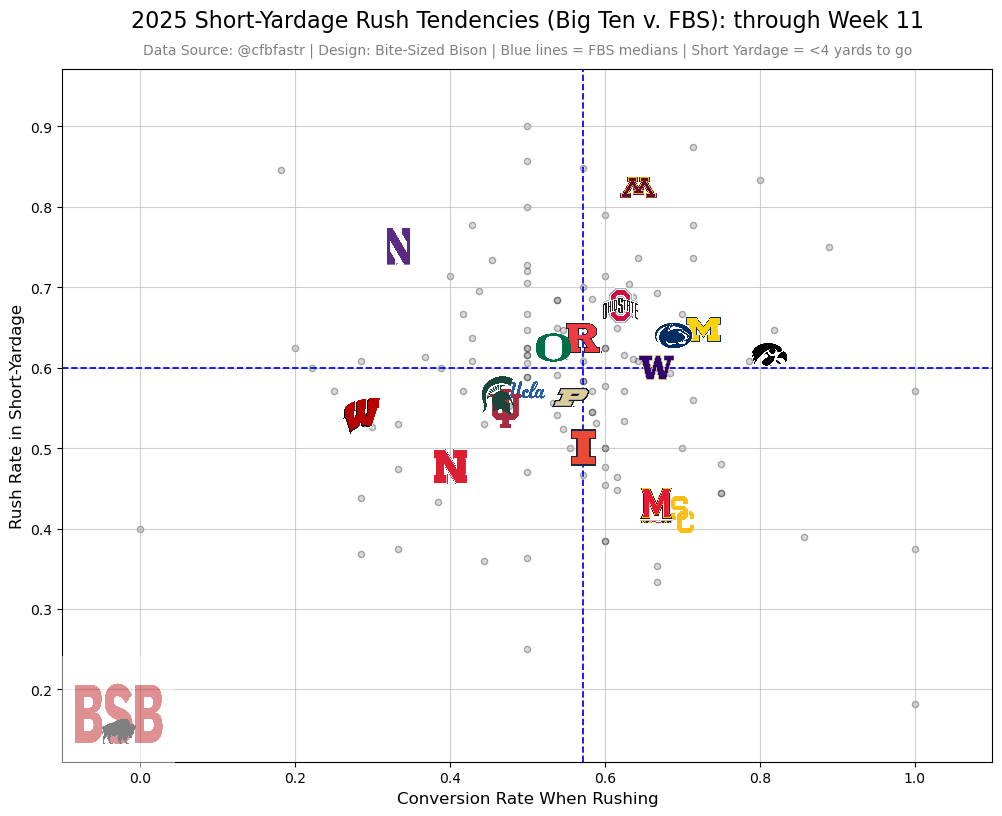
To continue the comparison to Old Dominion a bit longer, the Monarchs stonewalled Indiana’s short-yardage rushing attack in Week 1, showing an early vulnerability that Mike Shanahan has been working to fix all season (as discussed in last weekend’s Recap). Well, Wisconsin ranks 25th nationally in EPA/rush allowed in short-yardage scenarios (3 or fewer yards to go), just ahead of Old Dominion, Ohio State, and Iowa.
Can Wisconsin get anything going at all on offense?
The Badgers have become fairly one-dimensional on offense over their last four games, never passing more than 21 times and averaging just 3.5 (!!) yards/attempt on those dropbacks. Indiana allows the 3rd-lowest EPA/rush in the Big Ten and the 19th-lowest rushing success rate nationally.
One small trend in the last four weeks for this Indiana defense is that it has allowed 7+ passing yards/attempt in three of those four games, including 7.1 yards/attempt to Ethan Grunkemeyer. However, if Wisconsin can’t get anything going on the ground — I assume Bryant Haines will be loading the box, much like he did against Penn State — then that might not be enough.
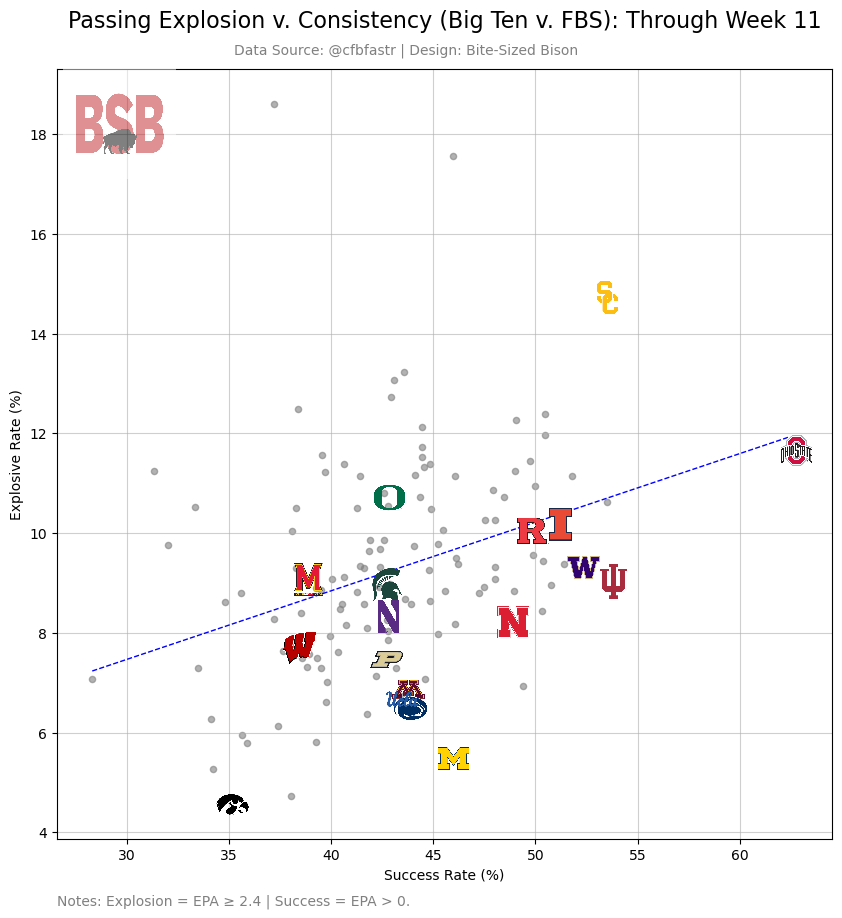
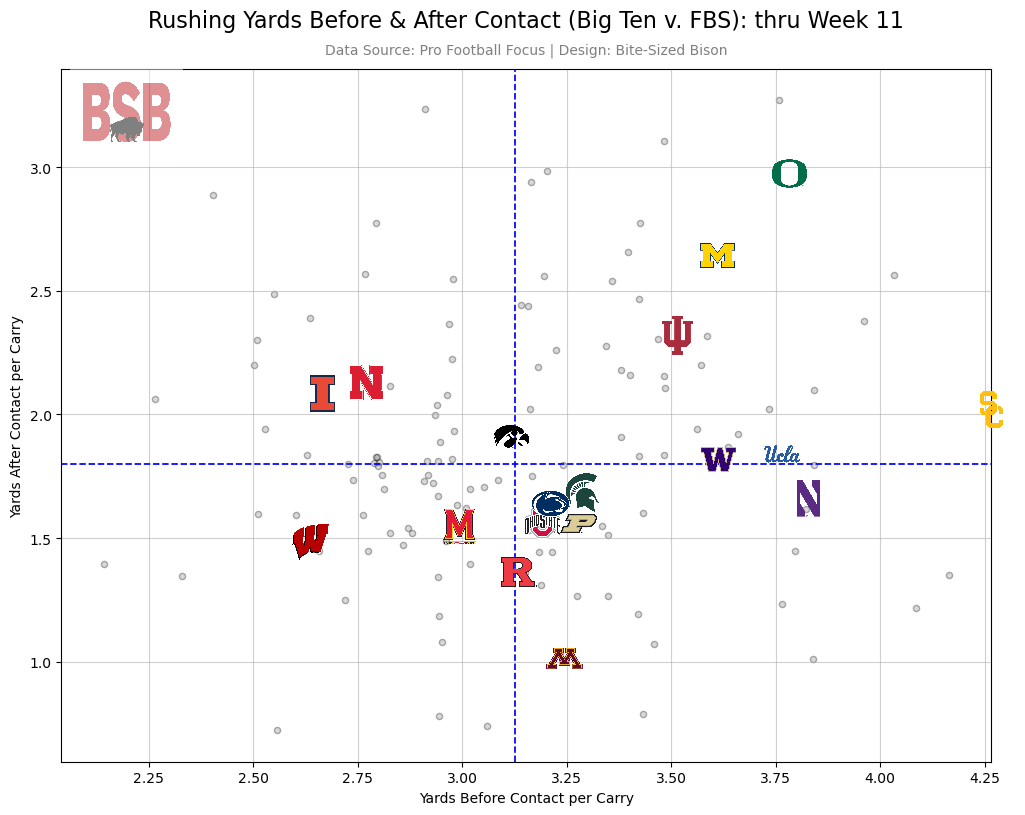
Between the EPA distribution charts above and the two charts below, the forecast isn’t looking too promising for the Badgers’ offense.
Is Indiana’s passing game sans Elijah Sarratt sustainable?
It’s difficult to overstate the role Elijah Sarratt played in Indiana’s early success. For example, in just 7 full games, he caught 10 TDs — already tied for 4th-most in a single season by a pass-catcher in Indiana history — and that included game-winning TD catches against Iowa and Oregon. Before going down with his hamstring injury, Sarratt was also 5th among Big Ten pass-catchers in targets (61).
There simply is no one-to-one replacement for Sarratt on this roster, but Mike Shanahan and the pass-catchers have managed so far. Charlie Becker burst onto the scene with 7 catches for 118 yards on 8 targets. Omar Cooper is the 3rd-most targeted receiver in the Big Ten during Sarratt’s absence and made the iconic game-winning grab against Penn State this weekend. Riley Nowakowski has stepped up in big ways, reeling in all 5 of his targets (quietly just 1 fewer than EJ Williams), including the longest target of his career on the final game-winning drive in Happy Valley.
But teams will focus on taking Cooper out of the game without Sarratt, and Penn State largely had before his TD — just 25 yards on 5 catches. He’s quickly demanded the attention of opposing defenses in ways he’s never had.
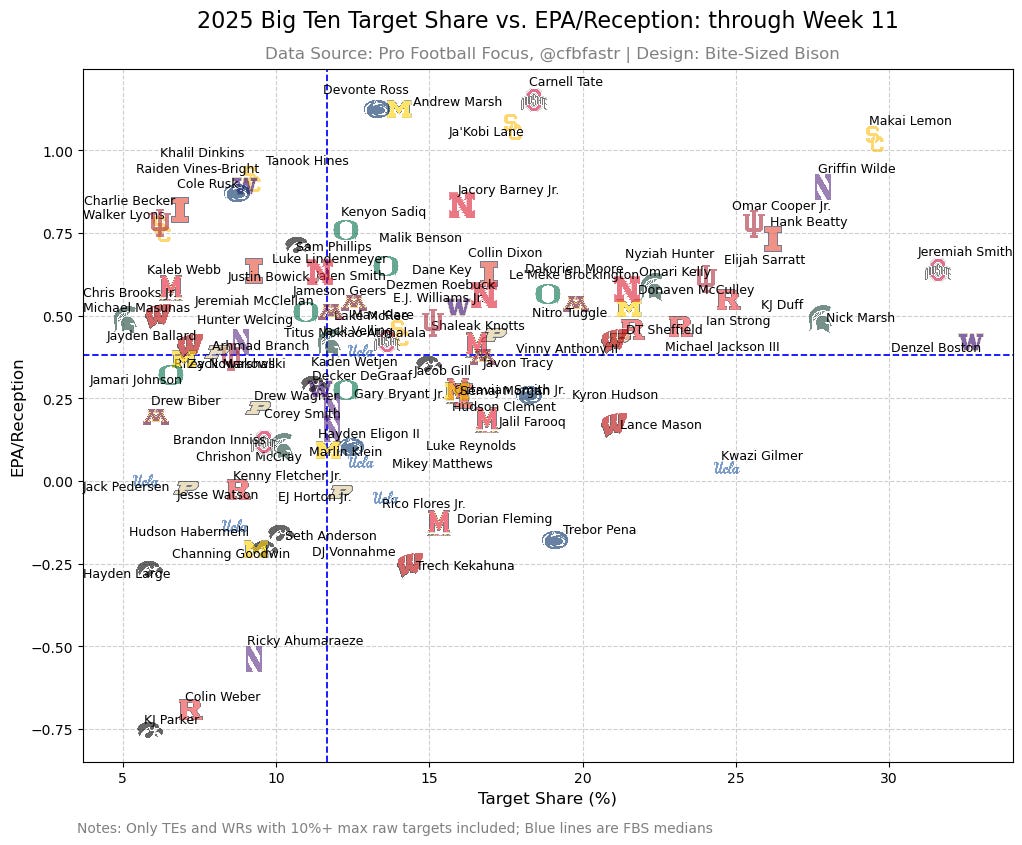
Can Charlie Becker continue his recent production? Can EJ Williams make up for it if not? What else might we see out of this passing attack?
I feel good about this game although injuries to IU’s offensive lineman is a major concern. I am not a gambler and find the point spread confusing. If IU can score early then maybe they can win comfortably. I’m prepared for a closer score and hope IU wins by at least three scores.
Also, looking forward to attending the game. I remember some years back attending senior day versus Rutgers. It was raining and hardly anyone showed up for the pregame recognition of the seniors. IU won handily that day. It will be great to experience the enthusiasm of the crowd Saturday.
IU’s OL without Evans is a concern. Let me put that in a frank MANNER: IU’s OFFENSIVE LINE PLAY WITHOUT EVANS IS A MAJOR CONCERN GOING FORWARD. Unless Ajani morphs suddenly into Orlando Pace I believe that ultimately could be their undoing.
I don’t know if Sarratt plays Saturday. I would be prepared to have him spend noon-3:30 in physical therapy.
“Charlie B” (thank you Joel Klatt and Gus) may become Kris Collinsworth in time, but he doesn’t command 2 defenders. Cooper and Williams thrive in part because of the attention Elijah commands. We may see more 21 personnel or Brady in the slot with Cooper outside.
I appreciate his running hard but Mendoza may see nightmares of Hemby in pass pro on his death bed.
Unless the defense forces turnovers
or there are special teams plays I expect a closer game than the spread.
I just want to win and get healthy