

Week 14 Preview: Purdue
Prepare for Indiana's Week 14 matchup against the Purdue Boilermakers with a comprehensive BSB Preview!

Indiana needs to make a statement. The College Football Playoff committee, by dropping the Hoosiers five spots to No. 10, has laid a foundation for a Clemson or even a Texas A&M to leapfrog Indiana in the coming weeks. Fortunately for Indiana, the worst team in Power 4 football is coming to town. Purdue is rated 118th by SP+, 113th in FPI, and 119th by BCFtoys.com. All of these measures are worst in the power conferences, and Sagarin.com ratings suggest Purdue would be competitive against Incarnate Word and Illinois State. Indiana wants to prove it is a top-10 team this week, and Purdue is 0-4 against top-10 teams and lost those games, 195-17. That’s an average scoring deficit of 44.5 points; that’s the standard this weekend.
It’s going to be very cold, so bundle up!
In This Preview:
Indiana’s SP+ Progress
Advanced Stat Preview
Big Ten Conversion Rates
Big Ten Passing and Rushing Distributions
Purdue OL Preview
Purdue’s Key Contributors
What BSB is Watching for
Witt’s Wager: Indiana -29
If you missed any of the content from Week 13 (Ohio State)), it is linked below. All three Week 1 newsletters are free to the public for those curious what is enclosed in typical BSB content. Some bye week content is also linked, in case you missed it.
Indiana’s SP+ Progression
The chart below conveys a weekly progression of ESPN SP+ percentile rankings in the FBS, indicating each season 2019-23 with lines and this 2024 season with bars.
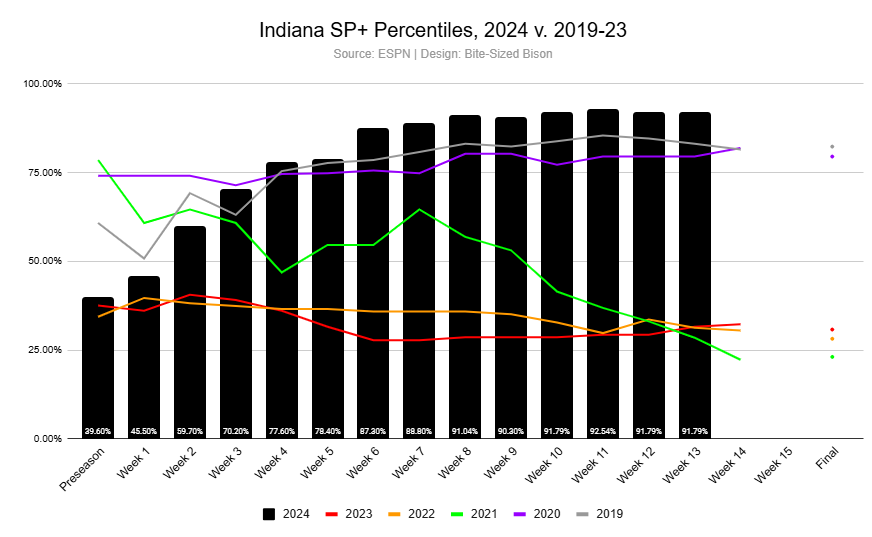
Note: Each week indicates Indiana’s ranking after the week’s game. For example, Indiana was in the 46th percentile after its game versus FIU in Week 1.
Advanced Stat Preview
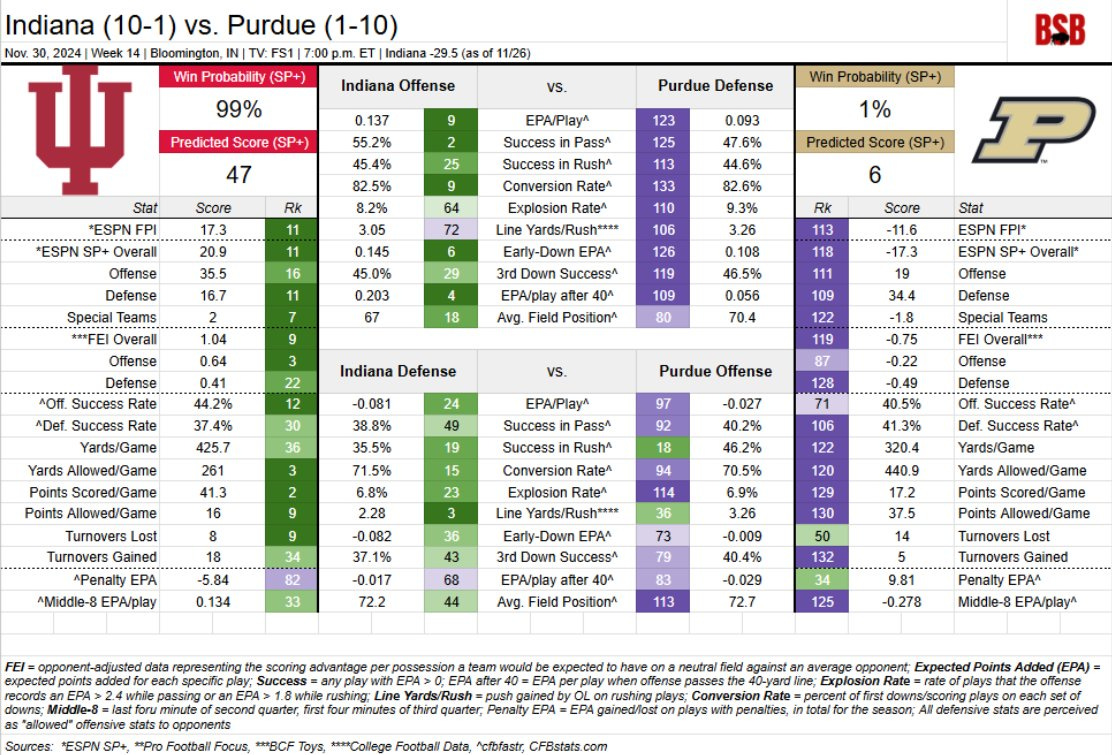
For an explanation of how the various algorithms (FPI, SP+, FEI) in this chart work, visit a previous Preview newsletter here.
BSB Stat Preview Highlights:
Purdue’s Turnovers: Purdue doesn’t turn the ball over that often. Hudson Card has thrown just 6 INTs, but three of their RBs have fumbled (including starter Devin Mockobee, who is one of five Big Ten RBs to fumble more than once). They will, however, commit turnovers in bunches. The Boilermakers have six games with multiple turnovers — three against top-10 teams (not Penn State, funny enough) — and are coming off a multi-turnover game against Michigan State. They’ve also forced just one turnover during the month of November (4 games). So there are either no turnovers at all or Purdue loses the runover margin badly, on a game-to-game basis.
Purdue’s Offensive Rushing Success Rate: Purdue has had some impressive rushing games — 208 rushing yards against Oregon and two other instances of 200+ against FBS teams (Illinois, Oregon State) — but the Boilermakers just posted -4 rushing yards against Michigan State and are averaging 2.09 yards per rush in their last four games (Northwestern, Ohio State, Penn State, MSU).
Indiana’s Explosion Rate: Something we’ve come to know about this Indiana offense is that it can certainly break off chunk plays, but in terms of explosion, there isn’t that much. The Hoosiers are currently outside the top-40 nationally in plays of 20+ and 30+ yards and are ranked 91st in plays of 40+ yards. Given Purdue’s explosion rate allowed, I’d expect something more there, especially given the standard outlined in the opening of this newsletter.
Big Ten Conversion Rates, Offense & Defense
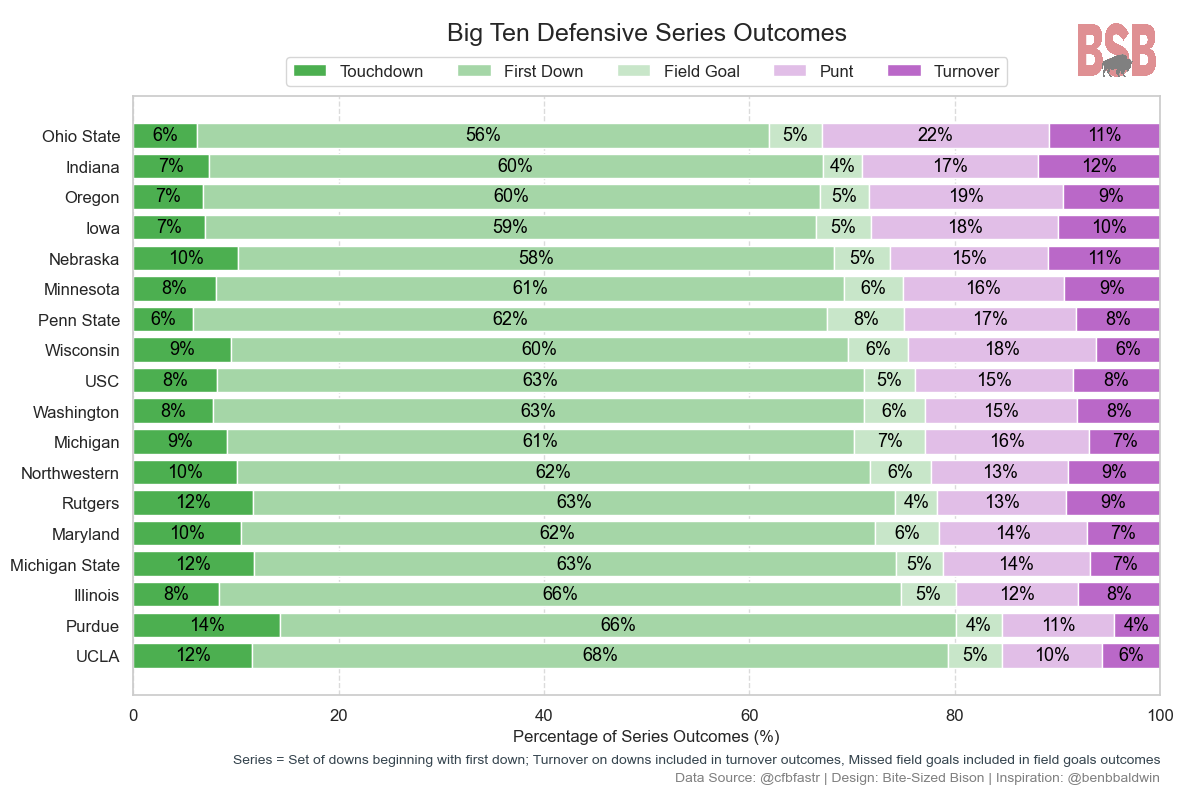
When a team begins a new set of downs, how often does it convert? How does that set of downs typically result? Below shows the conversion rate, which is how often each result takes place out of total offensive and defensive series (missed field goals included in Field Goal, and turnovers on downs included in Turnover).
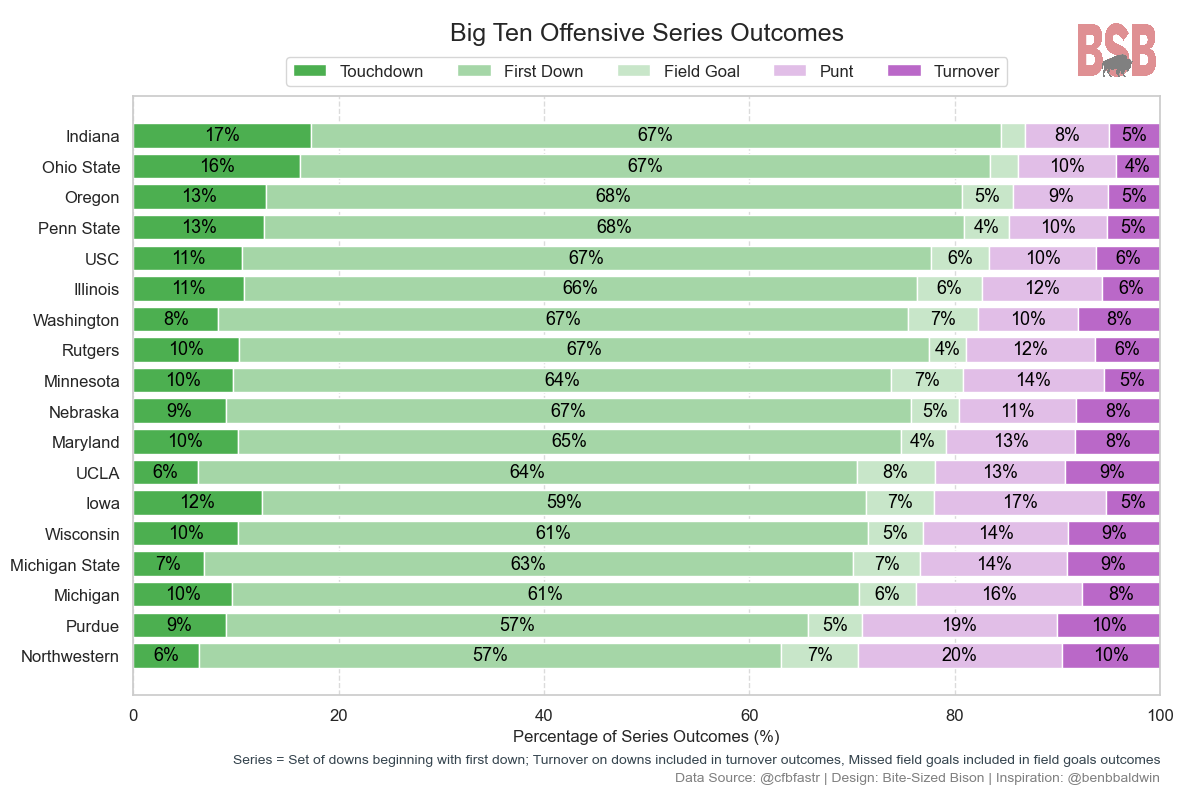
Observations:
Prepare yourselves for Indiana touchdowns. Purdue’s defense surrenders the highest TD rate in the conference, and Indiana, even with its more anemic couple weeks, still owns the highest TD rate in the Big Ten.
You might notice that Purdue’s offensive turnover rate is high here (10%) even though their raw turnover number isn’t that high in the Advanced Stat Preview. That is largely because Purdue has the lowest conversion rate on 4th downs (considered a turnover on this chart). The Boilermakers are 4-for-17 on 4th downs this season, which is the lowest rate in the FBS.
Purdue is ranked 16th nationally in total number of punts this season.
Big Ten Passing and Rushing Distribution
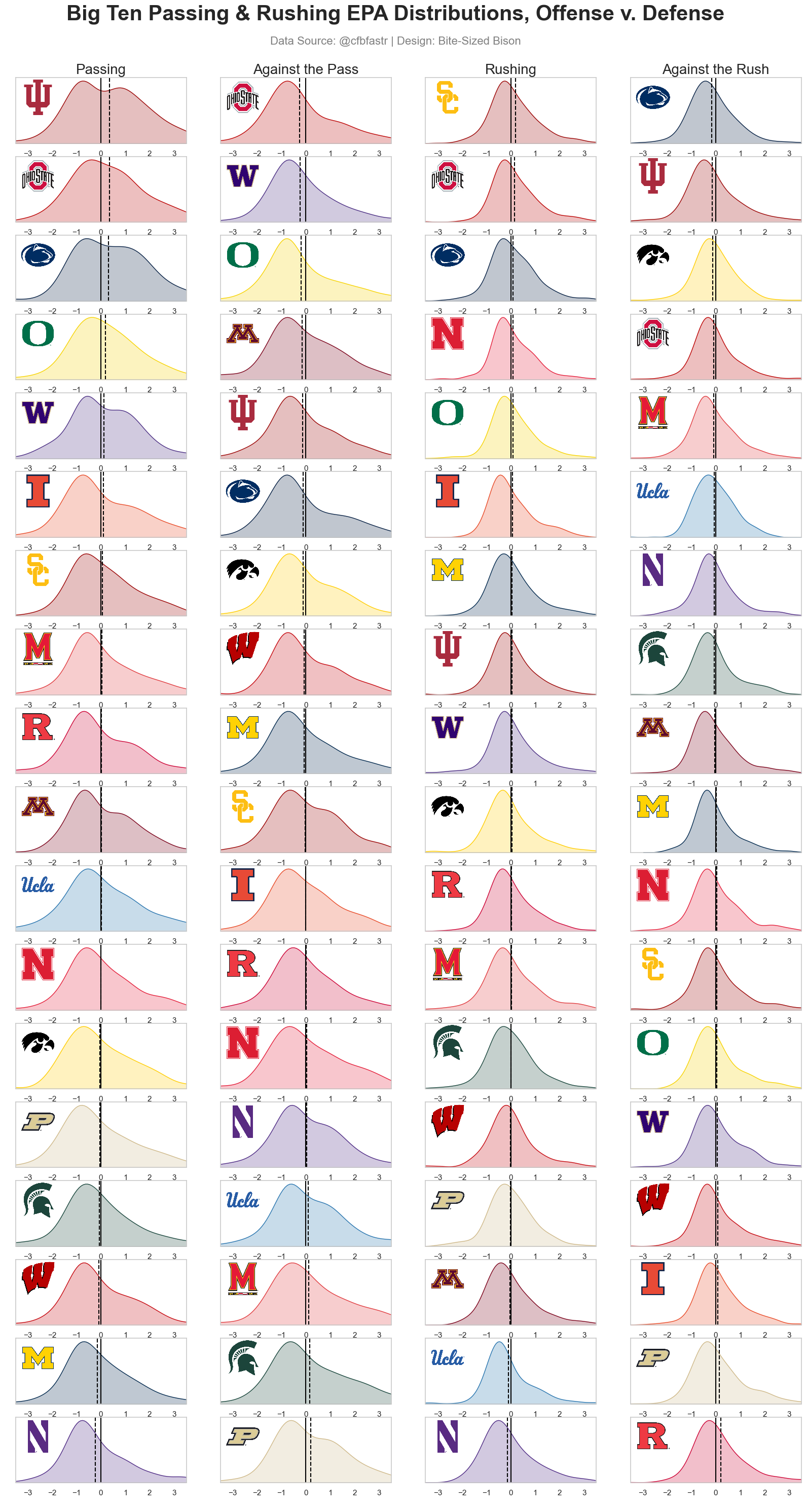
The chart below maps every play recorded by every team in the Big Ten by their EPA values — disaggregated by passing and rushing, and then again by offense and defense. The dotted line indicates EPA/play within each distribution and is the measure that orders each column. To explain the curves simply: the further right the crests of the curves are on offense the better, and the further left the crests are on defense the better.
Observations:
Purdue’s defense is so, so bad.
Purdue has had its moments in the passing game (more on this below).
The Hoosiers continue to improve in run defense and are currently one of the best teams nationally in this phase (also more on this below).
Offensive Line Preview
Observations:
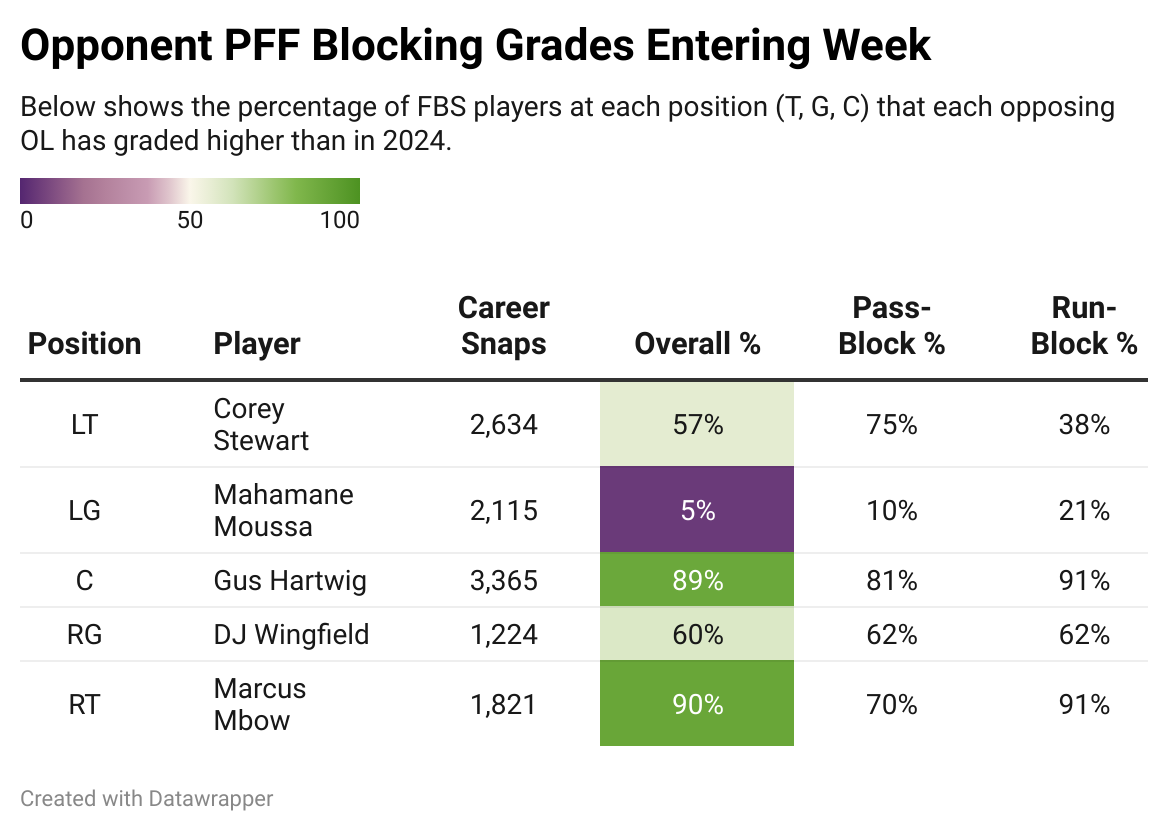
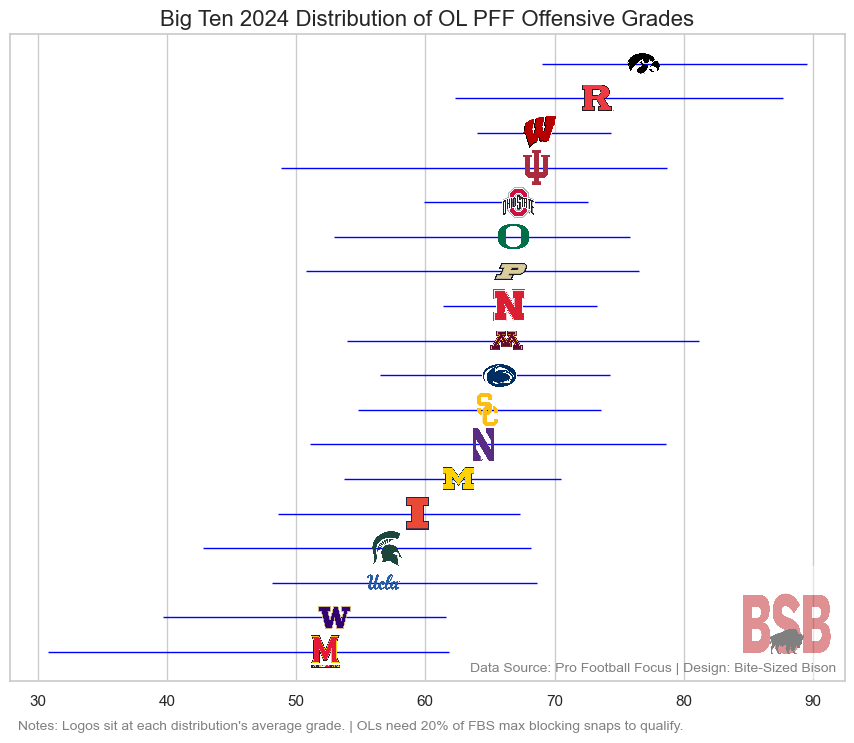
Besides some athleticism at the skilled positions, the OL is probably Purdue’s strength. It’s the most experienced unit Indiana has played this season, which makes it dangerous, especially with Gus Hartwig at center. This OL gives this offense more legitimacy than it probably deserves, but even with that, it does allow pressure in volume that isn’t conveyed in the PFF grades. The Boilermakers rank 102nd in sacks allowed (30.0).
Left Tackle: Corey Stewart is a transfer from Ball State. He’s allowed 17 QB pressures but only 1 sack (and only 2 other QB hits). That’ll do in the Big Ten.
Left Guard: Mahamane Moussa has been a liability for Purdue for awhile. Moussa struggled as the starting LT in 2022 and 2023 until he moved inside to guard this year. He’s been even worse, allowing the 4th-most QB pressures among Big Ten guards and committing a conference-leading 9 penalties.
Center: Gus Hartwig has been a solid starter at center for Purdue for four years, and he’s near the end of his best season in 2024, grading 17th among FBS centers (2nd in the Big Ten). Having a center like Hartwig elevates any OL quite a bit.
Right Guard: DJ Wingfield is the other transfer on Purdue’s OL, coming from New Mexico, where he started as a tackle in 2023. He’s played well in the transition but is one of seven Big Ten guards to surrender 3+ sacks this season.
Right Tackle: Marcus Mbow is the unusual interior OL that made the move to tackle in 2023, and he’s done well. In 2024, he struggled early, notching four games with 3+ QB pressures allowed, but as of late, he’s been pretty solid in pass blocking, allowing just 1 pressure to each of Oregon, Northwestern, Ohio State, Penn State, and Michigan State. That’s a pretty great stretch from any tackle.
Purdue Key Contributors
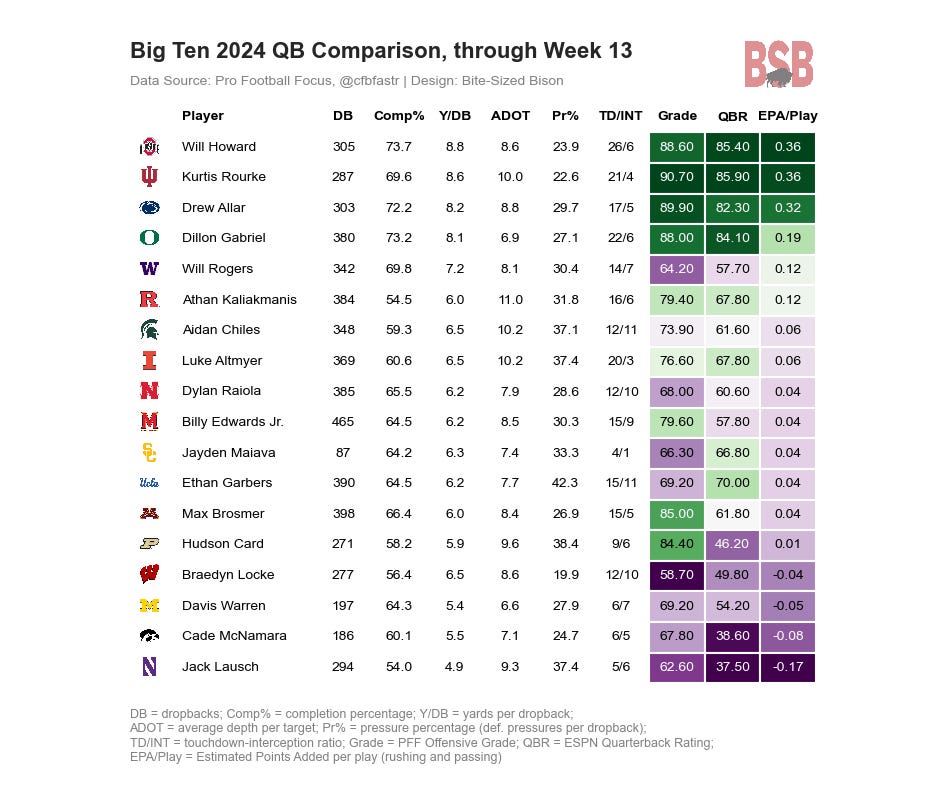
QB Hudson Card: Remember when Card was ranked the 3rd-best QB transfer by 247Sports during the 2023 offseason, above Shedeur Sanders? That feels like a long time ago, as Card has been battling Iowa’s Cade McNamara and Northwestern’s Jack Lausch all season to avoid owning the worst QB EPA/play in the conference. Even though Card has taken care of the ball thus far, his high-end production hasn’t been there, and even with a well-graded OL, he faces more pressure than most Big Ten QBs. It’s not been an easy year for the vet in his final season.
RB Devin Mockobee: Mockobee is a great story, as he walked onto the team and nearly rushed for 1,000 yards as a freshman in 2022. He’s averaged 5.0 yards per carry in his career (5.4 this year), but he’s been a bit inconsistent this season, given that Purdue has been playing from behind often. He hasn’t collected 100 scrimmage yards in Purdue’s last five games. If Purdue keeps the game close, or if the weather keeps things on the ground, Mockobee will be a much stronger presence.
TE Max Klare: Remember Michigan TE Colston Loveland? Well Purdue TE Max Klare is similar. He is 3rd in the conference (just behind Loveland) in TE targets and has 648 yards receiving (2nd among Big Ten TEs). He leads the receiving corps for Purdue
SAF Dillon Thieneman: As a freshman in 2023, Thieneman was graded as the 4th-best defender in the Big Ten. This season, he is graded the 80th-best (Purdue’s only top-100 defensive representative). The primary reason for this regression is his performance in coverage. He has seen far more targets (28) than in 2023 (12) and has 0 INTs versus the 6 he racked up last season. Thieneman is still one of the best safeties in the Big Ten, though, and demands attention from opposing offenses.
LB Kydran Jenkins & DE Will Heldt: Jenkins and Heldt rank 6th and 11th, respectively, in sacks this season. While Thieneman leads the team in tackles, these two are the primary havoc creators. They rank 2nd and 3rd on the team in tackles and combine for 21 TFLs and 11.5 sacks.
What BSB is Watching For
Can Purdue’s passing beat the Indiana defense?
The Advanced Stat Preview above suggested that Purdue can run the ball a bit, with its 18th-ranked rushing success rate and its 36th-ranked OL yards/rush. The Boilermakers have a capable RB in Devin Mockobee and are graded 63rd in run-blocking by PFF. In counter to this, Indiana, already boasting an impressive season-long defensive rushing success rate ranked 19th nationally, has allowed the 3rd-lowest EPA/rush in the FBS since Week 8 — the game after its first bye week (Nebraska). What’s even more impressive for the Indiana defense is that all but one of the opponents its played in that span has a top-40 rushing success rate (the other one has Jonah Coleman at RB). We may be looking at the best rushing defense in the country.
But Purdue, when considering its most competitive moments of the season, has actually found more success through the air. When within two possessions, Purdue is ranked 78th in passing EPA (slightly below average) — versus 114th in rushing EPA. So Purdue will be throwing, and they aren’t terrible at it!
TE Max Klare (noted above) is a tough matchup, lining up at slot for half of his snaps, and has the 4th-best receiving grade in the Big Ten, as well as the 11th-highest YAC per reception among all Big Ten pass-catchers.
WR Jahmal Edrine (who Curt Cignetti referred to Monday as “No. 7” and said he was “explosive”) ranks 11th in yards per catch (15.9) and 5th in average depth of target (14.3).
RB Devin Mockobee is very capable as a pass-catcher and owns the 3rd-highest yards per catch (10.0) among Big Ten RBs.
Hudson Card owns the 6th-best PFF grade among Big Ten QBs for a reason, primarily because he has taken decent care of the ball (only 7 turnover-worthy plays all season) but also because many of the games he’s played have been out of reach very quickly. It’s hard to find a ton of statistical value as a QB when you’re down 52-6 or 49-10 or 45-0.
How effective is Purdue’s OL against Indiana’s DL?
If you can hold off Indiana’s DL, you might have a chance against this defense. Ohio State found out last week, and Purdue has an OL that doesn’t get the credit it deserves (for obvious reasons).
Indiana’s interior DL will be a major key in subduing offensive success from Purdue. Oregon’s interior DL is probably the only comparison to Indiana’s on Purdue’s schedule, and it sacked Hudson Card 5 times. Also, Mikail Kamara is on notice, after he failed to record a sack or a TFL against both Michigan and Ohio State. This Purdue OL tends to surrender some pressure, so there should be some opportunities.
How aggressive is Indiana?
Like I mentioned at the beginning, Indiana needs to make a statement, so I anticipate the pedal being pushed to the medal for 60 minutes. But what does that mean exactly?
Indiana does not have the luxury of superior talent; that has never been the advantage. The advantage has always been in scheme, which makes these consistent blowouts so impressive. The staff will have a gameplan on offense, but when — not if — the threshold arrives for Indiana to put Purdue away…
Can they do it? (Most likely yes)
How does the scheme change around that moment?
We know Indiana has wrinkles to iron out, wrinkles shown against Michigan (see here) and Ohio State (see here). Does Indiana use this time to figure those out, or does it stick to what has found them success against Purdue and continue pounding that because of its CFP circumstances? Maybe both? Against its previous opponents, Indiana stuck to what schematic success it had found because, due to its lack of physical talent, there is no slowing down or schematic tinkering allowed. I anticipate that, but it is something to watch for.
How does the weather affect the game?
This game is going to be cold, below freezing. As outlined above, Purdue will be hoping to find some passing success in the beginning, and Indiana has concepts it needs to strengthen in its passing game (protection, short game, etc.). There is space for passing in a room-temperature matchup, but the cold might have something to say about that.
If this game is limited to running the ball, that heavily favors Indiana, but this offensive staff is always seeking balance, so I wouldn’t be surprised to see more passing than folks would think for a game this cold.
Witt’s Wagers
Ben Wittenstein has created sports betting content during the last five years for various media outlets, including Stadium, Bleav Network, BetMGM, and Bet QL. He graduated from IU with a journalism degree in 2017 and spent four years broadcasting IUFB games on top of Memorial Stadium’s press box (shoutout WIUX). You can find Ben on Twitter at @BenWittenstein, where you can ask betting questions about IU and beyond.
Bet: Indiana -29
Ben’s 2024 Record: 8-3
Hangover game? That’s not in the vocabulary of a Curt Cignetti-led team.
Sure, the loss to Ohio State was a gut punch, but if it weren’t for some special teams miscues and a *cough* questionable false start call *cough*, Indiana would be in a much better spot right now.
And it’s not like they’re out of the playoff race, either. Everything that had to go right for them did, so with the Hoosiers still squarely in the playoff mix, I don’t think they’ll take their foot off the gas.
Which brings me to this play.
Purdue sucks. And I’m not just talking about them in general — their football team is downright awful. With Indiana needing a big win to force the committee to put them in the playoff, they now have the perfect opportunity, combined with the Boilermakers’ ineptitude.
It’s the same story we’ve seen all season: when IU plays a much weaker team, they dominate. Just look at their first four games. As Taylor’s advanced stat chart shows, the Hoosiers should be knocking on the door of a 50-burger here.
And with the 30th-ranked defense in success rate, it’s hard to see Purdue scoring with any consistency.
This is the game for IU to show the committee that they do, indeed, belong in the playoff conversation. And with their history of dominating weaker teams, this game lines up as another potential IU blowout.
Weather may be a critical key. IU certainly needs to play better than the mistake laden OSU game. They have to show and play
This weather has me nervous. Not that we won’t win, but just going to be hard to have our offense be explosive and we need a convincing victory to remove any doubt about making the CFP. Weather can be a great equalizer (ie turnovers, defensive players losing footing etc.). Hopefully we jump on them early.