

Week 14 Preview: Purdue
Prepare for Indiana's Week 14 matchup against the Purdue Boilermakers with a comprehensive BSB Preview!

It’s Bucket Week, and this year’s contest carries the highest stakes in recent memory, which is saying a lot after the role Bucket Games have played in Indiana’s potential bowl berths in the last decade. Indiana is playing for its first 12-0 season and for a berth into the Big Ten Championship game in Lucas Oil Stadium, most likely matched up against Ohio State, setting up what should be the most intriguing conference championship game of the season.
Bill Connelly’s SP+ model, as well as BSB’s win probability model (using SP+ data), gives Indiana a 98% chance to win this game, but Curt Cignetti, saying he “respects what (he) sees on tape,” has downplayed any dismissal of a program the Hoosiers defeated 66-0 to end a storied 2024 regular season. That’s likely wise, as Purdue comes into this week’s game as an entirely new team and having played the 6th-toughest schedule in the FBS, even with zero conference wins on the resume.
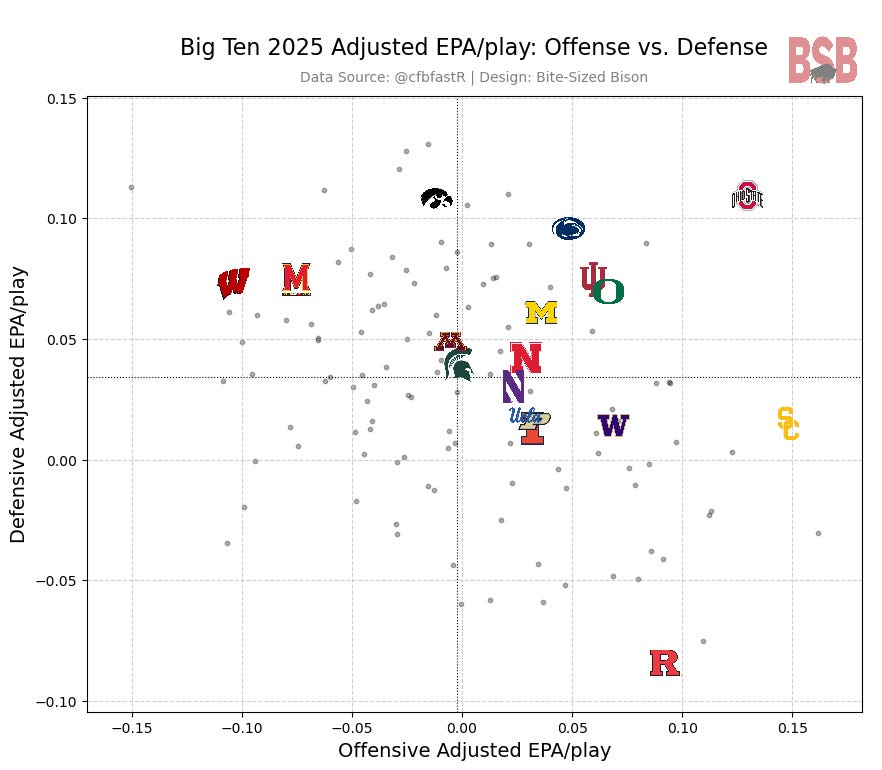
While Purdue has a a sharper bite than it did in 2024 (read more about this in the Opponent Overview below), this chart shows the Boilermakers overlapped — when adjusted for opponent — with two teams (Illinois and UCLA) that Indiana defeated, 119-16.
History is there for the Hoosiers; they just need to take it.
In this preview:
Opponent Overview
Advanced Stat Preview (The Chart)
Purdue OL Preview
Purdue Key Contributors
EPA Distribution by Scenario
What BSB is Watching For
Opponent Overview
Barry Odom took on one of the toughest tasks in college football this season — pulling Purdue out of its worst season since at least 1970 (in SP+ ratings terms). Odom, who’s spent the last decade as Missouri’s head coach, Arkansas’ DC, and UNLV’s head coach, arrived in West Lafayette with 31-year-old DC Michael Scherer — who has yet to coach on a defense not led by Odom — and turned over the roster with a record 54 incoming transfers in one offseason.
So far, the program has seen progress. even with a 2-9 record, which technically is a 1-win improvement from Ryan Walters’ last season. The root of the improvement is the offense, which has jumped from 126th in EPA/play to 62nd — against the 6th-toughest schedule (via FPI). This is thanks, in large part, to the hiring of former USC OC Josh Henson. A former Oklahoma State OL, Henson has coached OLs in the SEC, Big 12, and Big Ten since 2009 and won a national title with LSU as a TEs coach in 2007. He was elevated to OC at USC in 2022 and now brings an OL focus to a program in need of just that. The running game is where Purdue achieves its pinnacle success as a team (as well as passing explosion), ranking 31st in rushing success rate. When the Boilermakers have threatened an opponent — Minnesota (27-20), Rutgers (27-24), Michigan (21-16), and even Illinois (43-27) — it’s been because they’ve run the ball effectively. Against Ohio State, Purdue averaged more yards/carry (4.2) than any OSU opponent outside of Texas in Week 1.
Purdue has the potential for passing explosion and the capability of finding rushing success that could, theoretically, keep up with most offenses on any given day, which makes them dangerous. But it’s also still a program that’s a work in progress, which means there has been a ton of inconsistency.
Advanced Stat Preview (The Chart)
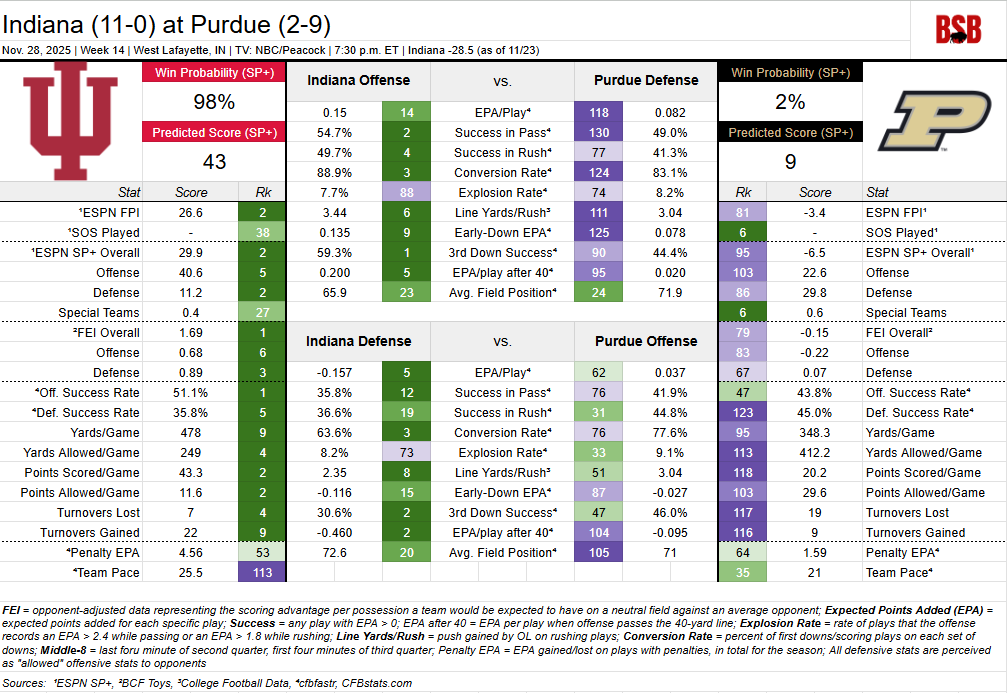
Some Observations:
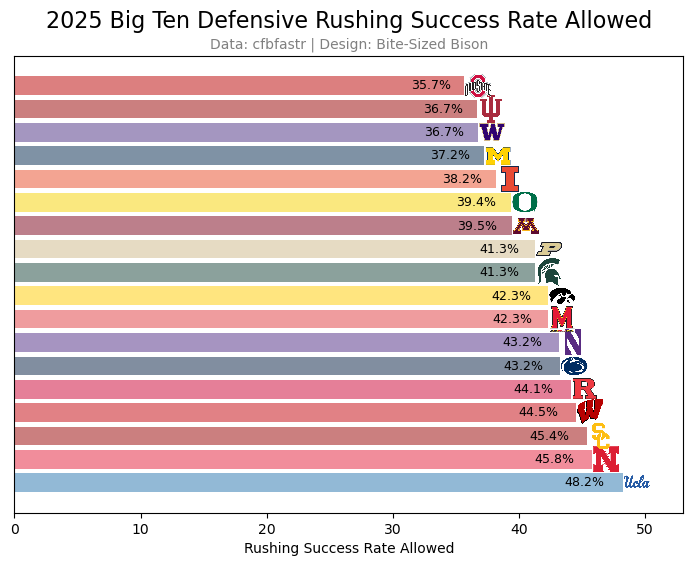
Purdue’s Defensive Line Yards/Rush: Purdue’s defensive front is the opposite of Indiana’s, where it doesn’t rely on DL havoc to disrupt an offense. It primarily focuses on limiting rushing success. It’s limited four of its eight Big Ten opponents to 4.0 or fewer yards/carry, so even if its 77th-ranked rushing success rate allowed doesn’t look impressive, it can limit the run.
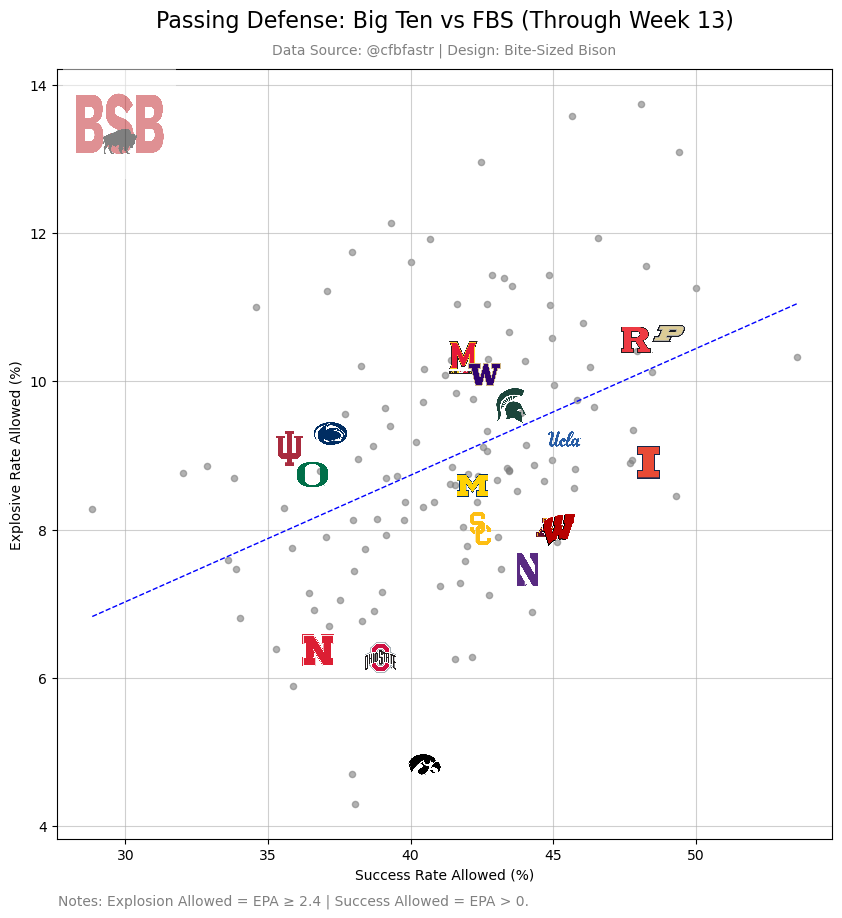
Purdue’s Passing Success Rate Allowed: As strong as Purdue can be in the rushing game on either side of the ball, its pass defense has been consistently terrible against good passing offenses, including allowing 17.7 (!) yards/attempt against Illinois. The Boilermakers rank 134th in passing yards/attempt allowed (9.2).
Purdue’s Turnover Margin: This is, of course, a huge mismatch, as Purdue ranks 128th in turnover margin while Indiana ranks No. 1. However, Purdue’s offense has done a much better job taking care of the ball during its last four games, coughing it up just one time per game.
QB Profile
Ryan Browne — who committed to transfer to North Carolina this offseason but returned to Purdue — has started all season for the Boilermakers and had a pretty strong start. But as the 20-play rolling EPA/play in the chart below shows, he’s struggled as the season’s progressed. In his last six games, he’s thrown 2 TDs and 4 INTs, which has led to a 2-QB approach this week for Purdue, between Browne and Arkansas transfer QB Malachi Singleton.
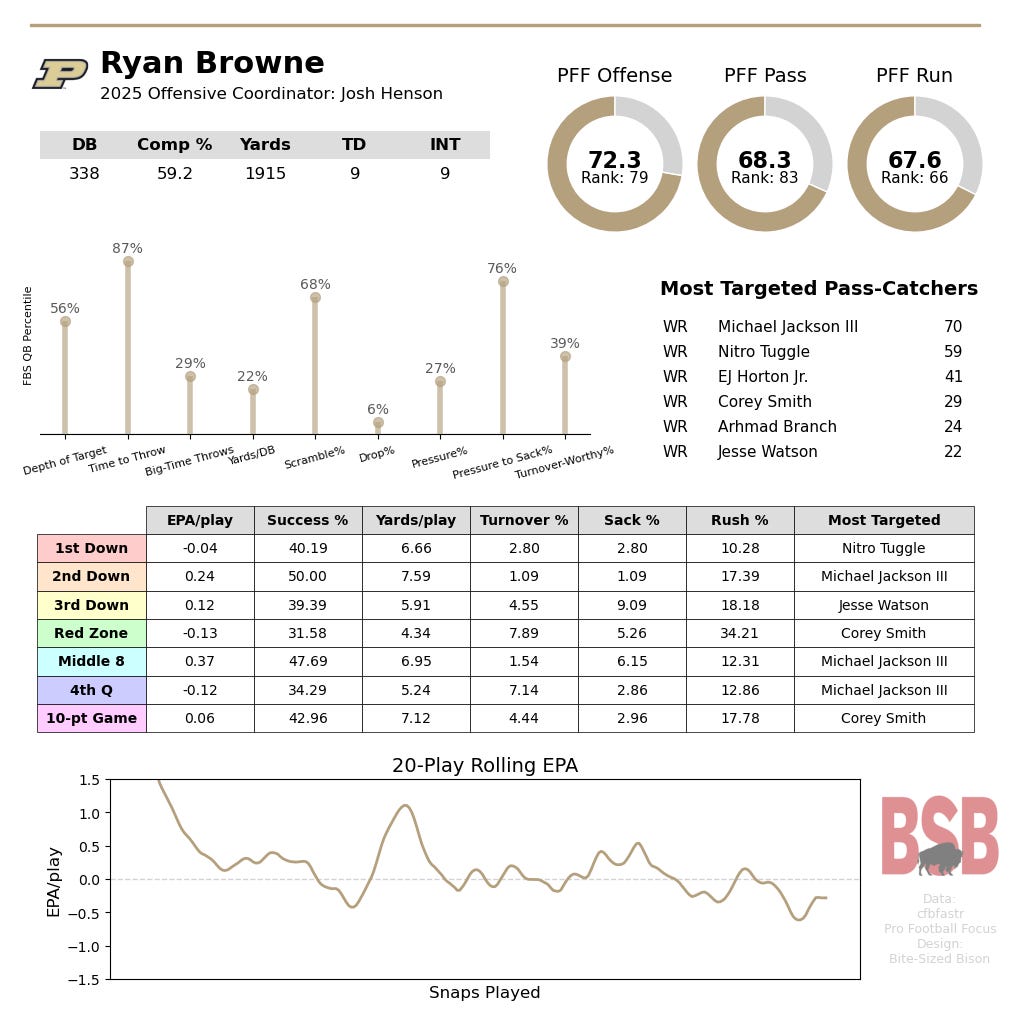
Observations:
Browne feels the 4th-most pressure among Big Ten QBs but has done an exceptional job escaping the pressure to buy himself time, as evidenced by his pressure-to-sack rate and his time to throw. He grades 7th in the Big Ten during pressured dropbacks.
Purdue runs quite a bit more 10 personnel than the average FBS team, and this graphic makes it clear why. There are no TEs in the top-6 most targeted receivers, yet the Boilers also spread the ball around. They will spread the formation and run the ball.
Interestingly, Purdue’s passing offense has been at its best during moments when passes are expected. On second down and in the Middle 8 minutes, Purdue has a passing success rate just under 50%, which is impressive.
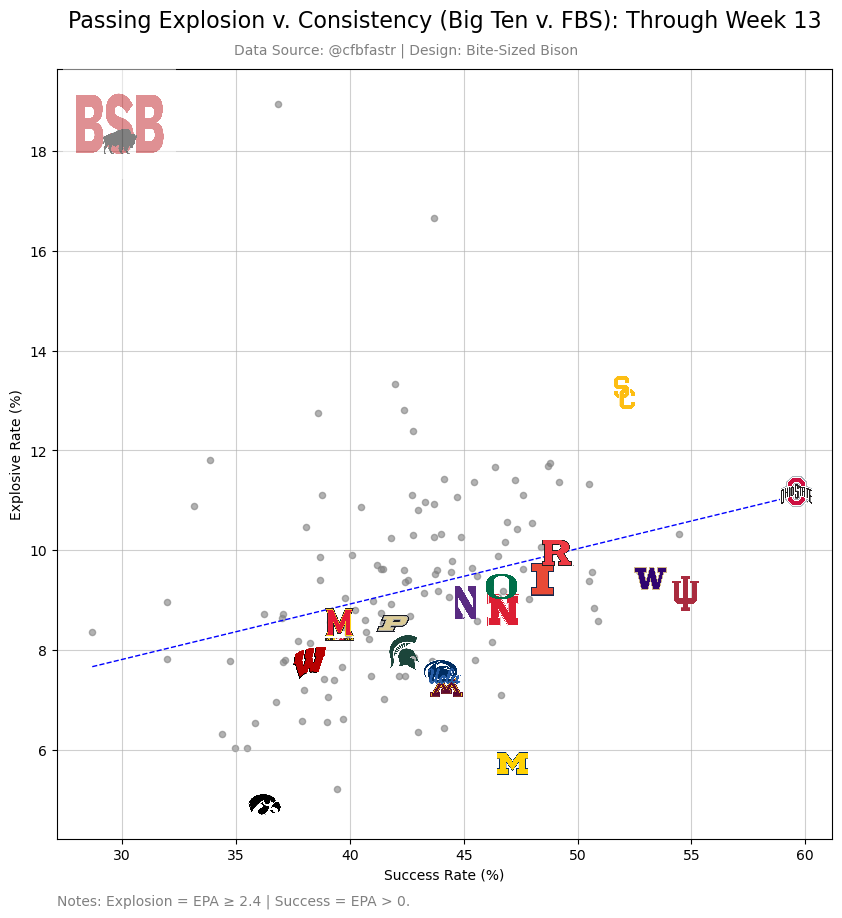
Observations:
Explosion here is not necessarily about chunk yardage but more about converting plays above expectation. Purdue doesn’t get a ton of long, explosive plays but rather significant conversions above what is expected — such as long third downs. None of this is consistent, as shown in the chart, but it is real. Purdue can convert passes in obvious passing situations.
Purdue OL Preview
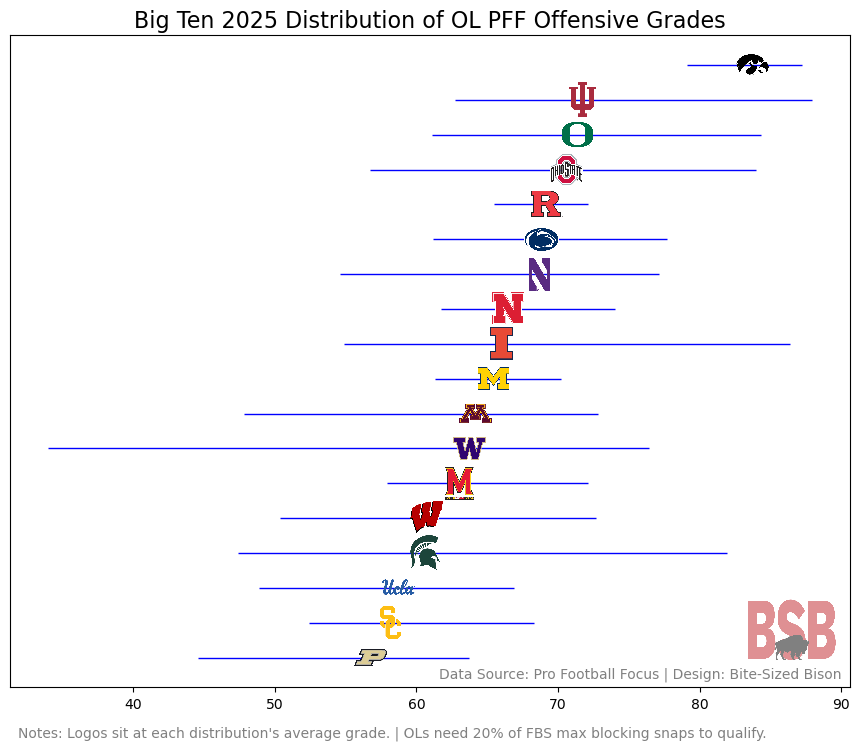
Notes:
While Purdue OC Josh Henson can scheme up a rushing attack pretty well, there is little he can do with the poor pass protection. Purdue’s OL grades mostly suffer because of how much pressure it allows on the QB.
The poor pass protection begins with the tackles. RT Bakyne Coly is among the worst in the nation at tackle and has surrendered the 2nd-most QB pressures (37), while LT Joey Tanona has allowed 22 pressures and is tied for the 8th-most penalties committed (10) among FBS tackles.
Purdue has gotten its best OL play from its interior trio, which explains why it runs less zone blocking schemes and more gap schemes (more on that below).
That Purdue front will have its hands full this weekend.
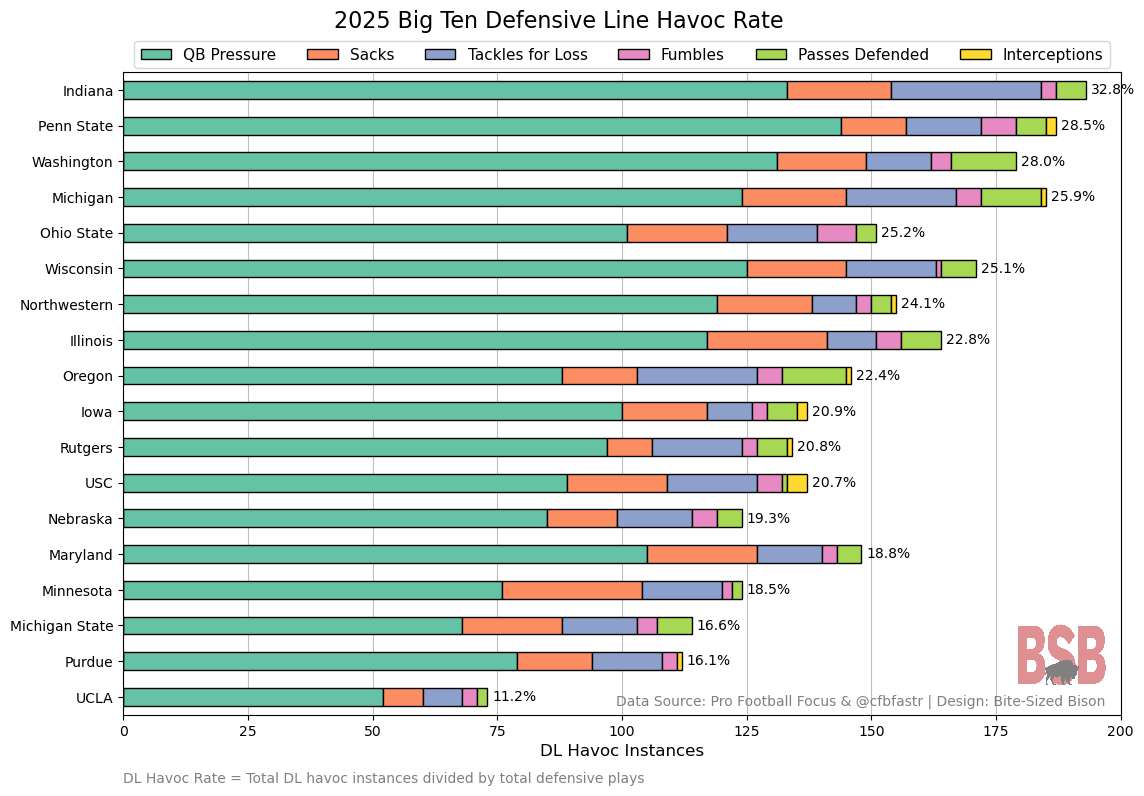
However, Purdue has done a decent job avoiding negative plays against three of the top-five teams on this list in the last three weeks. The Boilermakers have recorded negative yardage on just 6.0 plays per game in those last three matchups. In all of the games before those, they had averaged 7.4 per game.
Purdue Key Contributors
QBs Ryan Browne & Malachi Singleton: A 2-QB approach is expected this Friday for Purdue, and while Ryan Browne is heavily detailed in the QB Profile above, Malachi Singleton should also be on the radar. Read more about the Arkansas dual-threat QB near the bottom of this post.
RB Antonio Harris: Since Devin Mockobee went down, ending his four-year reign as Purdue’s starting RB, it’s been Antonio Harris. Harris had 20 carries up until Week 10, when he began starting in Mockobee’s place. Since then, his opportunities have flipped a switch to 34 carries in three games. But what explosion once existed when Harris entered the game (7.6 yards/rush before Week 10) has essentially disappeared, as he’s averaged 3.6 yards/rush as the starter. Losing Mockobee removed a phase of dynamism from this rushing attack, but Harris and backup Malachi Thomas, as well as what Purdue can find on the ground from its QBs, have been enough to make them competitive against Michigan and fairly productive against Ohio State and Washington in a couple recent blowout losses.
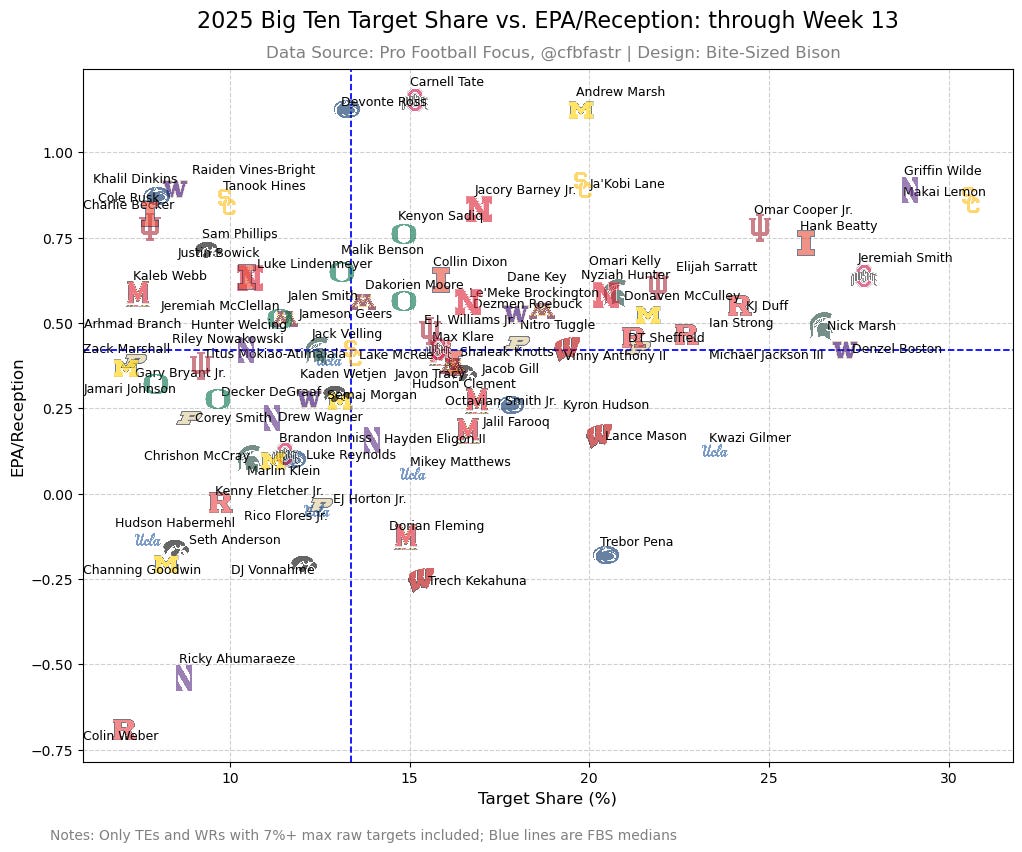
WR Nitro Tuggle: While Michael Jackson has recorded the most production at WR, redshirt freshman Nappanee native Nitro Tuggle, who transferred in from Georgia after signing as the No. 20 WR in the 2024 class, is the strongest talent in the WR room. He’s the guy Purdue wants to go to early and often, as he’s the most targeted receiver on first downs, and he’s explosive, with 14.5 yards/reception. The issue is that he’s a young receiver with a QB frequently under pressure and in a new system, which has struggled to convert the processes necessary to get Tuggle the ball. He’s caught just 49% of his targets, ranking last among Big Ten WRs (50+ targets). Right behind him? Donaven McCulley, with Michigan’s inept passing attack and a true freshman QB. Two Maryland WRs are among the six Big Ten WRs with sub-60% catch rates too, with a true freshman QB. The Indiana defense must make it difficult to get Tuggle the ball.
LB Mani Powell: Senior LB Mani Powell was originally a top-600 recruit coming out of Fayetteville, Arkansas, leading to his signing with Arkansas. Indiana (via Charlton Warren and Deland McCullough) hosted him for an official visit during the 2022 cycle. After Barry Odom and Michael Scherer left Arkansas, they brought Powell to UNLV, and then to Purdue for 2025. Now, Powell is leading Big Ten LBs in offensive plays blown up (55) and in total tackles (109). He also leads his team in TFLs (11.0) and QB pressures (24). The issue is that so much responsibility falls on Powell, much like Aaron Casey in Tom Allen’s 4-2-5, so while he fills box scores, he also misses tackles (3rd-highest missed tackle rate among Big Ten LBs) and surrenders ground in coverage (13th-worst coverage grade).
CB Tony Grimes: I’m really only including Tony Grimes — Purdue’s CB2 — here because he was one of my all-time favorite high school recruits to cover as a recruiting reporter. He was the No. 28 overall prospect (No. 2 CB) coming out of high school in 2020, and he signed with North Carolina. But like so many recruits in that cycle and the 2021 cycle, he was not scouted as accurately due to COVID. He’s a strong tackler, and he’s also allowed the 16th-lowest catch rate among starting Big Ten CBs, but he won’t make the big plays (just 1 INT in his career, 2020 as a true freshman). In fact, he gives up big plays. He surrenders 18.9 yards/catch, which is the 2nd-highest in the conference. Who surrenders the most? His teammate on the other side of the field — Hudauri Hines — with 23.2 yards/catch.
EPA Distribution by Scenario
The chart below shows the proportionate distribution of plays by EPA values in each of the four basic phases on offense and defense — Passing, Against the Pass, Rushing, and Against the Rush. These can show us how teams are finding their success on either side of the ball.
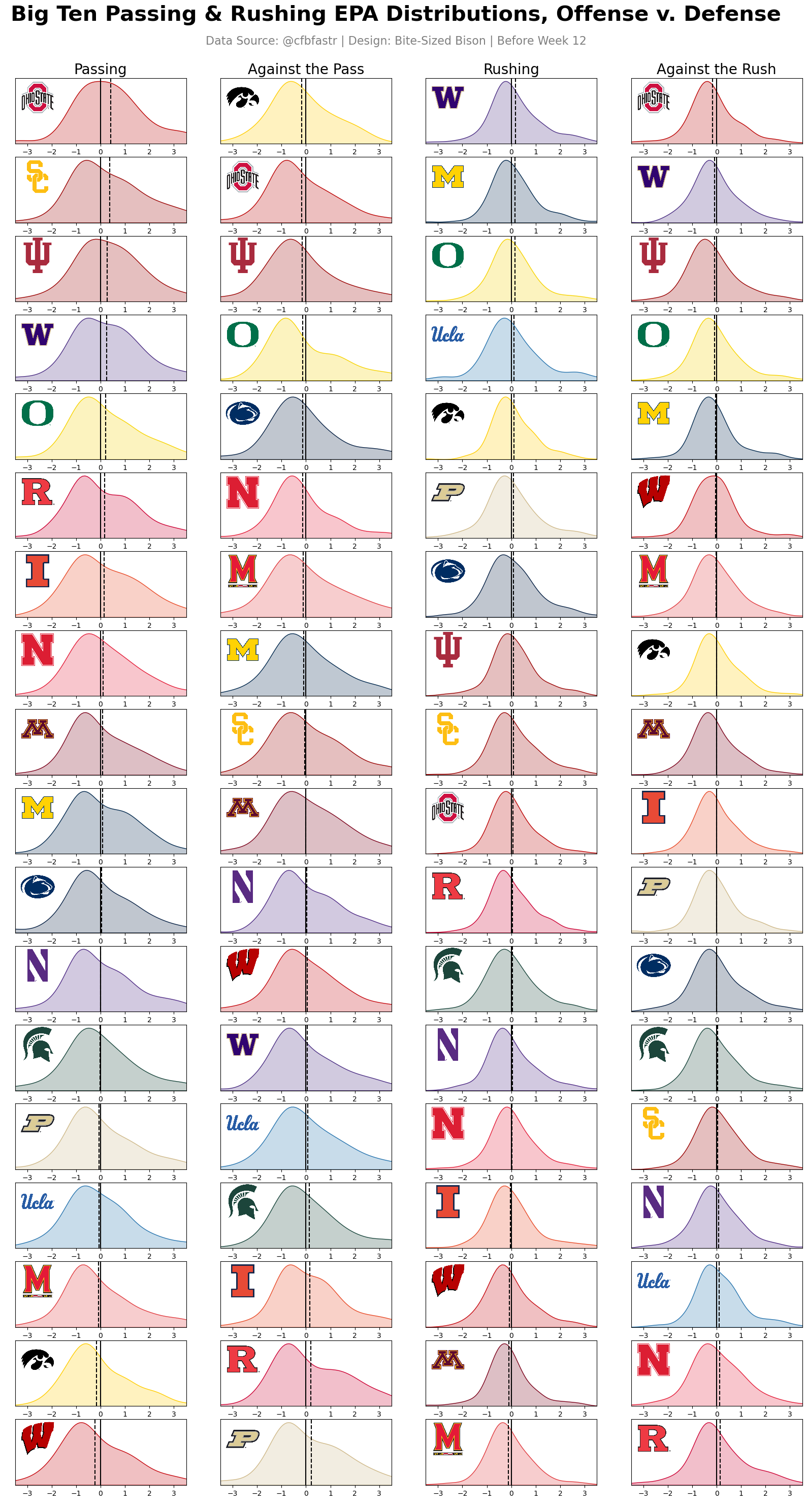
Purdue Rushing: This chart shows that Purdue actually has a higher EPA/rush than Indiana and the 6th-best in the conference. It’s a well schemed and well coached rushing attack, but with all of this, it’s still largely mediocre. Purdue gets next to no explosion from the running game (87th in carries of 10+ yards), is average on rushing in late downs (78th in conversion rate on 3rd and 4th down rushes), and is 60th in TFLs allowed. The Boilermakers’ per-carry numbers are decent, but they’ve run into a buzzsaw of a schedule, and Indiana certainly isn’t any easier.
Purdue Against the Pass: Purdue’s poor pass defense was noted above, but this curve shows a significant amount of passing explosion allowed (see the second bump on the positive side of the EPA axis). They’ve actually allowed 14 (!) pass plays of 40+ yards, which ranks 134th. When Curt Cignetti said Monday that Indiana will need to throw the ball despite the cold, this is why.
What BSB is Watching For
How does Purdue run against Indiana?
Purdue’s rushing attack has been somewhat inconsistent throughout the year, but it’s also been its strongest weapon, with an OL-minded OC in Josh Henson. The strength of Henson’s scheme shows in the chart below, as he’s schemed open some carries more than leaning on strong runners. This certainly hasn’t been helped by the loss of Devin Mockobee at RB.
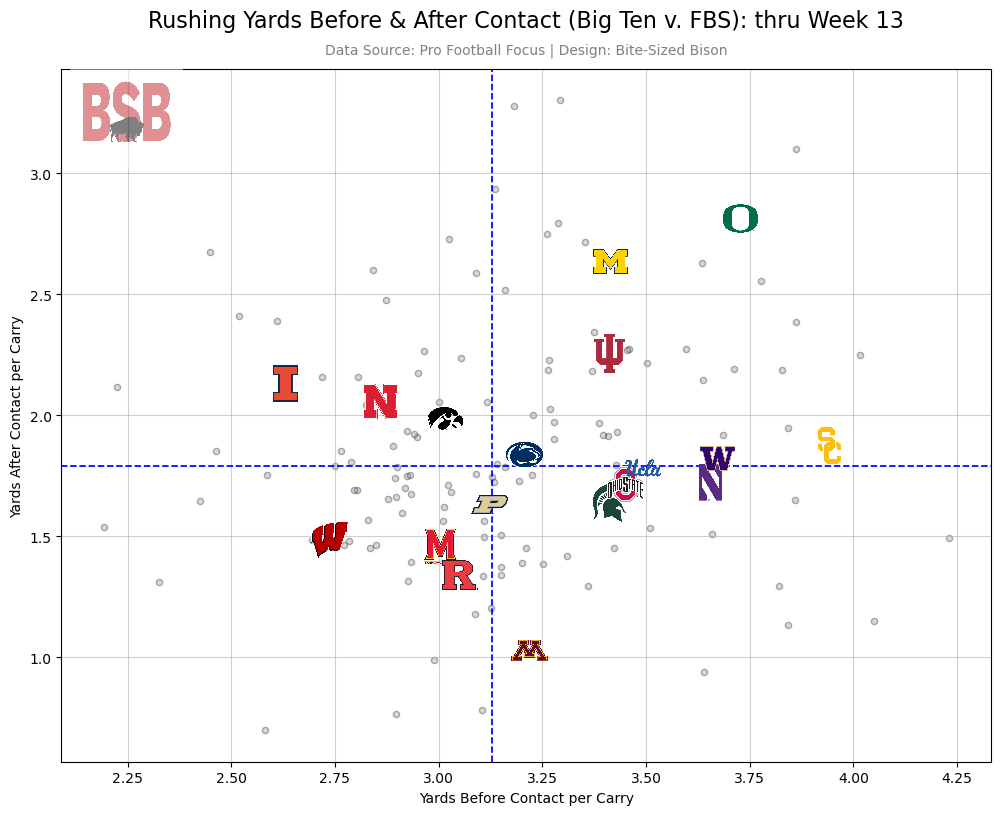
This rushing attack has quietly been a tough matchup in the Big Ten. The Boilermakers posted the 2nd-highest per-carry performance against Ohio State, with 4.2 yards/carry, second to Texas in Week 1 (4.5). But they’ve also had some duds, such as 1.7 yards/carry against USC (not a defensive juggernaut) and 3.3 against Northwestern.
While an offense like Indiana has leaned primarily on zone schemes, like inside and outside zone, which rely on OL athleticism and smart ball carriers, as opposed to strictly schemed rushing attacks, Purdue does the opposite, ranking 11th in how often it runs the power rushing scheme.
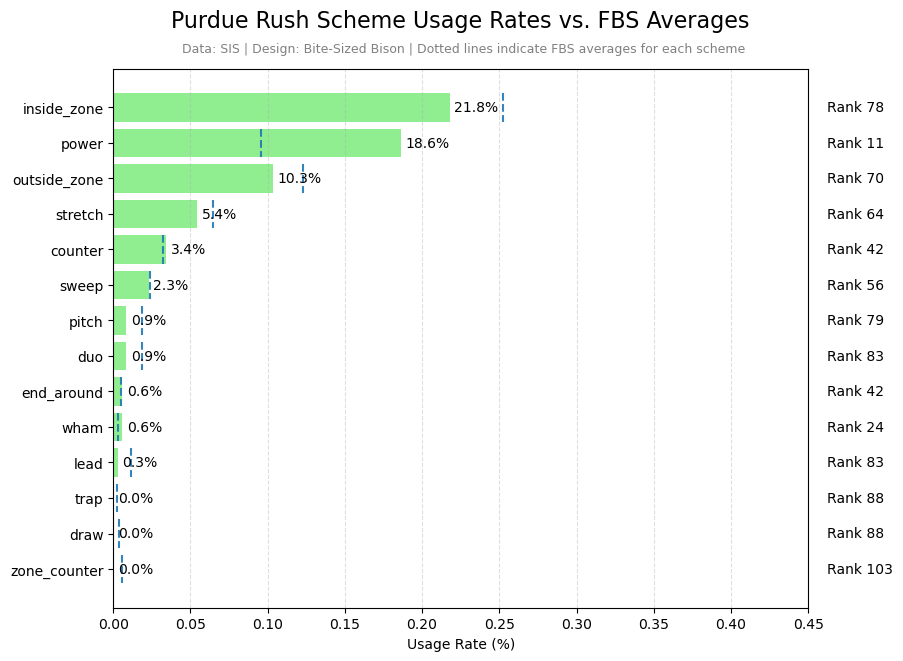
A power rushing scheme works well when an offense has strong guard play, but Purdue hasn’t played a defensive front quite like Indiana’s, which chooses to attack a defense from the interior and blow up gaps with LBs. Indiana’s defense is not easy to run power against, but what makes Purdue tougher to defend is that it stretches out a defense horizontally and then employs power. Purdue ranks 12th in the amount of 10 personnel (1 RB, 0 TEs) it uses.
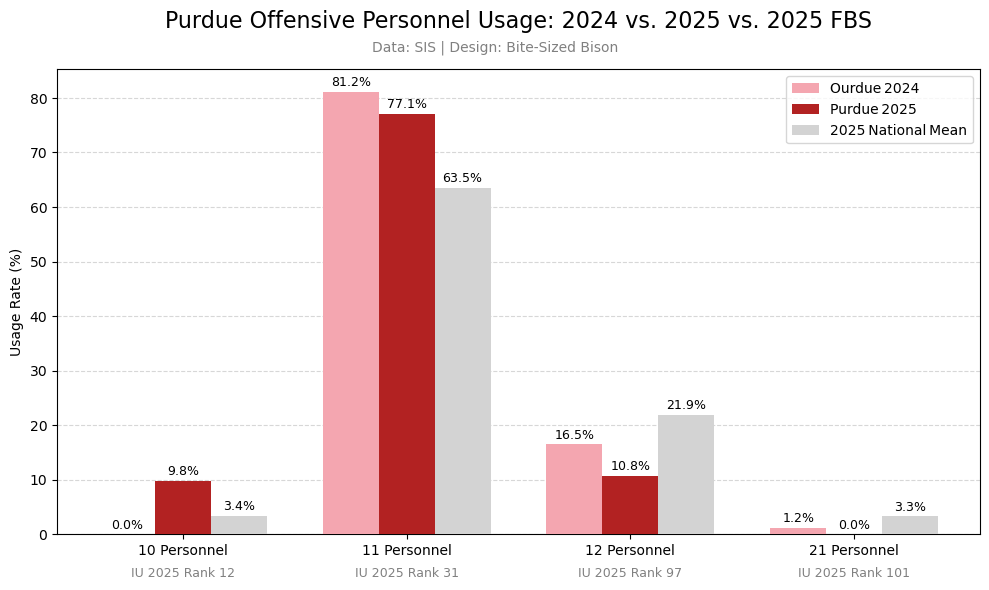
This could make Indiana’s life a bit difficult, especially if Malachi Singleton is running the ball from the QB position.
However, if there is one thing Indiana has hung its hat on since Bryant Haines took over the Hoosier defense in 2024, it’s been stopping the run. Very few teams have figured out how to make it happen on a consistent bases against Indiana, which is what would be required of Purdue, given the mismatch between Indiana’s offense and the Purdue defense.
How does Purdue approach the QB position?
While Josh Henson said Ryan Browne is the starter this week, he also said, “We aren’t afraid to play Malachi (Singleton).” Singleton entered the game early in place of Browne against Washington last week and not only went 16-of-28 for 150 yards, 1 TD, and 0 INTs but also had 9 carries for 27 yards.
On just 75 snaps played this season, Singleton has totaled 221 rushing yards, which ranks 11th among Big Ten QBs, and 174 of them are on designed runs. The offense changes when Singleton is in the game.
Since allowing the 75- and 78-yard TD runs to Old Dominion QB Colton Joseph in Week 1, Indiana has tightened up against rushing QBs, allowing just 2.7 yards/carry to dual-threat QBs the rest of the way. The difference, though, is that none of those teams played a scheme as close to ODU’s spread-and-run quite like Purdue does. A Singleton type of runner would be the closest replica of Colton Joseph that Indiana will have seen, especially if he can pass efficiently.
How often does Indiana pass on offense?
As the EPA distribution chart shows above, this is a major mismatch in Indiana’s favor. That’s why when Curt Cignetti noted that Indiana will need to throw the ball against Purdue, it wasn’t simply to maintain balance — it’s to exploit the biggest weakness in Purdue’s defense.
As noted previously, Purdue ranks 134th in passing yards/attempt allowed (9.2) and 134th in total 40+ yard passes allowed (14), and its two leading CBs surrender the most yards/reception allowed among Big Ten CBs. Elijah Sarratt, Charlie Becker, and EJ Williams (the three most perimeter-focused WRs on the team) could really have big games.
The issue, though, is that the temperature is forecasted to be below freezing. This doesn’t necessarily mean much. Kurtis Rourke threw for 349 yards against Purdue in the cold and snow last season, and then he threw 33 times against Notre Dame in similar conditions thereafter. Indiana will throw the ball, but how much?
How does Indiana integrate Elijah Sarratt back into the passing attack?
Curt Cignetti said in his weekly press conference Monday that Elijah Sarratt (as well as Mikail Kamara and perhaps Drew Evans) would be returning from injury this week. The question here is not how Elijah Sarratt fits but rather how all of the other pass-catchers fit around him. Since Sarratt suffered his hamstring injury against UCLA, others have stepped up in Mike Shanahan’s offense — particularly Charlie Becker and Riley Nowakowski. As noted in previous BSBs, Becker has graded as the 3rd-best Big Ten WR since Sarratt’s injury, and Nowakowski — who ranks 2nd among Big Ten TEs in YAC — has seen a bump in his target share as well.
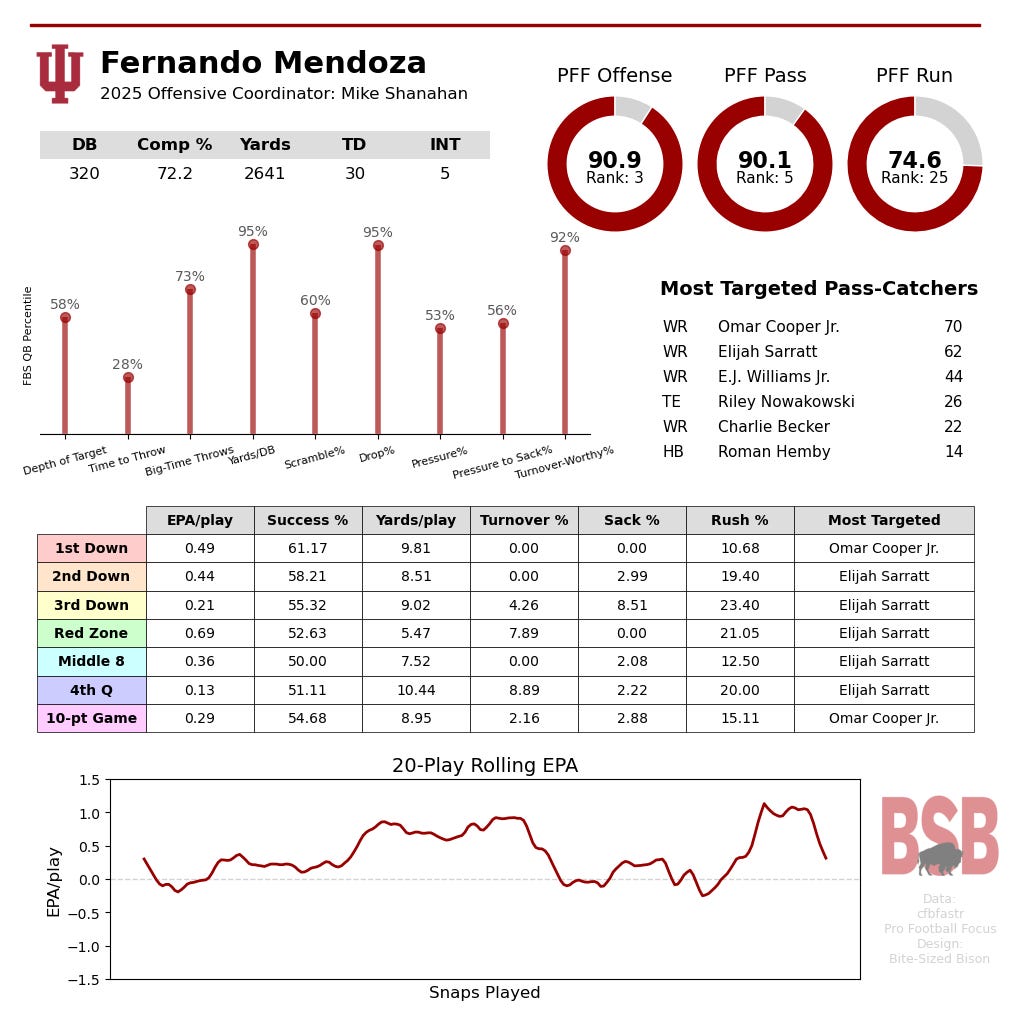
Most likely, Sarratt will not play the same snap share as he played before the injury, especially if the game gets ugly. That would leave plenty of room for Becker snaps. However, if Sarratt does play a significant snap share (especially looking ahead), there’s reason to believe Becker would then eat into EJ Williams’ snaps. Williams brings value to the offense on the perimeter, but he doesn’t bring the same dynamism as the trio of Sarratt, Becker, and Omar Cooper.
Great stuff, as always. Looks like we can throw the ball. Throw it deep and often. Then pound them with the run, once they’re softened up!
Looking forward to this one. I think Purdue grades out just so much closer to mid pack than the unique disaster they were last year... even if they still are firmly at the bottom of the conference. Notably, Penn State and Wisconsin have figured things out late.. but not our Boilers. I really am dreaming of the day we get a ranked-on-ranked Bucket Game.. but Odom's tenure thus far reminds me too much of Kevin Wilson to think he gets them there.