

Week 6 Recap: Northwestern
Now that the dust has settled, let's take a deeper look at Indiana's matchup against Northwestern

Indiana is bowl eligible after Week 6. The Hoosiers rank 14th in ESPN FPI, 17th in SP+, and 18th in the most recent AP Top-25 Poll. Indiana also owns the 9th-best odds (52.2%) to qualify for the College Football Playoff, according to the FPI.
This is far from a perfect team, and the schedule ramps up a bit after the bye week next weekend (as you’ll see below), but it wasn’t long ago when, during Indiana’s bowl seasons, fans were waiting for the result of the Bucket Game to know if they should expect any postseason action. Only in 2019 and 2020 did it feel as if the stars aligned for the program to find success.
This season, under Curt Cignetti, is not a “stars aligned” scenario. This is simply college football coaching competence at a level unseen within the walls of Memorial Stadium in quite some time. The way the team carries itself, the way the coaches communicate their messaging, the way the team collectively (staff and players) responds to its opponent mid-game, that is all how serious college football programs operate every season.
What this staff and team are proving is that Indiana is a place where you can win if you take the program seriously.
If you missed the Bite-Sized Bison Gameday Roundup after the game, it discusses scenario-based EPA, cumulative EPA, and win probability, as well as more traditional stats and their respective top performers for each team. You can find it at the button below.
Indiana Offensive Snap Counts & Grades
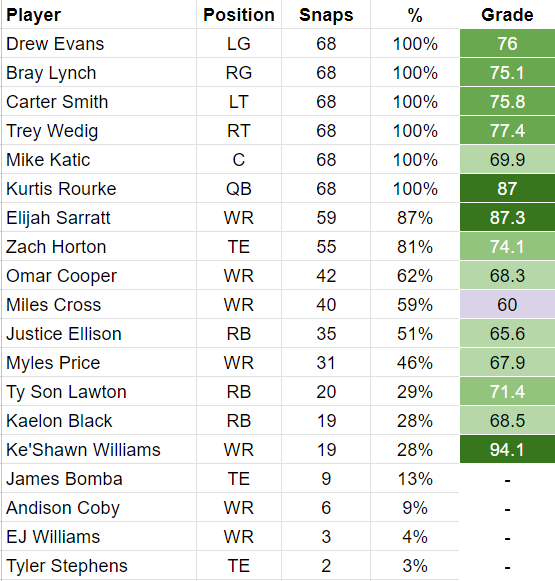
Observations:
The first thing that I noticed about this chart is that none of the offensive players recorded unfavorable grades. That’s a testament to Mike Shanahan’s gameplan against a pretty tough Northwestern defense.
One observation I’ve made in the last few weeks is that the JMU transfers Elijah Sarratt and Zach Horton are the primary two non-every-down offensive players that make this system move. Outside of QB and OL, those two are consistently on the field.
Kaelon Black got more into the mix this week, only playing one fewer snap than Ty Son Lawton. It seems like Justice Ellison will continue to see his snaps, regardless of the other RBs.
Indiana Defensive Snap Counts & Grades
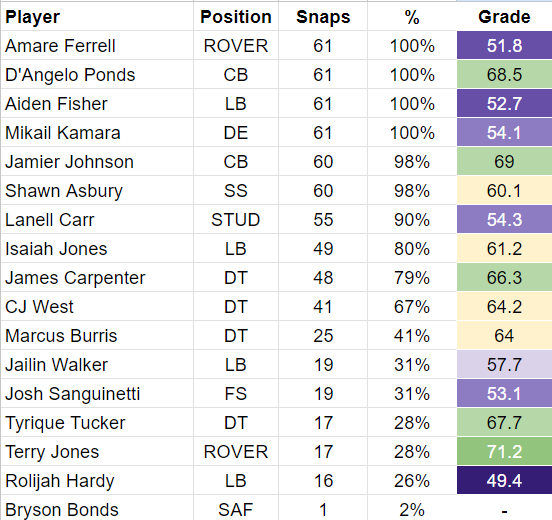
Observations:
Indiana gave Northwestern some different looks in this game. They divided free safety duties between Shawn Asbury and Amare Ferrell and only had Josh Sanguinetti on the field for 19 snaps. They also had some three-LB snaps at times, and CJ West played a higher percentage of snaps than he has all season. This seems to indicate Indiana wanted to primarily combat Northwestern’s OL and trust the second and third levels in handling the skilled position players.
Jailin Walker was injured fairly early in this one, playing only 19 snaps. Isaiah Jones and Rolijah Hardy filled in, but Walker’s absence was felt.
Indiana Cumulative EPA Comparison, Offense and Defense
Indiana was a drastically different team in any of the five seasons between 2019 and 2023, and 2024 is expected to be even more so. Comparing 2024 offensive and defensive cumulative EPA to the previous five seasons can offer some insight into how the season is progressing in relation to recent years.
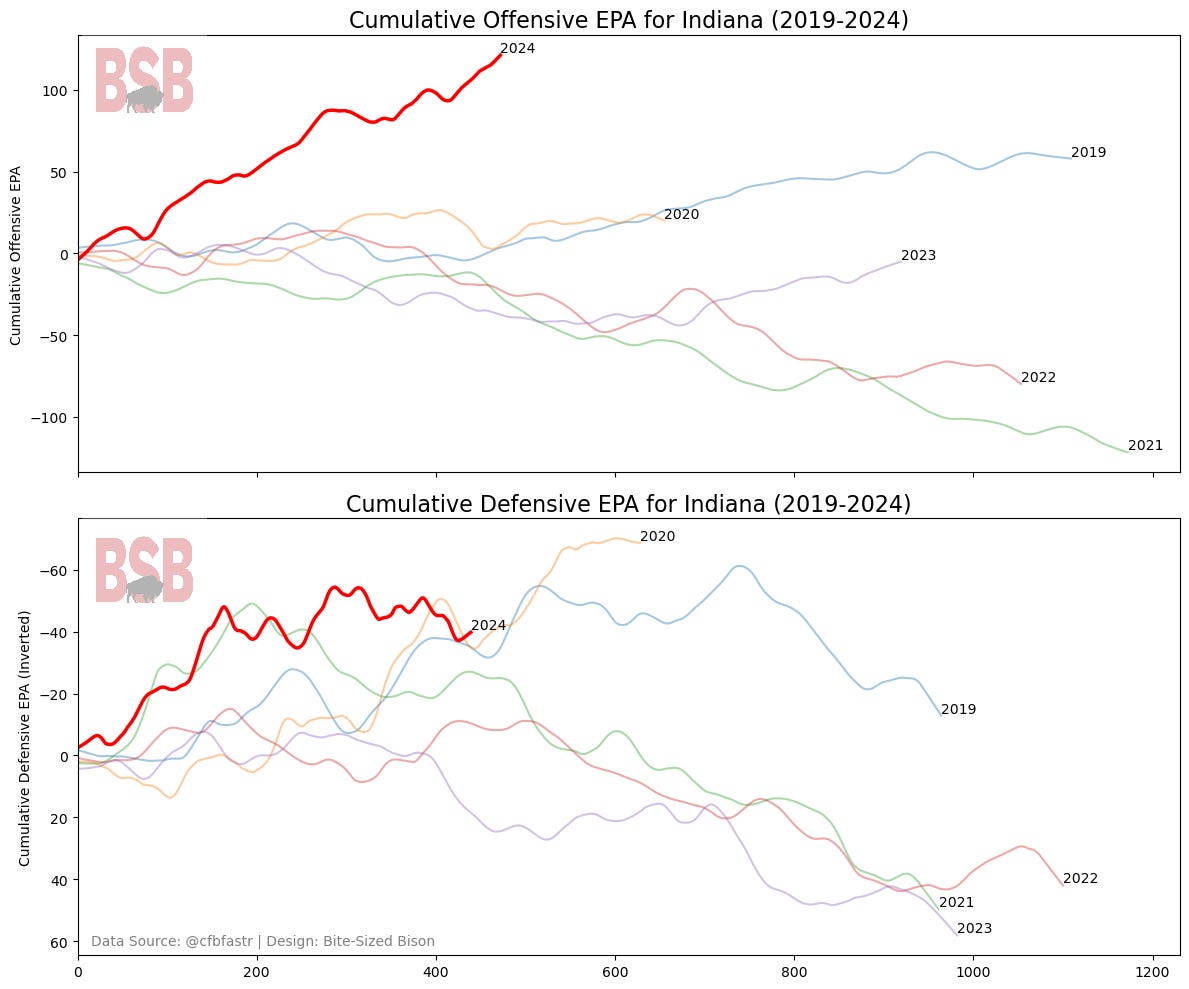
Observations:
Indiana’s offense incredibly effective. As the line shows, there hasn’t been much resistance yet, which is indicative in Indiana’s 47.5 points per game (3rd in FBS).
The defense, though, has struggled at times in the last couple weeks against Maryland and Northwestern, posting a combined negative total EPA between the two games.
Big Ten EPA/play Comparison
EPA (Estimated Points Added) is the best existing metric for conveying a play’s value. I explain a bit in the Gameday Roundup how it works, and in the below graph, each Big Ten team’s EPA is split between offense and defense to show which teams are statistically better in each phase.
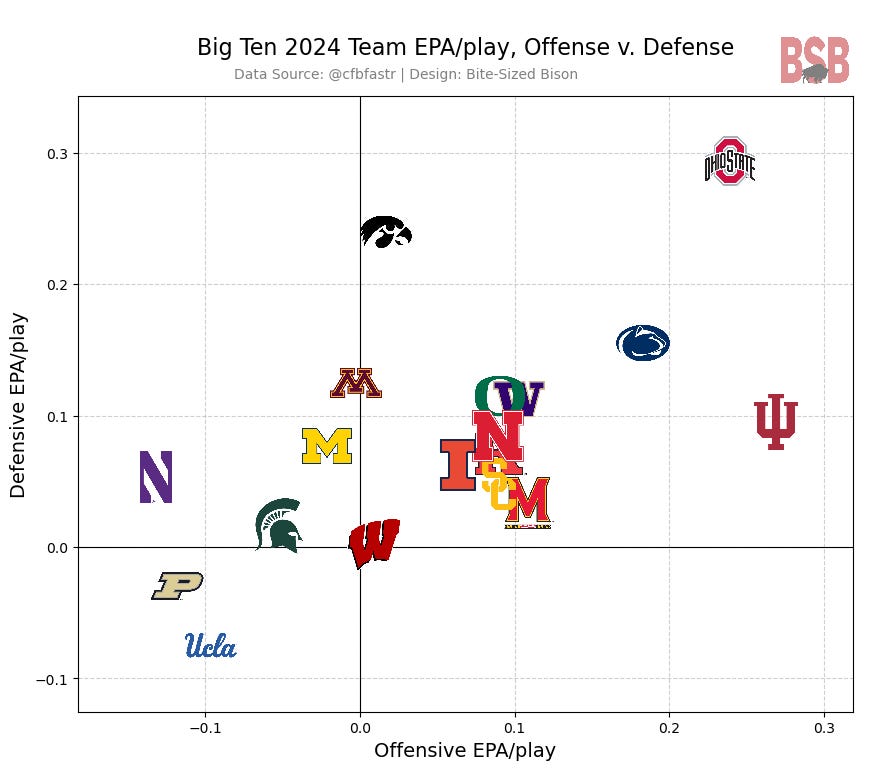
Observations:
Indiana continues to lead the conference in offensive EPA/play.
Nebraska and Washington are actually two of the toughest matchups in the Big Ten right now, analytically. Those two games will be crucial for the ceiling of the 2024 Indiana season.
Big Ten QB Comparison
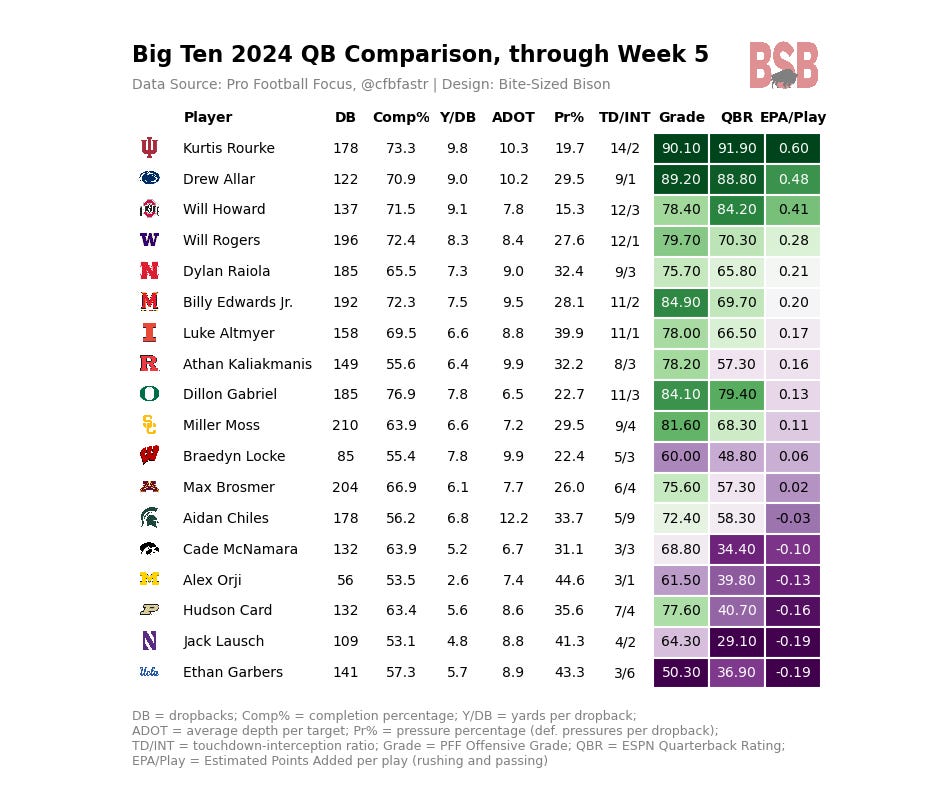
Observations:
There is a tier of one at the top of this list, and it’s Kurtis Rourke. But Indiana plays two of the third-tier QBs (Will Rogers and Dylan Raiola) in the first two games after the bye.
Who knows what’s going on at QB for Michigan?
Indiana Pass-Catcher EPA/target
The chart below conveys each Big Ten WR’s EPA/target, which is not entirely a reflection of the receiver but more of a way to show the value of the plays when each receiver is targeted. This way, rather than accounting for a pass-catcher’s individual performance alone, it also accounts for offensive scheme and execution when that player is involved, creating an assessment of the offense’s success rather than simply the player’s.
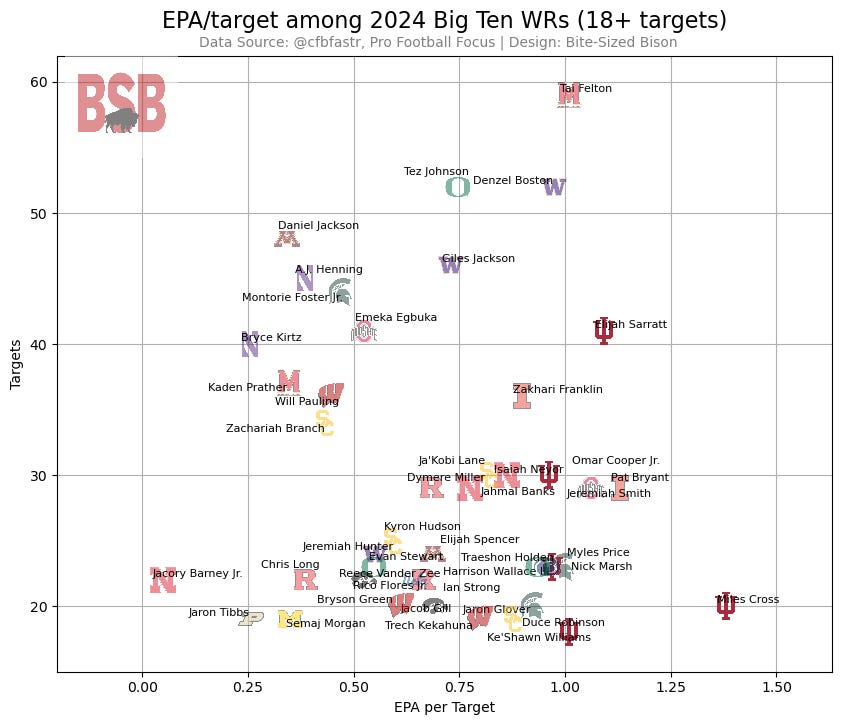
Observations:
It’s halfway through the season, and Miles Cross targets remain the most valuable passing play in the Big Ten.
Elijah Sarratt is beginning to separate himself on this chart. He’s currently graded 7th in this group by PFF, but we might see him provide more value than any other.
Indiana has played against three WRs in the top-left of this chart (a lot of low-value targets), but they all had decent games against the Hoosiers (Kaden Prather, AJ Henning, Bryce Kirtz).
Defensive Line Havoc
With this JMU staff coming to Indiana, there is going to be a major philosophical change on defense, charging the DL with creating havoc rather than just the LBs. The Hoosiers ranked second-to-last in DL havoc rate in 2023. Havoc is defined in different ways in different places, but I chose to include plays that involved QB hurries, QB hits, sacks, TFLs, forced/recovered fumbles, batted/deflected passes, and interceptions – basically any time a DL is negatively impacting the offense. The benefit of the below chart is that it disaggregates the different havoc plays to show not just the total number of havoc plays but also how that havoc is achieved. The chart is then sorted by havoc rate (the percentage of defensive plays that feature DL havoc).
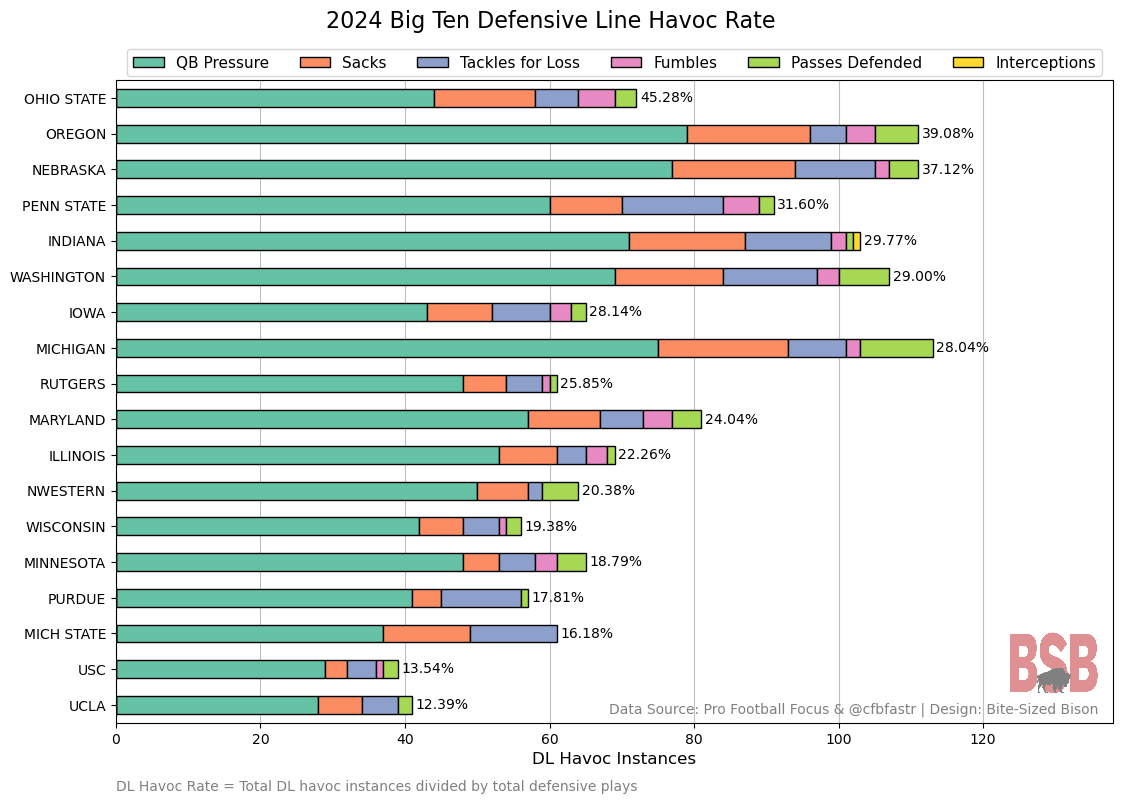
Observations:
Indiana remains solid here, at 5th in the conference, as it creates a havoc instance on roughly 30% of defensive plays, but I think the Hoosiers want to be a bit higher than that at this point, with some tough opponents coming up.
Nebraska (3rd) and Washington (6th) will be two of the top-3 toughest fronts Indiana faces this season.
While it’s somewhat unfair to list these figures because the teams played Indiana’s front already, the Hoosiers have played the 10th-, 12th-, and 18th-ranked teams on this list. Can the OL handle some of the Big Ten’s best?
Look at Tom Allen’s Penn State DL causing havoc on 32% of plays!
Offensive Line Production
Assessing OL play is so subjective and (in many ways) unquantifiable, so I’ve chosen to lean on PFF grades. The below chart is simple – each Indiana OL’s season-long PFF Offensive Grade is listed next to the percentile he ranks within at his respective position (T, G, C) in the FBS.
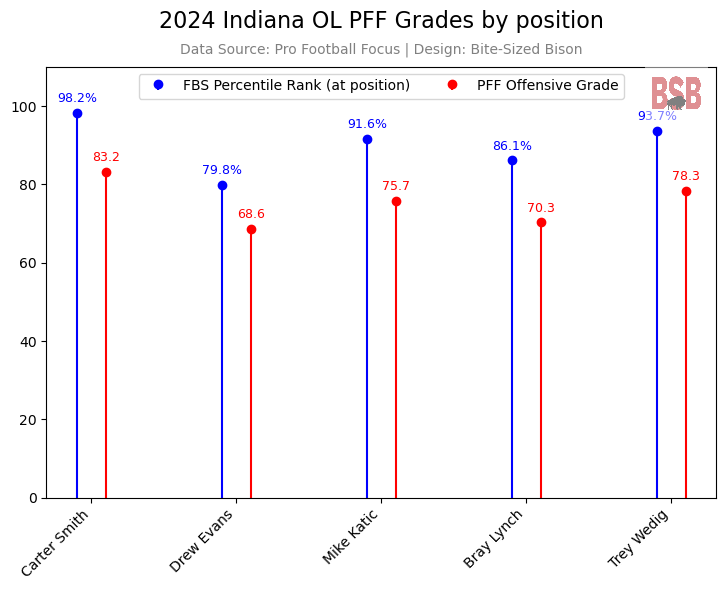
Observations:
For Week 6, Indiana placed all five of its starting OLs in the top-20 of the Big Ten, in terms of PFF grades. The top four were in the top-11.
Carter Smith is now the top-graded OL in the Big Ten and is 13th in the FBS. Among the nation’s offensive tackles, Smith and Trey Wedig are graded 7th and 21st.
We are halfway through the season, and former walk-on Drew Evans is graded just outside the top-20% of FBS guards. That is wild.
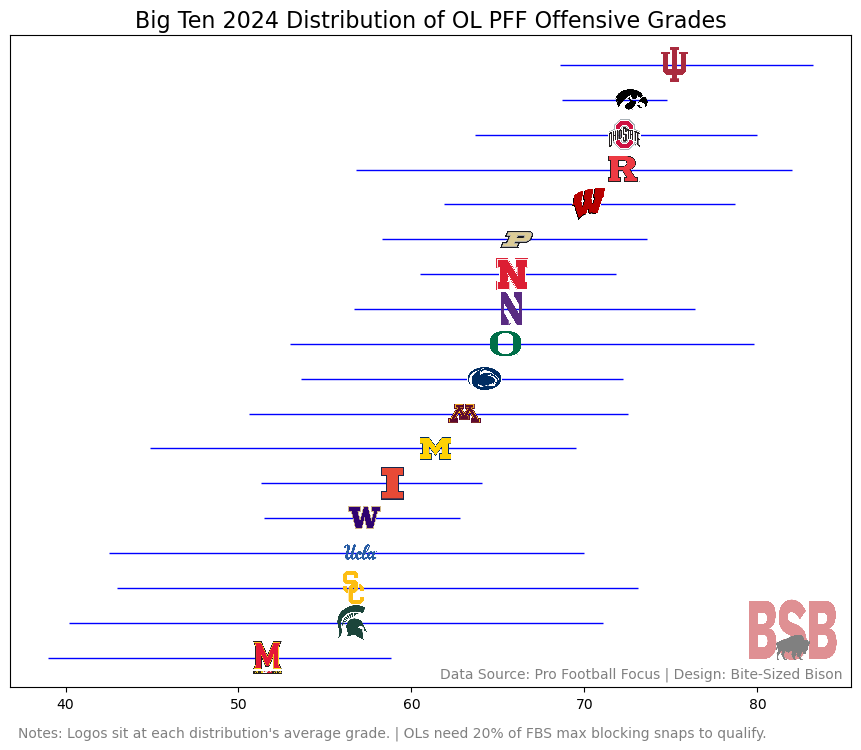
After a micro look at OL production, I want to zoom out and compare to the rest of the Big Ten. The below chart filters all PFF OL grades to account for any OL that records at least 20% of the highest recorded blocking snaps and draws a line for each team from its minimum grade to its maximum. Each team’s logo is then placed at the average grade.
Observations:
Indiana now owns the top average grade in the Big Ten among its starting OLs.
Looking ahead to Indiana’s next few matchups, the Hoosier might have an advantage in the trenches, defensively, against Washington and Michigan State.
I noted it last week in the preview, but Northwestern’s OL was nothing to disregard. It presented good resistance against Indiana’s front. Indiana has three more opponents with higher-graded OLs than NU, though one (Purdue) is a mess.
Notable Stats
Many folks (including myself) are nervous about the defense, but one way to measure success for a unit (outside of EPA or success rates) is conversion rate. Conversion rate determines the percentage of first-down series that end in a first down conversion or a score. The Indiana defensive season-long conversion rate allowed (62.8%) ranks 12th in the country, and for the past two weeks (when folks have been getting a bit more nervous), Indiana’s defensive conversion rate allowed (64.3%) is ranked 22nd. That is actually pretty good!
Indiana leads the nation in drop rate, recording just 1 drop through half of the 2024 season. That is a 0.6% drop rate. Surprisingly, that lone drop belongs to Elijah Sarratt.
Indiana leads the nation in redzone touchdowns, and by quite a margin. The Hoosiers have 30 redzone TDs, while 2nd-place Texas and Miami (FL) each have 24.
Kane Wommack might find himself in some deep water at Alabama soon. The Crimson Tide lost to Vanderbilt over the weekend, 40-35. Alabama now ranks 37th in EPA allowed per game, 41st in points allowed per game (20.0), and 58th in explosion rate allowed. And that’s while just now entering a stretch of games that includes South Carolina, Tennessee, Missouri, and LSU. Kalen DeBoer is undoubtedly taking heat for this too, but Wommack would be the first to go if this trend continues. Those types of programs don’t mess around.
There are a couple former Hoosiers playing significant roles for quality teams this season who BSB hasn’t checked on recently: 1.) Louis Moore at Ole Miss was graded as the 9th-best safety in the SEC before suffering an injury in Week 4 that’s kept him out since. He should be back soon. 2.) Zach Carpenter is playing center for Miami (FL) and is graded as the 6th-best center in the ACC (36th in FBS). For reference, Mike Katic is graded as the 13th-best center in the FBS.
I love how all this information is really helping us better understand what is happening for the Hoosiers and why. Will you at some point look back at the things you were expecting preseason and compare against how things have turned out, both positive and negative? There have been players that we as IU fans thought would have more of a role that has not panned out i.e. Donovan McCulley and Jacob Mangum-Farrar (who seems to have dropped off the face of the Earth!).
This is great to see and much appreciated. I look forward to every entry but this is among my favorites each week. Mobile QB’s have always given IU fits. I remember Clifford at PSU dashing through Allen’s defense. I don’t know if IU tried to account for the QB EARLY vs NW. we never saw the read option keeper from them after the first play.