

Bison Bites: Dispatch #13
Data bites touching on: Indiana's recruiting momentum, Fernando Mendoza's value metrics compared to other FBS QBs, and Indiana's WRs against man-to-man coverage.


If you’re new enough to Bite-Sized Bison, you might not be familiar with Bison Bites. Each dispatch of Bison Bites is intended to be a quick-hitting list of approximately 3-5 statistics of interest between typical Bite-Sized Bison posts.
Indiana’s 10 commitments to the 2026 class before June 3 is more than any class in at least the last 15 years.
With the commitment of Wisconsin OT Kenton Mondeau on June 2, Indiana reached its 10th commitment of the class quicker than it has for any recruiting class during the Early Signing Period Era (since 2017).
The chart below shows Indiana’s commitment totals by June 3 for the last 15 recruiting cycles.

It’s important to note that commitments began occurring earlier in recruiting cycles due to the Early Signing Period in December, which began for the Class of 2017. Now, teams typically have their recruiting classes near-complete by the season’s kickoff. That wasn’t always the case before the Early Signing Period because there were a couple of months left following the season to complete recruiting efforts by early-February.
You might also notice in the chart that this trend for Indiana was already in effect during this staff’s first full recruiting class (2025), even though the staff wasn’t at Indiana for the previous summer or fall to build recruiting momentum for the class. Building classes earlier is clearly an emphasis for Curt Cignetti.
June 3 is a notable date not only because it’s the day after Indiana’s 10th commitment this cycle but also because it is just at the beginning of official visit season. Through June 22, prospects will be making official visits to programs before a dead period that stretches from June 23 into August. That period is when a massive number of commitments will happen across college football. The Hoosiers will need to hang onto their current commitments through the summer primarily, but a few will remain priorities into the season as well.
Indiana’s 10 commitments is not a particularly large number in relation to the rest of the country. It ranks tied for 28th in that regard, but as a program, this is a more modern, bold approach to recruiting that Indiana hasn’t seen before.
Why is Indiana finding this recruiting success in 2026? It’s easy to point to the historic 11-win season that featured a College Football Playoff appearance, but it’s more than that. IF a program is primarily relying on the previous season’s success for the current recruiting cycle, it’s already too late. Last June, Indiana – both on-field assistants and support staff – had their foot on the gas to market the program as something new, and, thanks in part to the staff’s success at JMU, it pulled some significant talent onto campus for those ever-important June visits. For anyone paying close attention, it was clear that, with any notable success in 2024, this 2026 class was going to be strong.
Indiana has had successful seasons before; why is this class filling up so quickly? It’s not just that it’s filling up either. These are highly rated recruits too.
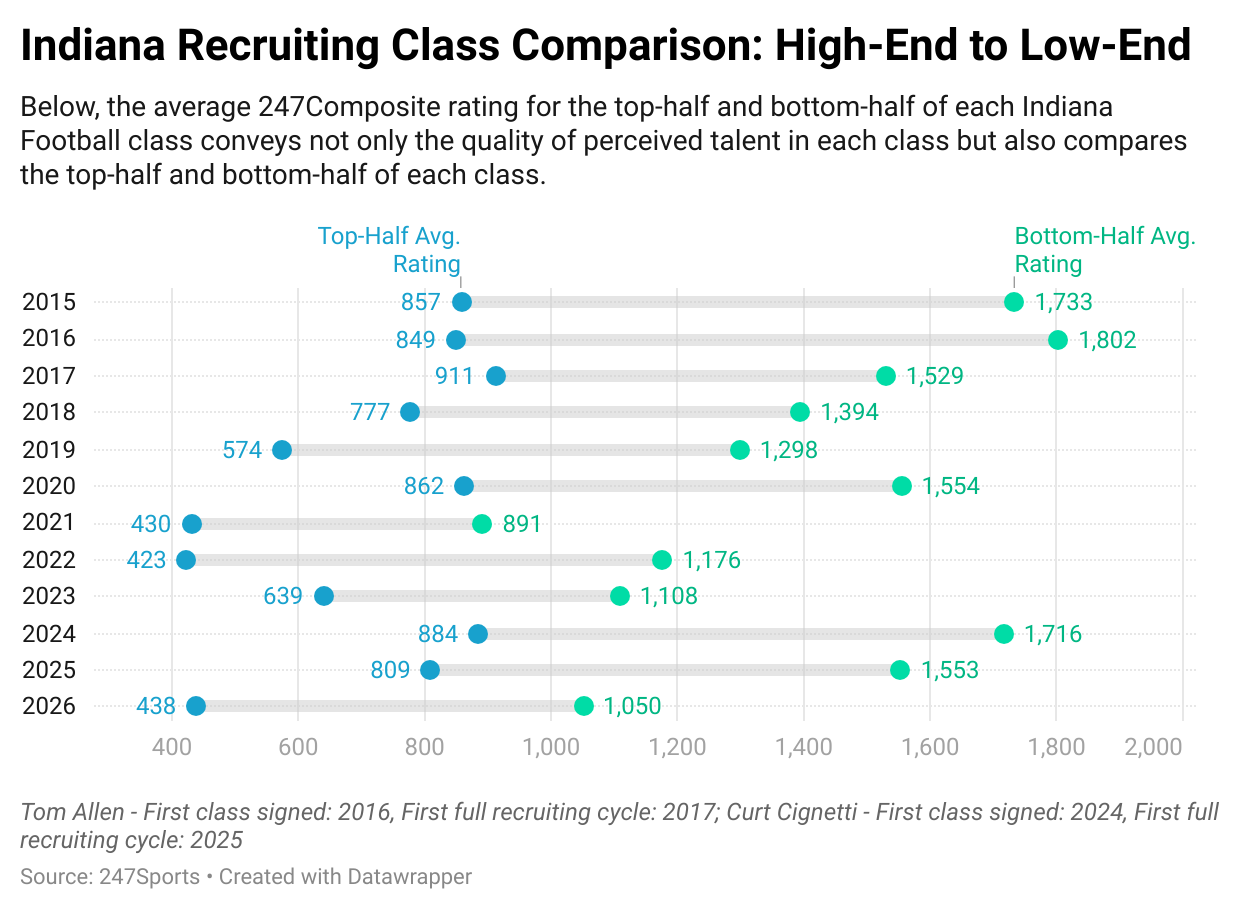
Commitments happen, especially when this early in the calendar, because recruits want to claim their spots in recruiting classes. Sometimes, programs find better prospects for those spots and need to nudge guys out, and sometimes, recruits receive more appealing offers and flip to other programs. That’s the nature of competing at a high level in the offseason. But if a class is filling up, it’s not just because the program is having on-field success but also because it does a good job with marketing from the support staff and a proactive approach and galvanizing message from the coaches, among other things.
Recruiting classes that are built in this way are a prime signal of program health. While Indiana won several program-altering, memorable games in recent seasons, we know now – particularly with the recent increased investment from the University and Cignetti’s approach to operations – that the program was still not exactly in a healthy state. That appears to be changing.
Fernando Mendoza ranked 28th among FBS QBs in EPA/play (passing and rushing) during the 2024 season.
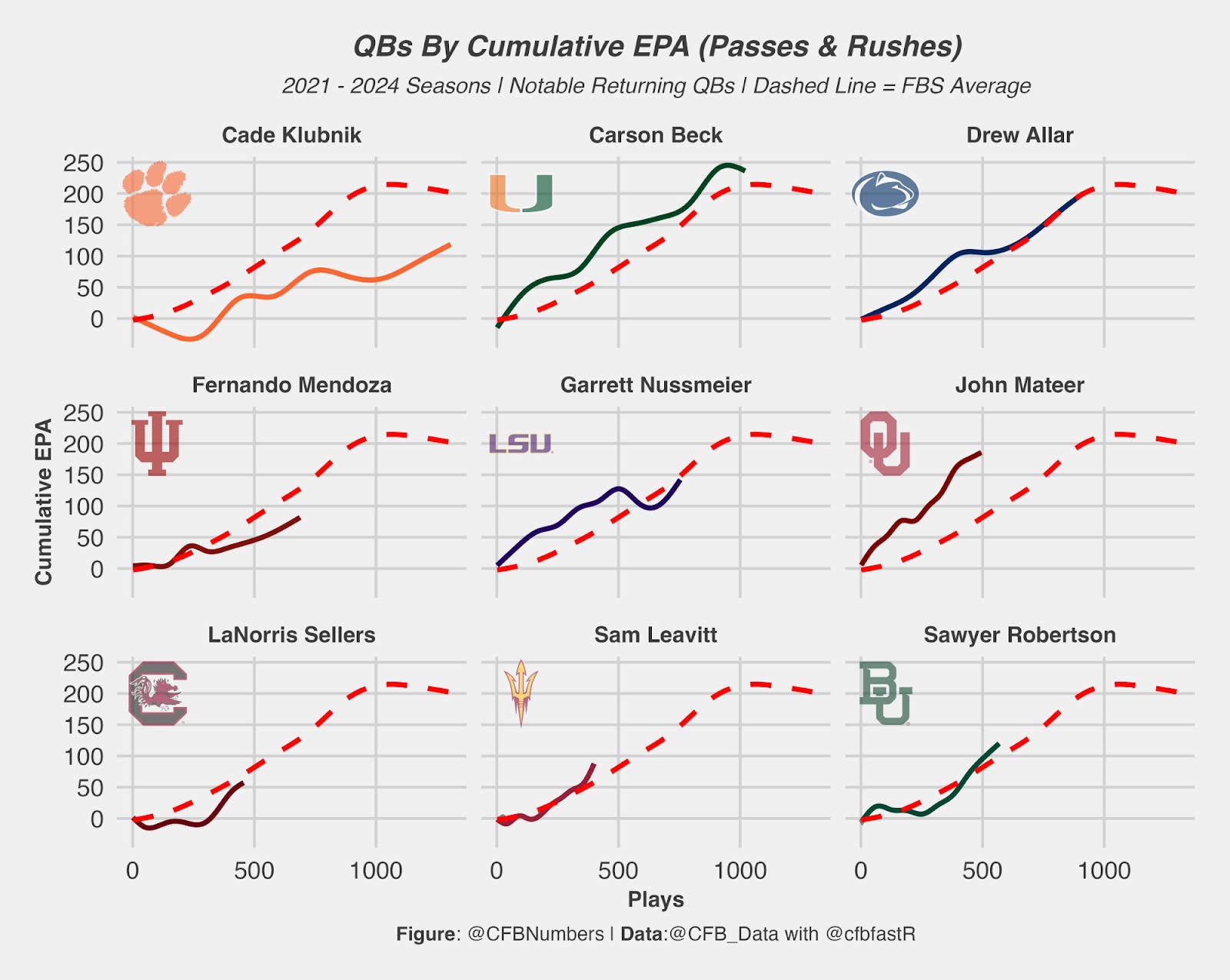
CFBNumbers always pulls through with an interesting graphic, and Indiana is frequently included, because that’s the state of things lately. Here, the graph shows cumulative EPA over the course of the 2024 season, compared to the average FBS QB during the 2021-24 seasons. The idea is that this line shows progressive value for each QB as the season moved along.
You can see Fernando Mendoza is below that line, but, much like a QB above the line, not all of that credit is on the QB. I wanted to explore his EPA, though, in response to this informative graphic.
Source: CFBNumbers
Overall, Mendoza ranked 28th in EPA/play, including rushes, among QBs with 300+ snaps in 2024. That is extremely impressive because Cal’s offense, which is so closely tied to QBs’ EPA performances, ranked 96th in the FBS. Mendoza found success despite Cal’s offense. For example, the offenses of the QBs listed above are as follows:
9. Penn State
13. Washington State (Mateer)
15. Georgia (Beck)
20. Arizona State
24. Baylor
28. LSU
38. Clemson
73. South Carolina
96. California (Mendoza)
Mendoza is certainly more mobile than Kurtis Rourke was able to be in 2024, but he still ranked just 91st among QBs in rushing attempts. However, when he ran, he found success, ranking 14th in the nation among QBs in rushing EPA/play. Indiana likely won’t ask for too much running from Mendoza, but he can do some. He leads all of the QBs on the above chart on a per-play basis, but John Mateer and Sam Leavitt are probably the best rushing QBs on this list.
In passing EPA/play, Mendoza ranked 3rd among the QBs in the above chart and inched out Quinn Ewers (Texas) for 27th nationally.
A couple scenarios I’m most intrigued to see Mendoza is 1.) third down and 2.) past the opponent 40-yard line. These are primarily offensive coordinator stats, but the reason I’m curious to see Mendoza in these scenarios is because Kurtis Rourke was so effective there within Mike Shanahan’s system. Rourke ranked 8th nationally in third-down EPA/play and 2nd when Indiana passed the opponent 40. At Cal in 2024, Mendoza ranked 39th in EPA/play on third down and 79th in EPA/play when past the opponent 40.
Last thing on QB EPA for now: Indiana-related QBs had really effective seasons in 2024! Below is a chart of QBs with connections to Indiana and their FBS rankings by success rate (percent of plays with positive EPA) and total EPA.
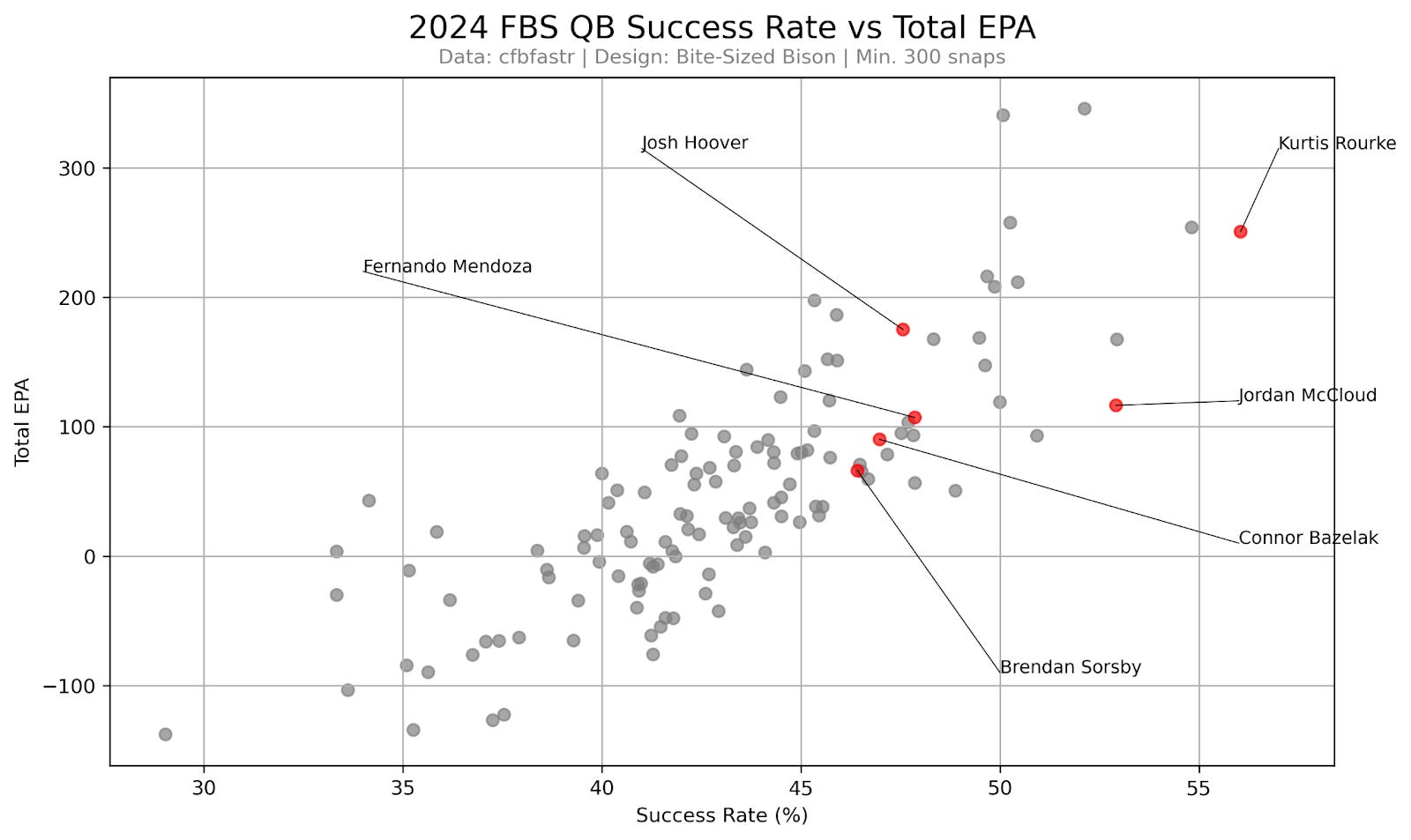
For those who may not be familiar, Connor Bazelak was Indiana’s starter in 2022, Brendan Sorsby was IU’s starter in 2023, Josh Hoover was committed to Indiana during the 2022 recruiting cycle but flipped to home-state TCU when Indiana moved on from Nick Sheridan, and Jordan McCloud was Curt Cignetti and Mike Shanahan’s 2023 QB at JMU (transferred to Texas State for 2024). And we all know Kurtis Rourke and Fernando Mendoza.
All of these QBs ranked in the top-30 in success rate during the 2024 season, which was higher than Garrett Nussmeier (charted above for LSU), Shedeur Sanders (Colorado), Quinn Ewers (Texas), Jalen Milroe (Alabama, with Kalen DeBoer), Carson Beck (charted above), Tyler Shough (Louisville), Cade Klubnik (charted above for Clemson), LaNorris Sellers (charted above for South Carolina), Riley Leonard (Notre Dame), and many more.
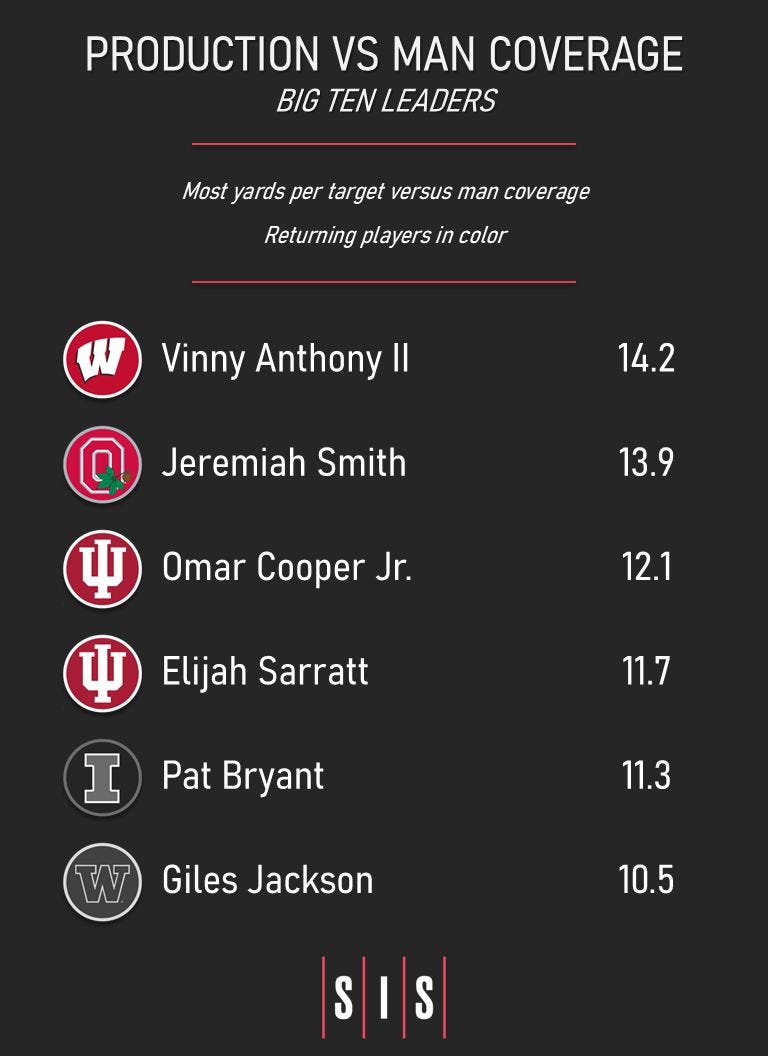
Indiana returns the best Big Ten WR duo against man-to-man coverage.
Sports Info Solutions reported that Omar Cooper and Elijah Sarratt were 3rd and 4th, respectively, in yards per target against man-to-man coverage. That’s what you want to see from your receivers because it’s not only a signal of separation but also a signal of strength. Cooper and Sarratt’s strength was well documented in BSB heading into 2024, so it should come as no surprise that Sarratt tied for the conference lead among WRs in contested catches against man coverage (11-of-15) nor that 5 of Omar Cooper’s 6 touchdowns came against man coverage (3rd in Big Ten) despite only 20% of his targets occurring against man.
Source: SIS
Indiana’s perimeter WRs weren’t targeted that often against man coverage – just 24% and 20% of targets. But when they were targeted, it was downfield, as Sarratt and Cooper were 6th and 7th among Big Ten WRs in average depth of target against man (15.8 and 15.5 yards). Execution on those plays is how they found the numbers listed in SIS’ post above.
However, when Indiana faced very physical man-to-man coverage, it often turned to its slot receivers, especially in the middle of the field. This is where Cal transfer WR Jonathan Brady and App State transfer WR Makai Jackson become so important. Between Brady and Jackson, there were 46 targets against man-to-man coverage in 2024; Myles Price and Ke’Shawn Williams combined for 38.
Awesome stuff….again! Love it! Thanks for the insights! All very interesting.
Thanks so much for the insight on recruiting. It's not something I have followed much because, quite frankly, it's overwhelming and maddening to sort through the noise. I like IU's high-level trend lines and hope they can sustain it against the Power 4 royalty.